


How accurate is an 80GHz Radar Level Sensor?
In the realm of industrial level measurement, the quest for precision has always been paramount. As industries evolve, the demand for accurate, reliable, and efficient level sensors has grown exponentially. Among the various technologies available, radar level sensors have emerged as a leading solution due to their non - contact nature, versatility, and high performance. One of the latest advancements in this field is the 80GHz radar level sensor, which promises exceptional accuracy. In this blog, we'll delve into the accuracy of 80GHz radar level sensors, exploring how they work, the factors that affect their accuracy, and how they compare to other types of radar level sensors.
How 80GHz Radar Level Sensors Work
Radar level sensors operate on the principle of electromagnetic wave propagation. An 80GHz radar level sensor emits electromagnetic waves at a frequency of 80 gigahertz. These waves travel through the air towards the surface of the substance (liquid or solid) whose level is being measured. When the waves hit the surface, they are reflected back to the sensor. The sensor then measures the time it takes for the waves to travel to the surface and back. Since the speed of electromagnetic waves in air is known (the speed of light), the distance to the surface can be calculated using the formula (d = \frac{c\times t}{2}), where (d) is the distance to the surface, (c) is the speed of light, and (t) is the time of flight.
The high - frequency operation of 80GHz radar level sensors offers several advantages. Firstly, the shorter wavelength associated with 80GHz allows for a narrower beam angle. A narrow beam angle means that the sensor can focus the radar waves more precisely on the target surface, reducing the chances of interference from nearby objects or walls. This results in a more accurate measurement of the level of the substance.
Factors Affecting the Accuracy of 80GHz Radar Level Sensors
1. Surface Characteristics
The nature of the surface being measured plays a significant role in the accuracy of the sensor. Smooth, flat surfaces reflect radar waves more efficiently, providing a stronger and clearer return signal. For example, the surface of a still liquid such as water or oil presents an ideal target for an 80GHz radar level sensor. On the other hand, rough or irregular surfaces, such as those of granular solids or foaming liquids, can scatter the radar waves in multiple directions. This scattering can lead to a weaker return signal, making it more challenging for the sensor to accurately determine the level.
2. Vapor and Foam
In industrial settings, the presence of vapor or foam above the substance can cause issues for radar level sensors. Vapor can absorb or attenuate the radar waves, reducing the strength of the signal. Foam, with its complex structure of bubbles, can scatter the waves in a similar way to rough surfaces. However, 80GHz radar level sensors are often better equipped to handle these challenges compared to lower - frequency sensors. The high - frequency waves can penetrate thin layers of vapor and foam more effectively, providing a more accurate measurement.
3. Installation and Environment
Proper installation of the 80GHz radar level sensor is crucial for accurate measurements. The sensor should be installed vertically above the center of the tank or vessel to ensure that the radar beam is directed straight at the surface. Any misalignment can cause the beam to hit the side of the tank or other objects, leading to inaccurate readings. Additionally, the environment around the sensor can affect its performance. For example, extreme temperatures, high humidity, or the presence of dust can all impact the accuracy of the sensor.
Comparison with Other Radar Level Sensors
26GHz Radar Level Sensor
26GHz Radar Level Sensor operates at a lower frequency compared to 80GHz sensors. The longer wavelength of 26GHz waves results in a wider beam angle. While 26GHz sensors are suitable for many basic applications, they may be more prone to interference from nearby objects. In applications where there are obstacles close to the target surface, an 80GHz radar level sensor with its narrow beam angle can provide a more accurate measurement. 26GHz Radar Level Sensor For Basic Applications are often used in less demanding environments where cost - effectiveness is a key factor.
Guided Wave Radar Level Sensor
Guided Wave Radar Level Sensor works by guiding the radar waves along a probe that is in contact with the substance. This technology is highly accurate in many applications and is less affected by surface characteristics and vapor compared to non - guided radar sensors. However, guided wave radar sensors require physical contact with the substance, which may not be suitable for all applications, especially those involving corrosive or high - temperature materials. 80GHz radar level sensors, being non - contact devices, offer greater flexibility in such situations.

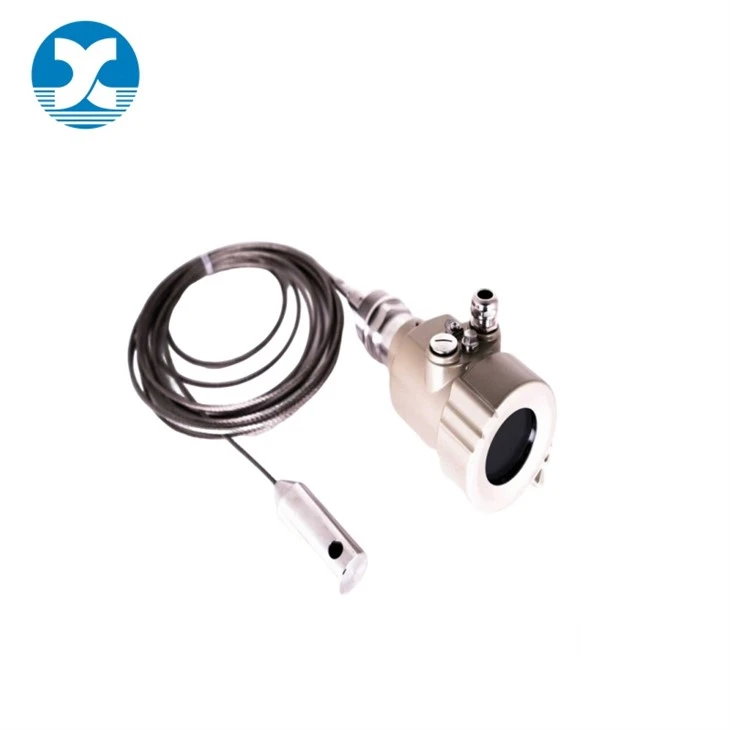
Achieving High Accuracy with 80GHz Radar Level Sensors
To ensure the highest level of accuracy from an 80GHz radar level sensor, several steps can be taken. Firstly, proper calibration of the sensor is essential. This involves setting the sensor to account for the specific characteristics of the installation, such as the height of the tank and the dielectric constant of the substance being measured.
Secondly, regular maintenance and inspection of the sensor are necessary. This includes checking for any signs of damage, cleaning the antenna to remove any dirt or debris, and verifying the alignment of the sensor.
Finally, choosing the right model of 80GHz radar level sensor for the application is crucial. Different sensors may have different features and performance capabilities, so it's important to select a sensor that is designed to handle the specific requirements of the application.
Conclusion and Call to Action
In conclusion, 80GHz radar level sensors offer a high degree of accuracy in level measurement applications. Their high - frequency operation, narrow beam angle, and ability to handle challenging conditions make them a superior choice for many industrial settings. Whether it's measuring the level of liquids in a storage tank or solids in a silo, the 80GHz radar level sensor can provide reliable and precise measurements.
If you're in need of a high - accuracy level measurement solution, we invite you to reach out to us. As a trusted supplier of 80GHz radar level sensors, we have the expertise and experience to help you select the right sensor for your application. Contact us today to start a discussion about your level measurement needs and explore how our products can meet your requirements.
References
- Gray, A., & Smith, B. (2018). Industrial Level Measurement Technologies. London: Industrial Press.
- Johnson, C. (2019). Advances in Radar Sensor Technology. New York: Tech Publishers.
- Wilson, D. (2020). Handbook of Radar Level Sensing. Sydney: Engineering Books.


