


Yes, an electromagnetic flowmeter can be used in irrigation systems, provided the irrigation water has sufficient electrical conductivity. Because electromagnetic flowmeters measure flow based on Faraday's law of electromagnetic induction, they are especially suitable for clean water, treated water, river water and many agricultural water sources. They are not suitable for distilled water, deionised water or non-conductive liquids.
For agricultural operators, landscape managers and irrigation contractors, the main question is not only whether an electromagnetic flowmeter can work, but whether it is the most reliable and cost-effective choice for a specific irrigation layout. The answer depends on water quality, pipe conditions, required accuracy, maintenance expectations and budget.
How an electromagnetic flowmeter works in irrigation
An electromagnetic flowmeter generates a magnetic field inside the pipe. When conductive water flows through this field, a small voltage is induced on the electrodes. This voltage is proportional to the flow velocity, so the flowmeter can calculate the volumetric flow rate.
In irrigation systems, this principle offers several practical advantages:
High measurement accuracy for water flow monitoring and irrigation scheduling.
No moving parts inside the measuring tube, reducing wear and maintenance.
Low pressure loss, which helps maintain pump efficiency.
Good long-term stability when the pipe remains full and the water is conductive.
When an electromagnetic flowmeter is a good fit for irrigation
Electromagnetic flowmeters are most suitable for irrigation applications where:
The water source is river water, well water, reservoir water, treated water or similar conductive fluids.
The pipe can remain full during measurement.
Accurate totalisation and flow rate data are needed for irrigation management.
Low maintenance is preferred, especially in remote fields or large irrigation networks.
The system requires reliable monitoring for pump control, valve automation or water allocation.
They are commonly used in main-line irrigation pipes, pump discharge lines, district metering points, greenhouse irrigation systems and large agricultural water supply networks.
Limitations to consider
Although electromagnetic flowmeters are widely used in water applications, they are not universal. Important limitations include:
Conductivity requirement: The liquid must be electrically conductive. Distilled water, deionised water or very low-conductivity fluids may not be measurable.
Full pipe requirement: The measuring tube should remain full. Partially filled pipes can cause inaccurate readings.
Upstream straight pipe: Sufficient straight pipe before and after the meter helps stabilise the flow profile.
Initial cost: Electromagnetic flowmeters usually cost more than simple mechanical meters, but can deliver better accuracy and lower maintenance over time.
Solid content: Heavy sand, slurry or fibrous debris may affect electrode performance if the meter is not properly selected.
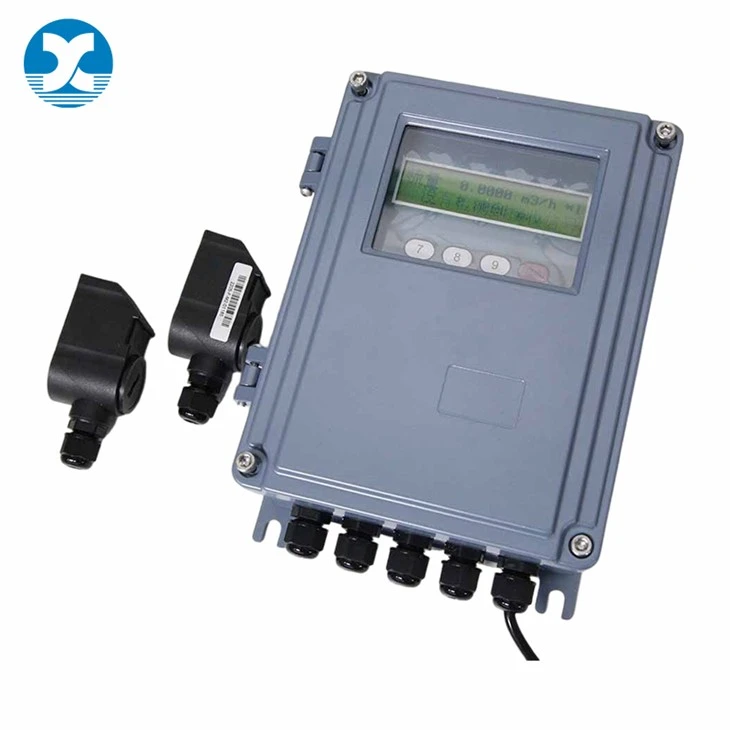

Comparison with other irrigation flowmeters
Electromagnetic flowmeter vs. Turbine Flow Meter
A Turbine Flow Meter uses a rotating rotor to measure flow. It can provide good accuracy in clean water, but it has moving parts that are more sensitive to debris, sand and biological growth. In irrigation water that contains particles or organic matter, a turbine meter may require more frequent maintenance.
An electromagnetic flowmeter is usually more robust in dirty or slightly contaminated water because there are no moving parts in the flow path. However, a Turbine Flow Meter may still be considered for small, clean-water lines where cost is the primary concern.
Electromagnetic flowmeter vs. Ultrasonic Flow Meter
An Ultrasonic Flow Meter measures flow by detecting the effect of fluid movement on ultrasonic signals. It can be a good option when pipe intrusion must be avoided or when the installation conditions are difficult.
However, an Ultrasonic Flow Meter can be more sensitive to air bubbles, suspended solids, pipe lining and flow profile disturbances. In irrigation systems with variable flow, entrained air or inconsistent pipe conditions, an electromagnetic flowmeter often provides more stable performance.
Electromagnetic flowmeter vs. Ultrasonic Clamp-on Flowmeter
An Ultrasonic Clamp-on Flowmeter is attractive because it can be installed on the outside of the pipe without cutting or stopping the process. This makes it useful for temporary testing, retrofitting existing irrigation lines or quick troubleshooting.
However, an Ultrasonic Clamp-on Flowmeter is generally more sensitive to pipe material, wall thickness, liner condition and coupling quality. For permanent irrigation metering where accuracy and repeatability are important, an inline electromagnetic flowmeter is often the more reliable choice.
Best practices for using electromagnetic flowmeters in irrigation
Confirm water conductivity. Most natural and treated irrigation water is conductive enough, but distilled or highly purified water is not.
Ensure full-pipe flow. Install the meter in a horizontal pipe section or a controlled vertical section where the pipe remains full.
Provide adequate straight pipe. Follow the manufacturer's recommendations for upstream and downstream straight lengths.
Choose suitable lining and electrodes. For agricultural water, consider abrasion resistance and potential chemical exposure.
Avoid air pockets. Install air release valves if necessary, especially at high points in the pipeline.
Match the meter size to actual flow. Oversized meters can reduce accuracy at low irrigation flows.
Conclusion
An electromagnetic flowmeter is a strong choice for many irrigation systems, especially where accurate water measurement, low maintenance and long-term reliability are required. It works well for most conductive irrigation water sources and can help improve water use efficiency, pump control and irrigation management.
If your irrigation system uses non-conductive water, frequently runs partially filled, or has extreme sand and debris loads, it may be better to compare an electromagnetic flowmeter with a Turbine Flow Meter, an Ultrasonic Flow Meter or an Ultrasonic Clamp-on Flowmeter before making a final decision.
If you are selecting a flowmeter for an irrigation project, share your pipe size, flow range, water source and installation conditions. We can help you confirm whether an electromagnetic flowmeter is suitable and recommend the most appropriate configuration for your system.


