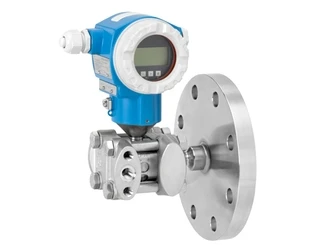
Product Overview
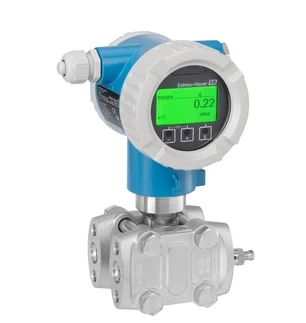
The Deltabar FMD77 is not a general-purpose differential pressure transmitter. It is a purpose-built level instrument: a digital DP transmitter with a metal sensor cell, connected on one side to a customer-specified diaphragm seal assembly mounted directly on the tank flange, and on the other side to the tank's gas phase or atmosphere. This single-flange architecture exists to solve one recurring problem in tank measurement - getting a pressure-tolerant, corrosion-resistant, temperature-isolated signal out of a vessel whose process conditions would overwhelm a standard threaded pressure connection.
Where a conventional DP transmitter needs two impulse lines running from the tank to the instrument, the FMD77 replaces that entire plumbing on the tank side with a welded diaphragm seal and capillary filled with a stable fill fluid. The process medium never enters an impulse line, so there is nothing to plug, freeze, evaporate or leak. That is why the FMD77 is the default choice for hot oil tanks, condensate drums, acidic or alkaline storage vessels, and any installation subject to German WHG overflow-protection rules.
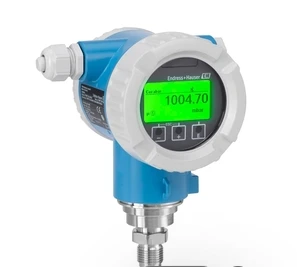
The transmitter itself is modular. The electronics housing, the sensor module and the diaphragm-seal capillary are separate assemblies, so a failure in the electronics does not require draining the tank or disturbing the process connection. The cell range spans 100 mbar to 16 bar, with a minimum calibratable span of 5 mbar and a 100:1 turn-down. Long-term stability is specified at 0.05% of URL per year, which is the figure that governs level drift over years of unattended operation.
Core Product Features
Single-flange diaphragm seal architecture for tank level
The high-pressure side mounts directly to a customer flange (DIN, ASME or JIS) via a welded diaphragm seal. There is no gasket, no thread and no impulse piping on the process side - the diaphragm is welded to the flange adapter. The low-pressure side takes a 1/4-18 NPT or RC1/4 connection for the reference leg. This arrangement is standard on pressurized storage tanks, distillation columns and buried or insulated vessels where running two impulse lines would be impractical.
Second process barrier for overflow protection
The FMD77 carries a second process barrier between the diaphragm seal and the sensor cell. In the event of primary diaphragm damage, the second barrier contains the process medium and prevents it from escaping into the electronics housing. This is a design requirement for installations under the German Water Management Act (WHG), where a tank overflow caused by instrument failure carries environmental liability. The second barrier is monitored by on-board diagnostics so a primary diaphragm leak raises an alarm before it becomes a spill.
Modular transmitter design
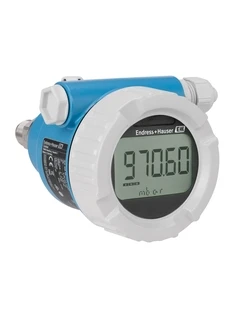
The FMD77 separates into a housing module, a sensor module and a remote display module. In the field, technicians swap electronics without breaking the process connection, and swap the display without touching the wiring. This matters on insulated tanks and outdoor bunded areas where draining the vessel for a transmitter swap is a multi-day planning exercise.
Self-diagnostics and process anomaly detection
On-board diagnostic logic monitors diaphragm integrity, fill-fluid condition, electronics temperature and reference-side vent condition. Abnormal patterns are flagged on the local display and transmitted over the digital bus, so operators can distinguish a real level change from a measurement fault. Combined with SIL certification, the FMD77 is intended for level loops that double as overfill protection.
Wide temperature and material envelope
Process temperature runs from -40°C to 400°C depending on fill fluid and diaphragm-seal configuration. Wetted diaphragms are offered in 316L, Alloy C, tantalum, gold-rhodium and PTFE-lined versions. Fill-fluid options cover silicone oil, inert oil, vegetable oil, low-temperature oil and high-temperature oil, so the instrument can be matched to oxygen service, food-grade duty, cryogenic service or molten-temperature applications without changing the transmitter platform.
Multi-bus communication
Three digital interfaces are available - 4-20mA HART, PROFIBUS PA and FOUNDATION Fieldbus. The FMD77 is one of the few instruments in this class that still ships natively on FOUNDATION Fieldbus, which keeps it relevant in older refineries and chemical plants that standardize on FF rather than PROFINET.
Technical Specifications
Figures below reflect the standard FMD77 configuration. The exact ordering depends on flange code, diaphragm material, fill fluid and approval combination.
|
Parameter |
Specification |
|
Measuring principle |
Differential pressure, single-flange diaphragm seal on high-pressure side |
|
Characteristic |
Digital transmitter with metallic diaphragm sensor, modular design, second process barrier, self-diagnostics |
|
Measuring cell range |
100 mbar … 16 bar (40 inH₂O … 240 psi) |
|
Smallest calibratable span |
5 mbar (0.075 psi) |
|
Maximum turn-down |
100:1 |
|
Reference accuracy |
0.075% plus diaphragm-seal system influence |
|
Long-term stability |
0.05% URL/year; 0.125% URL/5 years |
|
Maximum overpressure limit |
160 bar (2,400 psi) |
|
Vacuum resistance |
50 mbar (7.25 psi) absolute |
|
Process temperature |
-40°C … 400°C (-40°F … +752°F) |
|
Ambient temperature |
-40°C … +85°C (-40°F … +185°F) |
|
Supply voltage - 4-20mA HART, non-Ex |
10.5 … 45 V DC |
|
Supply voltage - 4-20mA HART, Ex ia |
10.5 … 30 V DC |
|
Supply voltage - PROFIBUS PA / FF, non-Ex |
9 … 32 V DC |
|
High-pressure side process connection |
Flange (DIN, ASME, JIS) |
|
Low-pressure side process connection |
1/4-18 NPT, RC1/4" |
|
Process diaphragm materials |
316L, Alloy C, tantalum, gold-rhodium, PTFE |
|
Gasket |
None - welded diaphragm seal system |
|
Fill fluids |
Silicone oil, inert oil, vegetable oil, low-temperature oil, high-temperature oil |
|
Housing materials |
316L stainless steel, cast aluminum |
|
Communication |
4-20mA HART, PROFIBUS PA, FOUNDATION Fieldbus |
|
Hazardous-area approvals |
ATEX, FM, CSA, CSA C/US, IECEx, TIIS, INMETRO, NEPSI, EAC |
|
Safety approvals |
SIL |
|
Water-management / overflow |
WHG-compliant design |
|
Design approvals |
NACE MR0175, EN 10204 3.1 |
|
Successor model |
PMD78B |
Typical Applications
The FMD77 is chosen where a standard DP transmitter cannot survive the tank's process conditions.
Pressized tank level on hot process fluids. Hot oil, thermal fluid, condensate and feedwater tanks routinely run above 110°C - the limit of a standard threaded DP cell. The diaphragm seal and high-temperature fill fluid extend the process side to 400°C while the electronics housing stays near ambient.
Corrosive chemical storage. Acid, caustic and chloride-laden media are matched with tantalum, Alloy C, PTFE-lined or gold-plated diaphragms. The welded seal eliminates the gasket as a leak path, which matters on corrosive services where a gasket failure becomes a chemical release.
WHG-regulated bunded storage in German and EU sites. Plants subject to the German Water Management Act need overflow protection on liquid storage. The FMD77's second barrier and SIL rating feed into a level switch or interlock that isolates the filling line on high level.
Food and pharmaceutical tanks requiring sanitary diaphragm seals. Vegetable-oil fill fluid is safe in the event of diaphragm rupture, and flange-mounted diaphragms can be specified with sanitary surface finishes. This variant handles water-based product, CIP/SIP cycles and clean-in-place vessels.
Cryogenic and low-temperature storage. Low-temperature fill fluid allows the FMD77 to sit on tanks carrying media well below freezing, where silicone oil would become viscous and destroy the measurement response.
Replacement of older Deltabar units. The FMD77 is the predecessor generation; Endress+Hauser now positions the PMD78B as its direct replacement. Where customers have an installed base of FMD77 units and need spares or matching replacements, the FMD77 ordering code remains the reference.
Frequently Asked Questions
Q1: How is the FMD77 different from a standard DP transmitter like the PMD75B?
A: The PMD75B is a general-purpose DP transmitter with two threaded process connections, used for flow, filter delta-P and level with impulse lines. The FMD77 is built around a single welded diaphragm seal on the tank flange, with the process side rated to 400°C and a second safety barrier. It is a level-specific instrument, not a flow instrument.
Q2: Can the FMD77 measure level in pressurized closed tanks?
A: Yes. The high-pressure side reads the hydrostatic pressure from the liquid column; the low-pressure side connects to the vapor space above the liquid to compensate for tank head pressure. This is how a DP transmitter handles pressurized vessels - it subtracts the gas-phase pressure from the total pressure at the bottom of the tank.
Q3: What is the second process barrier, and why does it matter?
A: It is a secondary diaphragm or containment chamber behind the process diaphragm. If the primary diaphragm corrodes through, the second barrier catches the process fluid before it reaches the electronics housing or the environment. This is a WHG requirement on tanks holding water-polluting fluids, because a primary diaphragm failure must not cause an overflow or spill.
Q4: Does the FMD77 need impulse lines?
A: No. That is the whole point of the diaphragm-seal design. The high-pressure side is welded to the tank flange via a diaphragm and capillary; there is no impulse tubing to plug, freeze or leak. The low-pressure side typically vents to atmosphere or references the tank headspace through a small reference line.
Q5: Why is the reference accuracy listed as 0.075% plus diaphragm-seal influence?
A: The sensor cell itself is accurate to 0.075%, but the diaphragm seal, capillary and fill fluid add their own temperature-dependent error. The total installed accuracy depends on capillary length, ambient temperature swing and fill-fluid choice. For high-precision custody transfer, specify a capillary length and ambient condition range so the seal-system influence can be calculated and compensated.
Q6: Is the FMD77 still in production, or is it a discontinued model?
A: The FMD77 has been succeeded by the PMD78B in Endress+Hauser's current catalog. Existing FMD77 units remain in service at many plants, and replacement units and spares are still traded through the aftermarket. If you are replacing an FMD77, we can quote the exact FMD77 code you supply; if you are starting a new project, the PMD78B is the current equivalent.
Q7: Which fill fluid should I specify?
A: Silicone oil is the general-purpose default. Inert oil is used for oxygen and strongly oxidizing services. Vegetable oil is specified for food, beverage and pharmaceutical applications where diaphragm rupture must not contaminate the product. Low-temperature oil handles cryogenic service; high-temperature oil handles the 400°C upper range. Fill fluid choice cannot be changed in the field - it is set at the factory when the diaphragm seal is filled and sealed.
Q8: Can the FMD77 be used for vacuum tanks?
A: Its vacuum resistance is 50 mbar absolute. That covers mild vacuum and pressurized vented recovery systems. For deeper vacuum or full vacuum service, specify a vacuum-compatible diaphragm seal arrangement and confirm with the ordering code.
We provide quotations for the Endress+Hauser Deltabar FMD77 differential pressure transmitter based on your complete part number or clear information captured from the product nameplate.
Please share the below information for us to check stock availability and prepare your formal quotation:
- Full FMD77 model number
- Nameplate photo of the transmitter (preferred)
- Required quantity
- Target delivery destination
Kindly provide the full model number or transmitter nameplate photo for quotation. We cannot prepare an ordering code from P&ID tags or general process specifications alone.
Once we receive your information, our team will review your request promptly and send you pricing and lead time information.
Hot Tags: deltabar fmd77 differential pressure transmitter, China deltabar fmd77 differential pressure transmitter manufacturers, suppliers, factory