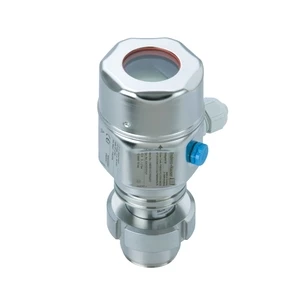
Ask anyone who reconciles tank inventory at month-end what the hard part is, and you won't hear "reading the level." The level is the easy bit. The hard part is that a level reading in cubic metres tells you nothing useful until you know the density, and density depends on temperature and, for some products, on pressure. So the plant ends up with three separate instruments on one tank-a level gauge, a temperature probe in a thermowell, and a pressure transmitter on a nozzle-each with its own cable, its own calibration schedule, and its own failure mode.
That's the gap an integrated multi-parameter indicator fills. One bypass chamber, one process connection set, one assembly that reports level, temperature, and pressure from the same elevation on the vessel. It sounds like a packaging gimmick until you have to maintain forty tanks, at which point the reduction in field devices starts to look like a genuine engineering choice rather than a convenience.
Let's go through what's actually involved, because the integration is far less trivial than "add a sensor."
Why the Three Parameters Belong Together
Density Compensation for Real Inventory Numbers
A float measures volume, not mass. Industrial accounting usually needs mass, because that's what's bought and sold. Converting volume to mass means knowing the density at actual operating conditions. For a product stored at ambient temperature with a stable density, a fixed figure in the DCS works fine. For anything that sits in the sun, gets heated, or is stored at low temperature, that fixed figure is simply wrong for part of the year.
Reading temperature at the same tank lets the control system apply a density correction curve. The same fill level in summer and winter converts to different mass values, and only the temperature input makes that calculation honest. This is the single strongest argument for putting temperature on the level gauge rather than on a separate probe.
Pressure as Process Health, Not Just Process Value
Pressure on a storage vessel tells you several things at once. For pressurised or cryogenic storage, it's a primary safety and process value. For atmospheric tanks, even a low-range reading catches blanketing gas problems, vapour pressure variation, or a blocked vent before it becomes visible in any other way.
Putting pressure on the same assembly is convenient because the nozzle already exists. The gauge chamber occupies a process connection on the vessel wall, and adding a pressure tap to that same manifold avoids drilling a second hole in a tank that may not appreciate it.
One Elevation, Consistent Reference
There's a quieter benefit that only shows up during commissioning. When level, temperature, and pressure are measured from the same assembly, they share a reference elevation and a common installation. You're not reconciling a level from a nozzle at one height against a temperature probe welded somewhere else, wondering whether stratification inside the tank makes the two readings describe different parts of the product. For tall tanks with temperature gradients, that consistency is worth more than it sounds.
How the Integration Actually Works
The Level Path Is Still Magnetic
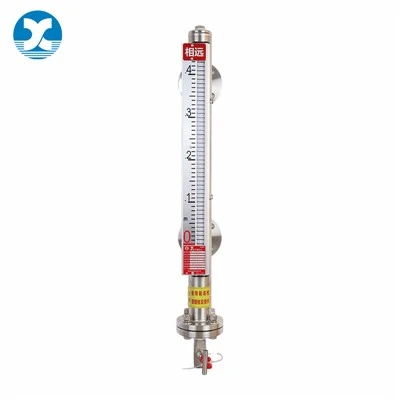
The measuring core doesn't change. A float with a permanent magnet travels inside the bypass chamber, and the magnetic field flips the external indicator flags for local visual reading. That mechanical display remains, and it remains independent of everything electronic in the assembly. If the transmitters fail, operators can still read the level directly.
Remote level output is taken from a reed chain or magnetostrictive element alongside the float path, converted into a 4-20 mA, HART, or digital signal. This is the same technology used on single-parameter gauges; integration doesn't change the level measurement itself.
Temperature Measurement Needs a Real Sensor Position
Temperature is the parameter that most often gets done badly in integrated designs. The sensor must measure the process fluid, not the ambient air around the chamber, and not the chamber wall temperature.
The usual approach is a thermowell or a temperature element mounted in the chamber wall or in a dedicated port in the gauge manifold. Where exactly it sits matters. For a tall tank with stratification, a single temperature point tells you the temperature at that elevation, which may not represent the whole contents. Some integrated assemblies offer two or three temperature points along the chamber for exactly this reason-and the control system averages them or applies a weighted calculation.
If your product stratifies, one sensor is a compromise, not a solution. Decide that during specification, not after the first inventory discrepancy.
Pressure Port Placement
Pressure is tapped from the chamber or manifold, usually through a separate isolation valve. The reading reflects the pressure at the gauge connection, which for a liquid-filled chamber equals the pressure at that elevation. If your process needs pressure referenced to a different point-vessel top, vapour space-clarify that in the specification. It's a common source of disagreement between what the supplier thought and what the process engineer meant.
For small pressure ranges, transmitter selection matters more than the port. A high-range transmitter on a low-pressure tank gives you a reading that's technically valid and practically useless. Choose the range to match the actual operating envelope.
Outputs and Loop Architecture
Each parameter needs its own output path. Three 4-20 mA loops is the traditional arrangement, and it works, but it also means three cable pairs, three analogue input cards, and three scaling configurations in the PLC.
Modern assemblies increasingly consolidate onto HART multidrop or a single digital protocol, carrying level, temperature, and pressure as separate variables over one connection. That's cleaner in new installations and much cleaner in retrofits where panel space is tight. The tradeoff is that a single communication failure takes all three values down at once, whereas three independent loops fail separately. For safety-critical applications, that independence may be worth the extra wiring.
Where the Integrated Assembly Earns Its Keep
Tank Farms With Many Vessels
The economics only work at scale. On one tank, three separate instruments are fine and often cheaper. On forty tanks, reducing three field devices to one assembly cuts the instrument count, the cable count, the calibration schedule, and the spare parts inventory. Maintenance teams notice this immediately, and it's usually the strongest argument in the business case.
Retrofits Without New Nozzles
Old tanks often have no spare nozzles. Boring a new hole in a vessel is expensive, needs engineering approval, and may require the tank to be emptied. An integrated gauge uses the existing level connection and derives temperature and pressure from the same manifold. In brownfield work, that's the difference between a project that happens and one that doesn't.
Inventory and Custody Applications
Wherever volume-to-mass conversion is part of the commercial picture, having level and temperature measured at the same point simplifies the calculation and, more importantly, makes it defensible. When an auditor asks how the figure was derived, being able to point to a single assembly with a documented sensor elevation is easier than reconciling three independent devices.
Skids and Packaged Systems
On a packaged unit, panel space and piping are tight. An integrated assembly reduces the footprint and lets the skid builder wire one device interface instead of three. This is where the concept is most widely adopted already.
Where It Gets Complicated
Three Failure Modes in One Body
Integration cuts device count but concentrate risk. If the assembly needs to come out for a temperature sensor fault, you lose the level reading and pressure reading too, unless the design allows each element to be serviced independently. Ask specifically about serviceability: can the temperature element be replaced without removing the whole chamber? Can the pressure transmitter be isolated and swapped on its own?
If the answer is no, you've traded maintenance simplicity for maintenance complexity. On a critical tank, that's a bad trade.
Calibration Is Now a Multi-Parameter Job
Three parameters mean three calibration scopes, three sets of records, and three potential drift sources. The instrument technician's workload per device goes up even though the device count goes down. Whether that's a net saving depends on how your site is organised-and it's worth checking with the maintenance team before the purchase order, not after.
Material and Rating Constraints Multiply
Now the wetted materials must suit the process for the chamber, the thermowell, the pressure diaphragm, and the seals-all at operating temperature and pressure. A material choice that works for the level chamber may not suit the pressure sensor's diaphragm. Integrated assemblies are less flexible than three separate instruments chosen individually, so the material specification needs more thought, not less.
Accuracy Interactions
Temperature and pressure sensors inside a common housing sit close to each other and to the level electronics. Good designs handle the thermal effects. Cheap ones don't, and you end up with a temperature reading influenced by the pressure transmitter's self-heating, or a level reading with a temperature coefficient nobody documented. Ask for the specified accuracy of each parameter and how it was verified in the integrated configuration, not just as a standalone sensor.
Specification Points That Actually Matter
- Confirm the exact elevation of each sensor-level reference, temperature point, pressure tap-and document it.
- Decide whether one temperature point is enough, or whether stratification requires two or three.
- Match the pressure transmitter range to the real operating envelope, not the vessel design pressure.
- Confirm which parameters can be serviced individually, and which require the whole assembly out.
- Choose the output architecture: three independent loops, or consolidated digital with a fail-mode discussion.
- Verify wetted materials for all three sensor paths at operating conditions.
- Ask for accuracy specifications as verified in the integrated build.
- Confirm hazardous area certification covers the whole assembly, not just the level transmitter.
Conclusion
A multi-parameter integrated magnetic level indicator makes the most sense where the alternative is three instruments, three nozzles, and three maintenance routines on a tank that only has one connection available. On a large tank farm, a retrofit without spare nozzles, or a packaged skid, the savings in devices, wiring, and downtime are real and measurable.
It makes less sense on a single tank with plenty of nozzles and a maintenance team that prefers to swap one device at a time. There, three separate instruments give you flexibility that integration takes away.
The deciding questions are practical, not technical: how many tanks, how many spare nozzles, how does your team service instruments, and does the commercial calculation actually depend on temperature-corrected mass? Answer those, and the choice is usually obvious.
If you're evaluating an integrated level, temperature, and pressure assembly for your tanks, share your tank count, media properties, stratification behaviour, available nozzles, and required outputs, and our team can help you scope the configuration. Visit our magnetic level gauge page: /magnetic-level-gauge.html to review materials, connection options, and available parameter combinations.
References
- API MPMS Chapter 12.1, Calculation of Static Petroleum Quantities – Upright Cylindrical Tanks and Marine Vessels
- ISO 4266-1, Petroleum and liquid petroleum products – Measurement of level and temperature in storage tanks by automatic methods
- IEC 60751, Industrial platinum resistance thermometers and platinum temperature sensors
- IEC 61511, Functional safety – Safety instrumented systems for the process industry
- Manufacturer operation and maintenance manuals for multi-parameter magnetic level indicators