Product Overview
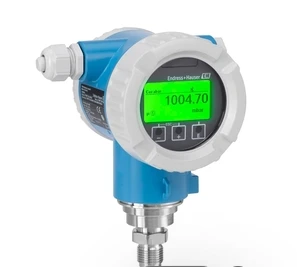
The Deltapilot FMB50 is a single-process-pressure instrument: one diaphragm senses the hydrostatic pressure exerted by the liquid column above it, and the transmitter converts that pressure reading into a level value. It is not a differential-pressure device and has no impulse tubing, capillary or reference leg on the process side. A flush metal diaphragm sits directly against the liquid, so the measured medium touches only the welded sensor face and the housing connection - no trapped cavity, no fill-fluid path through a remote seal.
The sensor itself is E+H's CONTITE design: a fully sealed, welded metal diaphragm assembly filled with a stable fill fluid and hermetically closed against the outside atmosphere. That construction is what gives the FMB50 its stated resistance to internal condensation and changing weather conditions. On outdoor tanks, wash-down stations and locations where ambient humidity swings between day and night, ordinary sealed-gel or vented diaphragms can trap moisture that drifts the reading; the CONTITE weld eliminates that failure path.
Cell range runs from 100 mbar to 10 bar, with a minimum calibratable span of 10 mbar and a 100:1 turn-down. Reference accuracy is 0.2% standard and 0.1% on the optional trimmed version. Long-term stability is held at 0.05% of URL per year, which sets how much the level reading can be trusted between service visits. The instrument withstands full vacuum (0 mbar absolute) and a 40 bar overpressure limit, which covers vacuum degassing tanks and pressure excursions common in closed vessels.
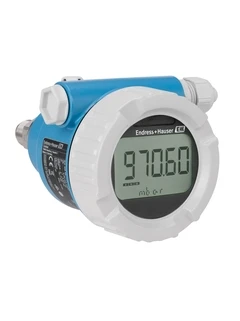
Because the electronics platform is modular, the local display unit can be removed or swapped without touching the process connection, and the underlying electronic module is shared across E+H's broader pressure transmitter family. That commonality simplifies spare-parts holding for plants that run several E+H instrument types in parallel.
Core Product Features
Sealed-welded CONTITE sensor
The CONTITE sensor face is welded shut rather than vented or gel-sealed. The fill fluid behind the diaphragm never exchanges gas with the ambient air, so condensation, humidity ingress and outgassing from the medium cannot migrate into the sensor chamber. Temperature influence on the zero point is minimized through matched material expansion, which matters most on shallow tanks where a small pressure shift translates into a noticeable level error.
Flush process diaphragm, no cavity buildup
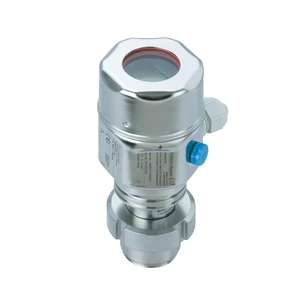
The diaphragm sits flush with the process connection. There is no recessed throat in which product can settle, crystallize or foul - a detail that matters on viscous foods, sugary liquids, slurries and services that are CIP cleaned. Combined with hygienic connection options, this lets the FMB50 satisfy clean-in-place and sanitary wash-down regimes rather than requiring a disassembly after each production run.
Full hygienic connection range
Beyond standard threaded and flanged connections, the FMB50 accepts Tri-Clamp, DIN 11851, DIN 11864-1, NEUMO, Varivent N, SMS and DRD fittings. Wetted diaphragms are offered in 316L, Alloy C and rhodium-over-gold. Hygienic approvals include 3A, EHEDG and ASME-BPE CoC, so the instrument fits dairy, brewing, pharmaceutical and biotech lines that audit surface finish and product contact.
Drinking-water and marine approved variants
For municipal water and potable-water storage, the FMB50 carries KTW, NSF and ACS drinking-water certifications. Offshore and shipboard installations can be specified with GL, ABS, LR, BV and DNV marine classifications. These approval tracks let the same transmitter platform serve water-treatment plants, tanker vessels and coastal bulk storage without a separate custom qualification.
Modular electronics and replaceable display
The FMB50 uses a shared modular electronic architecture across E+H's pressure and DP transmitter line. The display module clips onto the housing and can be rotated or replaced on site; the electronics underneath carry the measurement and output functions. In the field, a failed display can be swapped without disturbing wiring or process isolation, and a spare common electronic module covers multiple instrument types in the spare-parts cabinet.
Multi-bus output across three protocols
Three communication stacks are available: 4-20mA HART for conventional control rooms, PROFIBUS PA for fieldbus-based DCS architectures, and FOUNDATION Fieldbus for older FF-standard plants. Supply voltage follows the protocol: 10.5-45 V DC on HART non-Ex, 10.5-30 V DC on HART Ex ia, and 9-32 V DC on PA and FF segments.
On-board diagnostics and safety ratings
Self-diagnostics monitor sensor state, electronics temperature and output condition, and flag abnormal behavior over the digital bus. The transmitter is rated SIL for safety-related level loops and carries WHG overflow-protection approval for water-polluting liquid storage. Hazardous-area approvals span ATEX, FM, CSA, CSA C/US, IECEx, TIIS, INMETRO and NEPSI.
Technical Specifications
The figures below reflect the standard FMB50 ordering range. Exact diaphragm material, fill fluid, connection and approval combination must be read from the specific ordering code or nameplate.
|
Parameter |
Specification |
|
Measuring principle |
Hydrostatic pressure / hydrostatic level |
|
Sensor type |
Flush-mounted metal CONTITE sensor, fully sealed welded, no gasket |
|
Cell range |
100 mbar … 10 bar (1.5 psi … 150 psi) |
|
Smallest calibratable span |
10 mbar (1.45 psi) |
|
Maximum turn-down |
100:1 |
|
Reference accuracy |
Standard 0.2%; optional 0.1% |
|
Long-term stability |
0.05% URL/year |
|
Maximum overpressure limit |
40 bar (600 psi) |
|
Vacuum resistance |
0 mbar absolute (full vacuum) |
|
Process temperature |
-10°C … +100°C (14°F … 212°F) |
|
Ambient temperature |
-40°C … +85°C (-40°F … 185°F) |
|
Supply voltage - HART non-Ex |
10.5 … 45 V DC |
|
Supply voltage - HART Ex ia |
10.5 … 30 V DC |
|
Supply voltage - PROFIBUS PA / FF, non-Ex |
9 … 32 V DC |
|
Threaded connection |
G1 1/2, MNPT 1 1/2 |
|
Flanged connection |
DN40 … DN100; ASME 1 1/2" … 4"; JIS 10K |
|
Hygienic connections |
Tri-Clamp, DIN 11851, DIN 11864-1, NEUMO, Varivent N, SMS, DRD |
|
Process diaphragm materials |
316L, Alloy C, rhodium > gold |
|
Gasket |
None - welded sensor |
|
Fill fluids |
Inert oil, synthetic oil |
|
Housing materials |
316L stainless steel, cast aluminum |
|
Communication |
4-20mA HART, PROFIBUS PA, FOUNDATION Fieldbus |
|
Hazardous-area approvals |
ATEX, FM, CSA, CSA C/US, IECEx, TIIS, INMETRO, NEPSI |
|
Safety approvals |
SIL, WHG overflow protection |
|
Design approvals |
EN 10204 3.1, NACE MR0103 |
|
Hygienic approvals |
3A, EHEDG, CoC ASME-BPE |
|
Marine approvals |
GL, ABS, LR, BV, DNV |
|
Drinking-water approvals |
KTW, NSF, ACS |
|
Platform notes |
Modular electronics, swappable display unit, common electronics across E+H pressure/DP family |
Typical Applications
Food, beverage and dairy processing. Tanks holding milk, beer, juice, syrups, cream and CIP return lines use the hygienic clamp or DIN 11851 connection, flush diaphragm and food-contact-approved fill fluid. The 3A/EHEDG/ASME-BPE certification trail supports customer audits in dairy, brewing and plant-based production.
Pharmaceutical and biotech vessels. Product vessels, buffer tanks and water-for-energy systems require a cleanable wetted surface, traceable 3.1 material certificates and NACE compliance where process chemistry demands it. The flush diaphragm avoids product hang-up between batches.
Potable water and wastewater storage. Treated water reservoirs, distribution tanks and sludge buffer tanks take the KTW/NSF/ACS certified variant. Outdoor mounting is covered by the condensation-proof CONTITE design and the -40°C to +85°C ambient range.
Marine and offshore tank sounding. Ballast tanks, lubricating oil tanks, fuel service tanks and chemical cargo tanks on ships and offshore structures can be ordered with GL, ABS, LR, BV or DNV classification. The welded sensor withstands hull vibration and salt-air exposure better than a vented or gel-sealed cell.
Chemical and process bulk storage. Closed pressurized vessels holding corrosive or sour fluids use Alloy C or gold-rhodium diaphragms, NACE MR0103 compliance and the SIL/WHG level-overfill protection on tanks carrying water-polluting liquids.
Shallow low-range level measurement. The 10 mbar minimum span and full-vacuum resistance fit shallow vessels, open channels and vacuum degassing tanks where other hydrostatic sensors lose zero stability at the bottom of their range.
Frequently Asked Questions
Q1: How does a hydrostatic level transmitter work?
A: The diaphragm measures the pressure exerted by the liquid column above it. Pressure equals liquid density multiplied by column height and gravity, so once the medium density is entered into the transmitter, the pressure reading converts directly into level. Open tanks vent to atmosphere; pressurized tanks need the headspace pressure accounted for, either through a reference line or a compensated installation.
Q2: What makes the CONTITE sensor different from a standard welded diaphragm? A: CONTITE is E+H's fully sealed, welded sensor design. The fill-fluid chamber is hermetically closed, so ambient humidity cannot condense inside, vented reference passages cannot draw in moisture, and weather exposure does not drift the zero point. That sealed construction is the main reason the FMB50 is specified for outdoor tanks and wash-down areas where ordinary sensors develop condensation-related drift.
Q3: Is the FMB50 a differential pressure transmitter?
A: No. It measures single hydrostatic pressure against the reference side of the cell. It is a pressure/level transmitter, not a DP instrument for flow or dual-tank differential measurement. If your application requires subtracting a vapor-space pressure on a pressurized vessel, a DP-based level transmitter with two connections would be the matching architecture.
Q4: Can it be cleaned in place or steamed?
A: The hygienic connection versions are designed for CIP regimes within the stated process temperature range of -10°C to 100°C. Sanitary surface finish and EHEDG/3A approval support cleanable design; actual SIP steam temperature and cycle limits must be checked against the specific ordering code and the manufacturer's current datasheet before installation.
Q5: Which fill fluid is used in the FMB50?
A: Inert oil or synthetic oil, selected at the factory when the sensor is filled and sealed. Fill fluid cannot be changed in the field. The choice depends on medium compatibility, process temperature and whether food-contact requirements apply; the valid fill fluid for a given unit is identified on the nameplate or ordering code.
Q6: Does the FMB50 handle vacuum tanks?
A: Yes. Its vacuum resistance is rated down to 0 mbar absolute, so it can stay installed on vessels that run under full or partial vacuum, within the pressure and temperature limits of the chosen cell.
Q7: Can the display be replaced without rewiring the transmitter?
A: The local display module is a swappable part of the modular electronics platform. A failed or damaged display can be removed and replaced while the transmitter stays wired and powered; the measurement electronics underneath carry the configuration and signal output.
Q8: What does the WHG approval apply to?
A: WHG is the German Water Management Act. The WHG-rated FMB50 variant is acceptable for level and overfill monitoring on tanks holding water-polluting liquids, where the transmitter contributes to an overflow-protection loop. Combined with the SIL rating, it fits safety-related level installations regulated under environmental protection rules.
Q9: Why are the reference accuracy figures (0.2% / 0.1%) wider than a high-end DP transmitter?
A: The FMB50 is a general-purpose hydrostatic level instrument rather than a custody-transfer precision cell. The 0.2% standard and 0.1% optional figures are adequate for tank inventory, pump control and overfill protection. For flow metering or tight mass-balance duties, a dedicated DP transmitter with tighter reference accuracy would be the usual selection.
We provide quotations for the Endress+Hauser Deltapilot FMB50 hydrostatic level transmitter based on your complete part number or clear information captured from the product nameplate.
Kindly provide the full ordering code or transmitter nameplate photo for quotation. Once we receive your information, our team will review your request promptly and send you pricing and lead time information.
Hot Tags: deltapilot fmb50 hydrostatic level transmitter, China deltapilot fmb50 hydrostatic level transmitter manufacturers, suppliers, factory