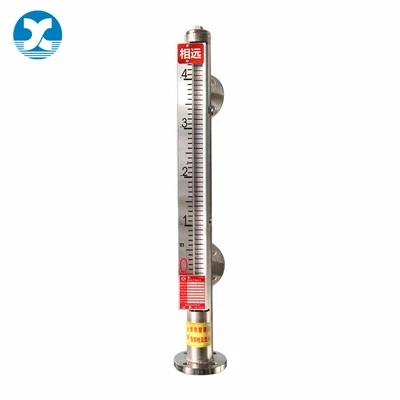
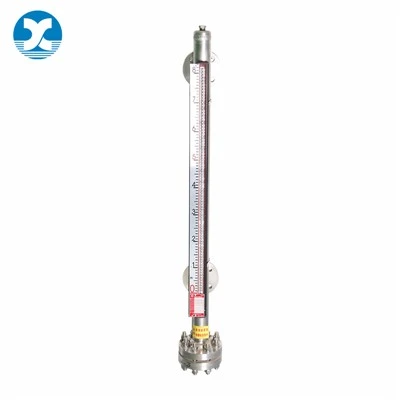
What is magnetic level indicator?
A magnetic level indicator is a level gauge with a float that can experience floatation in various density fluids. Magnetic level indicators may also be designed to adapt to severe environmental conditions up to 210 bars. Magnetic level indicators are used to detect and monitor the levels of liquids in various industrial environments.
How does a magnetic level indicator work?
The magnetic level indicator is attached to the vessel and connects directly with the fluid to be measured. Within the chamber is a float with a magnet assembly inside. As the fluid level rises or falls, so does the float. The magnetic float rises and falls on the surface of the fluid, registering the changes on the external indicator.
Since the magnetic level indicator relies on the interaction between magnets, the level measuring instruments do not need a power source. The indicator's magnetic force can affect switches or transmitters mounted outside the chamber. The size and material of the float are chosen according to the media, temperature, pressure and density of the medium.
What are the applications of a magnetic level indicator?
All chemical and petrochemical tanks
Tanks for petroleum and petroleum products
Diesel fuel tanks and generator sets
Submarine, helicopter and ship fuel tanks
Power generation
Water and wastewater treatment
Food and Beverage
Pharmaceutical
Semiconductor

What are the installation steps for a magnetic level indicator?
A magnetic level indicator is a commonly used liquid level detection instrument. Proper installation can effectively ensure production safety and efficiency. So, what are the installation steps and requirements for a magnetic level indicator?
Pre-installation preparation
Before installing a magnetic flap level gauge, you need to complete the following preparations:
Familiarize yourself with the device model, performance specifications, and installation requirements.
Determine the installation location and method for the level indicator, and conduct an on-site inspection.
Clean the installation site and ensure the surrounding area is tidy.
Installation
The level gauge should be installed approximately 15-20 cm above the highest liquid level.
The magnetic flap should be installed perpendicular to the level indicator's measuring range. If there is an inclination, perform a vertical correction on the level gauge to ensure the correct angle reading.
During installation, the magnetic flap must be hung at an appropriate height to ensure free rotation. Furthermore, the flap must be protected from external forces, such as wind.
Electrical control circuits must be separated from on-site pipeline grounding circuits to ensure electrical safety.
When using magnetic measurement methods, care must be taken to prevent magnet adsorption and damage. The flap must be kept sealed and clean to avoid contamination.
After installation, on-site inspection and calibration must be performed.
What is calibration procedure for a magnetic level indicator?


Required tools and materials
Measuring tape for accurate liquid measurement
Standard liquid
Valve keys to control the liquid flow
Personal protective equipment
System inspection
Verify that the magnetic level gauge is installed vertically;
There is no mechanical damage;
Ensure there are no visible leaks in the float chamber;
Confirm that all valves between the vessel and the magnetic indicator are opened;
Step-by-step calibration procedure
Zero Level Check
Purpose: Check that the magnetic indicator correctly displays the minimum liquid level (zero). Procedure: Fully drain the tank to ensure there is no liquid in the system. Observe the magnetic indicator strip on the indicator to verify that the zero mark aligns with the actual empty position. If not, manually adjust the zero mark by sliding the indicator to the correct position.
Incremental Calibration at Specified Levels
Purpose: To verify the accuracy of the gauge at multiple levels (25%, 50%, 75%, 100%). Procedure: Slowly fill the tank with liquid in small, defined increments (e.g., up to 25% of the full level). At each increment, measure the actual liquid height with a magnetic tape or ruler. Record the indicated level on the magnetic strip against the measured value on the calibration sheet. Repeat this process at 50%, 75%, and 100% of the tank's capacity. Ensure that the magnetic indicator moves smoothly and without binding.
Recording Deviations and Making Adjustments
Objective: Identify and correct any discrepancies between the actual and displayed values. Procedure:
Compare the measured liquid level to the value displayed on the magnetic level gauge.
If the deviation is outside the acceptable tolerance, record the discrepancy on the calibration sheet.
If a discrepancy occurs, inspect the float for damage, blockage, or weakened magnetism.
If necessary, recalibrate the float or adjust the level gauge according to the manual.
Full-Scale Test
Purpose: Ensures that the gauge accurately measures the maximum liquid level. Procedure:
Fill the tank to its maximum capacity.
Confirm that the float and magnetic indicator move freely to the top of the indicator.
Check for smooth operation and correct indicator alignment.
Post-Calibration Procedures and Maintenance
Record Retention:
Record all calibration points and any deviations found during calibration.
Current calibration records should be maintained for future reference and regulatory compliance.
Periodic Calibration:
Develop a regular calibration schedule based on the criticality of the application (e.g., every 6 to 12 months).
Component Maintenance:
Regularly inspect the float chamber for sediment buildup or corrosion.
Inspect the integrity of the float to ensure it remains buoyant and magnetically responsive.
Calibration Verification:
Perform spot checks regularly between full calibrations to verify accuracy, especially in demanding applications.