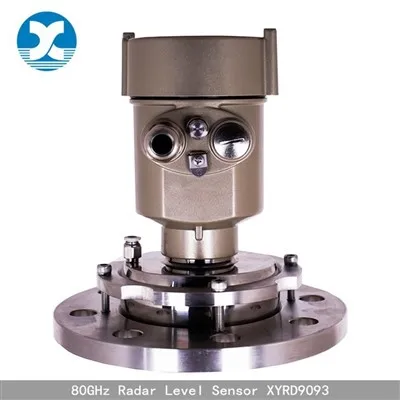
The Case for 26GHz Pulse Radar
The Pulse Radar Level Sensor leverages a purposefully lower operating frequency as a calculated engineering trade‑off, rather than accepting it as a technical limitation. Operating at 26GHz, it delivers a naturally wider beam that is far less susceptible to minor turbulence and vapor interference compared with ultra‑narrow high‑frequency radar beams. Paired with a robust horn antenna structure, this pulse radar maintains powerful signal penetration to handle harsh industrial conditions, including extreme heat, heavy condensation, dense dust, and weak reflections generated by low‑dielectric solid materials.
This pulse radar series avoids the common design compromise of universal sensors. It is divided into two specialized models, each uniquely optimized to solve distinct on‑site measurement challenges: XYRD9002‑NCR focuses on thermal and chemical durability, featuring excellent anti‑condensation capability and corrosion resistance for hot, aggressive liquids and abrasive slurries. XYRD9003‑NCR prioritizes enhanced signal sensitivity, equipped with a dual‑amplifier front end that stably captures valid echoes from solids, granules, and low‑dielectric media that typically produce weak or unstable feedback for ordinary radar sensors.
In short, instead of a single compromised antenna design that attempts to cover all scenarios poorly, this Pulse Radar Level Sensor series provides two application‑focused transmitters, each delivering reliable, high‑performance results for its targeted working conditions.
Engineering Highlights
Horn Antenna, High Signal Strength - the horn design used across this series delivers strong, wide-coverage signal return, making it a reliable, cost-effective default for the large majority of liquid and slurry applications.
Dual-Amplifier Option for Difficult Media - XYRD9003-NCR adds a second amplifier stage specifically to recover echoes from solid lumps, granular materials and low-dielectric substances that produce naturally weak reflections - without needing a different frequency or antenna family.
Built for Real Thermal Extremes - XYRD9002-NCR is rated to 250℃ and 4.0MPa for pressurized hot-liquid service; XYRD9003-NCR extends to 500℃ for direct measurement on hot solid materials, with anti-condensation performance protecting the signal path from moisture-related errors on humid or steaming processes.
Long Reach on Solids - XYRD9003-NCR's measuring range extends to 70m, well beyond what most silo or bunker applications require, giving headroom for tall storage structures.
Dual-Certified for Hazardous Areas - both models carry Ex ia IIC T6 Ga and Ex db IIC T6 Gb certification, covering Zone 0/1/2 installations in flammable-atmosphere plants.
Consistent Operation Across the Family - same 128×64 dot-matrix display, 4-key local setup, PC configuration software, IP67 housing and 4~20mA+HART / RS-485 output on both models, so maintenance teams only need to learn one interface regardless of which tank they're servicing.
Model Comparison & Specifications
|
Item |
XYRD9002-NCR |
XYRD9003-NCR |
|
Best Suited For |
Anti-condensation, highly corrosive liquids |
Solid blocks and granular materials |
|
Measuring Range |
0~30m |
0~70m |
|
Process Connection |
Bracket / Flange |
Flange |
|
Process Temperature |
-40℃ ~ 250℃ |
-40℃ ~ 500℃ |
|
Process Pressure |
-0.1 ~ 4.0MPa |
Ambient (atmospheric) pressure |
|
Accuracy |
±5mm |
±5mm |
|
Resolution |
±1mm |
±1mm |
|
Working Frequency |
26GHz |
26GHz |
|
Antenna / Signal Path |
Horn antenna |
Horn antenna + dual-amplifier module |
|
Wetted Material |
304/316 SS + PTFE |
304/316 SS + PTFE |
|
Housing Material |
Aluminum alloy w/ anti-corrosion powder coating, or stainless steel |
Same |
|
Display & Local Setup |
128×64 dot-matrix display, 4-key operation, PC configuration software |
Same |
|
Ingress Protection |
IP67 |
IP67 |
|
Hazardous Area Rating |
Ex ia IIC T6 Ga; Ex db IIC T6 Gb |
Ex ia IIC T6 Ga; Ex db IIC T6 Gb |
|
Signal Output |
4~20mA+HART or RS-485 |
4~20mA+HART or RS-485 |
|
Power Supply |
2-wire / 4-wire, DC24V |
2-wire / 4-wire, DC24V |
|
Ambient Temperature |
-40℃ ~ 80℃ |
-40℃ ~ 80℃ |
|
Electrical Interface |
M20×1.5 / 1/2NPT |
M20×1.5 / 1/2NPT |
|
Key Trait |
High cost-performance, strong signal, suited to most liquid conditions |
Large range, strong signal, resists dry/dust interference |
Where It Gets Used
Hot & Corrosive Liquid Storage (XYRD9002-NCR) - chemical process tanks, hot condensate vessels, and corrosive slurry tanks where condensation and heat would degrade a lesser instrument's signal path over time.
High-Temperature Process Vessels (XYRD9002-NCR) - reactors and buffer tanks running well above ambient temperature, where the 250℃ / 4.0MPa rating covers pressurized hot service.
Bulk Solid Silos & Bunkers (XYRD9003-NCR) - cement, ore, plastic pellets and similar bulk solids, where the dual-amplifier module recovers a usable signal even from materials with weak natural reflectivity.
Very Tall Storage Structures (XYRD9003-NCR) - the 70m range comfortably covers large silos and bunkers that shorter-range instruments can't reach.
Low-Dielectric Media Applications (XYRD9003-NCR) - plastics, light powders and other materials that return a naturally weak echo, where standard-gain antennas often struggle to hold a stable reading.
Frequently Asked Questions
How do I choose between the two models?
It comes down to what's in the tank. If it's a liquid or slurry - especially hot, corrosive, or condensation-prone - XYRD9002-NCR is the match. If it's a solid, granular, or low-dielectric material, XYRD9003-NCR's dual-amplifier front end is built specifically for that weaker signal return.
Why does XYRD9003-NCR need a dual-amplifier module?
Solids and low-dielectric materials naturally reflect less energy back to the antenna than liquids do. The second amplifier stage compensates for that weaker echo, keeping the reading stable instead of intermittent or noisy.
Can XYRD9002-NCR handle pressurized tanks?
Yes - it's rated to 4.0MPa, covering most pressurized liquid and slurry vessels. XYRD9003-NCR, by contrast, is designed for atmospheric-pressure solid storage rather than sealed pressure vessels.
Is 500℃ really usable for direct measurement?
Yes, on XYRD9003-NCR - the housing and wetted materials are rated to sustain that temperature for hot solid-material applications, such as measurement near kilns or hot-material discharge points.
What if my tank has both intermittent liquid and solid phases?
Talk to our engineers with your process description - depending on which phase dominates and the dielectric properties involved, one model will usually outperform the other, and we can confirm with your actual conditions.
Do both models share the same electronics and setup process?
Yes - same display, keypad, PC software, output signal and power options, so field teams don't need to learn two different interfaces.
Send us your medium type (liquid/slurry or solid/granular), process temperature and pressure, tank height and installation constraints, and our engineers will confirm the right model - XYRD9002-NCR or XYRD9003-NCR - along with a full technical proposal and quotation, typically within 24 -48 hours.
Hot Tags: pulse radar level sensor, China pulse radar level sensor manufacturers, suppliers, factory, 26GHz Radar Level Sensor, float and board type level indicator price, guided radar level measurement, magnetic fuel gauge, oil tank sight gauge float, tank level float indicator