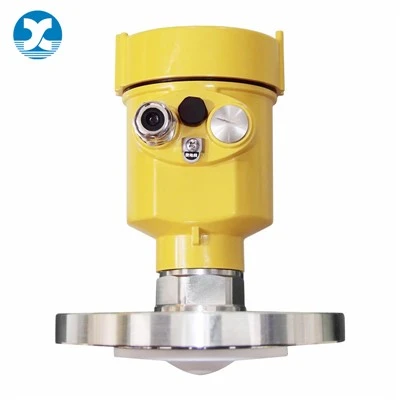
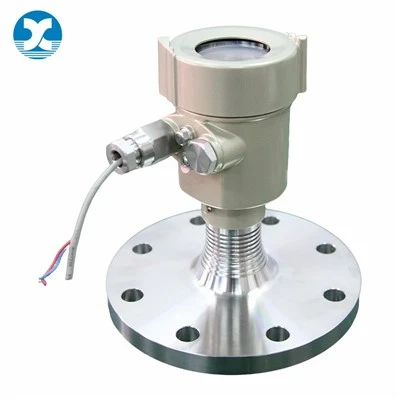
What is the measurement principle of radar level sensor?
Radar level sensor is a commonly used level detection instrument that can monitor the level of liquid or solid materials in containers through radar waves. Its basic working principle mainly includes three processes: emission, reflection and reception.
Firstly, the radar level sensor transmits electromagnetic waves of a certain frequency to liquid or solid materials through an internal transmitter, and these waves will be absorbed, reflected or refracted by the material. When the wave encounters the inner wall, it is reflected back, and this process is called reflection.
Then, the level sensor receives the reflected waves and processes them through an internal processor. The processor uses the reflected waves to determine the distance between the surface of the material and the level sensor, thereby determining the level of the material in the container.
Finally, the level sensor sends the calculated data to the control system through internal transmission technology to achieve real-time monitoring of the liquid level.
Through the above basic working principle, the radar level sensor can accurately measure the level of liquid or solid materials in the container without direct contact with the material, avoiding the errors and safety hazards that may occur in traditional level detection methods. It has been widely used in chemical plants, petrochemicals, food processing and other fields.
Technical characteristics of radar level sensor
Radar level sensor is a widely used non-contact level transmitter. It determines the liquid level by emitting electromagnetic waves to the liquid surface and receiving the reflected signal. This technology can be applied to various types of liquids and can achieve high-precision and long-term stable liquid level measurement.
When using radar level sensor, you need to pay attention to the following technical essentials. The first is the selection of antenna. The core of the hardware equipment of radar level sensor is antenna. The selection of antenna should be based on different actual application scenarios, and it should be noted that metal antenna and plastic antenna have different application ranges. The second is the processing of radio frequency signals. Since radar level sensor realizes liquid level measurement by emitting and receiving electromagnetic waves, the processing of radio frequency signals needs to be fully optimized. Finally, the optimization of signal analysis algorithms, such as waveform processing algorithms and reflection signal processing algorithms, can improve the accuracy and reliability of radar level sensor measurement by adjusting and optimizing these algorithms.
In industrial applications, radar level sensor can be widely used in petrochemical, chemical, pharmaceutical and food industries to control liquid storage and material flow. For example, in the tank storage and transportation system, the level sensor can adjust the tank level and manage the inventory by controlling the liquid level height. At the same time, for the food industry, the level sensor also plays an important role, which can realize the liquid level monitoring in the container during the food production process, thereby ensuring the quality and safety of food production. Therefore, mastering the technical characteristics of radar level sensor is also of great significance in industrial applications.
What are the features of radar level sensor?
Radar level sensor is a liquid measuring device used in industrial production. The features are as follows:
1. Non-contact measurement: radar level sensor transmits microwave signals to the liquid surface and captures its reflected signals to achieve non-contact liquid level measurement. Compared with traditional level meters, there is no need to contact the container physically, avoiding adverse effects such as damage or contamination to the container and the liquid in it.
2. High precision: radar level sensor uses high-frequency microwave technology to measure the liquid level with high precision and in real time. No matter how complex the environment is, it can measure the liquid level stably and accurately.
3. High reliability: radar level sensor uses advanced digital signal processing technology, which can analyze and process reflected signals in real time, eliminate interference factors, and ensure the reliability of measurement data. In addition, it also has good anti-interference performance and stability, suitable for the measurement of various liquid medium.
4. High safety: The radar level sensor itself is not easily affected by factors such as liquid corrosion, high temperature, and high pressure, and has a long service life. At the same time, due to the use of non-contact measurement, the possibility of manual measurement by operators is avoided, which improves the safety and stability of the system.
In the modern chemical production process, accurate measurement of liquids is very necessary. As an advanced high-tech product, the performance and advantages of radar level sensors are gradually being recognized and popularized by the industry. Whether in the fields of petroleum, chemical, food, beverage, pharmaceutical, etc., radar level sensors are one of the indispensable and important equipment, providing reliable guarantee for industrial production.
How to judge the pros and cons of radar level sensors
From the perspective of science and technology, level meters play an important role in industrial production. radar level sensors are an emerging level meter technology. Compared with traditional float and float level meters, they have higher accuracy, wider application range and stronger adaptability.
So, how to judge the pros and cons of radar level sensors? First of all, we need to pay attention to the following points:
1. Frequency: radar level sensors use microwave signals for measurement, and their frequency can affect the measurement accuracy and scope of application. Generally speaking, high-frequency radar level sensors can measure shorter distances and are suitable for small containers and high-precision measurements; while low-frequency radar level sensors are suitable for long-distance measurements such as large storage tanks.
2. Anti-interference ability: radar level sensors work in complex industrial environments and need to have strong anti-interference ability to ensure measurement accuracy and stability. Excellent radar level sensors should have characteristics such as anti-electromagnetic interference and high temperature resistance.
3. Appearance: The appearance of the radar level sensor also reflects its quality and performance. radar level sensors with simple structure, excellent materials and fine craftsmanship are more durable and can better adapt to different application scenarios.
4. Brand and after-sales service: For industrial equipment such as level meters, brand and after-sales service are also important criteria for judgment. The product quality of well-known brands is guaranteed, and the timely and professional after-sales service can solve the problems encountered by customers.
In summary, if you want to judge the pros and cons of radar level sensors, you need to consider multiple factors such as its frequency, anti-interference ability, appearance and brand. Choosing a brand with excellent quality, stable performance and timely after-sales service will help improve the stability and production efficiency of the equipment, and can also bring greater benefits to industrial production.
What are the precautions for using radar level sensors?
As an advanced level measurement device, radar level sensors have the advantages of accuracy and real-time, and have been widely used in chemical, petroleum, food and other industries. However, the following points should also be noted:
1. External interference: The radar level sensor needs to emit microwave signals when working. If there are metal structures or a large amount of clutter interference around it, it will affect the signal transmission. Therefore, when installing the radar level sensor, it is necessary to avoid these interference factors and choose a suitable installation location.
2. Material adaptability: The antenna of the level sensor and the part where the level sensor contacts the container need to choose a material suitable for the measured medium. For example, for corrosive medium, it is necessary to choose a material that is resistant to corrosion, otherwise it is easy to cause problems such as antenna damage.
3. Safety protection: For flammable, explosive and other dangerous substances, explosion-proof requirements should be considered when using the radar level sensor, and corresponding measures should be taken to ensure the safe and stable operation of the equipment.
The above are a few points that need to be paid attention to during the use of the radar level sensor. These precautions are followed to ensure the accuracy and reliability of the radar level sensor. In modern industry, radar level sensors have become irreplaceable intelligent level measurement equipment, and also provide us with broader prospects for scientific and technological applications.
Debugging and calibration method of radar level sensor
In the field of industrial automation, radar level sensor is a commonly used instrument used to measure the position and height of liquid in a container. To ensure the accuracy and reliability of the radar level sensor, it needs to be debugged and calibrated. The debugging and calibration method of radar level sensor are as follows:
Firstly, the calibration of the radar level sensor needs to be carried out in a real industrial environment, because environmental factors such as temperature, pressure, and medium at the industrial site will affect the measurement results of the radar level sensor. Secondly, standardized equipment such as standard liquid level gauges or standard measuring barrels are required to calibrate the radar level sensor. Before calibration, it is necessary to check whether the installation position and angle of the radar level sensor are correct, and whether the antenna of the radar level sensor covers the liquid surface.
The following are the specific steps for debugging and calibration. First, adjust the liquid level in the standard liquid level gauge or measuring barrel to the predetermined height and record the standard height value. Then, align the radar level sensor with the standard liquid level gauge or measuring barrel for measurement, record the measured value, and compare and analyze it with the standard height value. If the measured value and the standard height value deviate greatly, it is necessary to recalibrate or adjust the installation position or angle of the radar level sensor. Finally, through multiple measurements, comparative analysis and adjustments, accurate and reliable radar level sensor measurement results are obtained.
In short, the radar level sensor debugging and calibration method needs to be carried out in a real industrial environment, and standardized equipment and tools are used to ensure the accuracy and reliability of the radar level sensor through multiple measurements, analysis and adjustments.
How to eliminate the interference of radar level sensor
In industrial environments, radar level sensor is a commonly used liquid measurement tool. Its working principle is to use the reflection of microwave signals to measure the height, volume and other information of the liquid. However, during use, due to factors such as material properties, medium changes, and environmental interference, the radar level sensor will encounter interference, thereby affecting the accuracy of measurement. So, how should the interference of the radar level sensor be eliminated?
Firstly, the anti-interference ability of the radar level sensor can be improved by technical ability. For example, increasing the power of microwave signals, adjusting the frequency of microwaves, and using higher frequency microwaves can all improve the radar level sensor's resistance to interference. In addition, for occasions with large environmental interference, radar level sensors with ground wave suppression functions can also be used to suppress the interference of ground wave signals and improve the signal-to-noise ratio of radar level sensors.
Secondly, the impact of interference on the radar level sensor can be reduced by optimizing the installation location and maintenance equipment. Generally speaking, the radar level sensor needs to be installed directly above the material flow direction and keep a certain distance from surrounding obstacles to avoid the influence of strong reflection and scattering. In addition, regularly cleaning the ultrasonic transmitter and receiver of the radar level sensor to keep the equipment in good working condition can also reduce the occurrence of interference.
Finally, if the above methods cannot effectively eliminate interference, you can consider using other types of level meters or combining multiple level meters for comprehensive measurement. For example, vibrating string level meters and float level meters have their own advantages and scope of application. You can choose the appropriate level meter combination according to the specific situation, and conduct a comprehensive analysis and correction of the measurement results to obtain more accurate level data.
Maintenance of radar level sensor
In industrial production, radar level sensors are often used to measure the level of liquid. To ensure the normal operation of the equipment, the maintenance of radar level sensors is particularly important. Firstly, in terms of maintenance, regular cleaning and inspection are required. Since the level gauge is often in contact with liquid, it is easy to accumulate scale and blockage, so it is necessary to clean its interior regularly to maintain a smooth passage and accurate measurement. Secondly, paying attention to the connection of the power supply and signal lines of the equipment to ensure that it is stable and reliable. If the equipment fails, you can locate it through the fault self-diagnosis function of the interface, repair it by yourself, or contact professional technical service personnel for maintenance.
In the aviation field, radar level sensors play an even more important role. Aircraft needs to keep track of important data such as fuel and hydraulic oil at any time during flight to ensure the normal operation of the aircraft. Radar level sensors are a very effective detection method and are widely used in fuel measurement. In view of the extremely high requirements on aircraft, the maintenance of radar level sensors requires constant vigilance. During use, in addition to regular cleaning and inspection, special attention should be paid to the protection of radar systems and electronic equipment to prevent damage from external factors, while ensuring the accuracy of data and the normal operation of the system. In addition, the aviation field has strict requirements on the accuracy and stability of radar level sensors, so key operations such as instrument calibration and testing are also required during maintenance to ensure its high accuracy and high reliability.