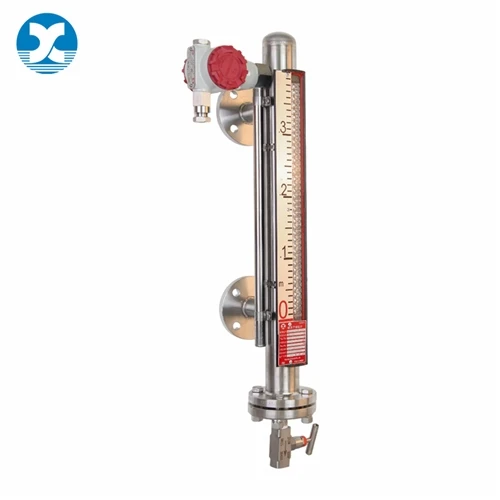
Pick up any magnetic level gauge brochure and you'll see two options listed in the spec table: reed switch alarms, or a 4-20 mA transmitter. Both bolt onto the same bypass chamber, both read the same float, and both send a signal back to your control system. Yet they are not interchangeable, and choosing wrong means either paying for capability you'll never use, or discovering too late that your "level signal" can't actually do what the process needs.
The question isn't which one is better. It's which one matches the job. This guide walks through how each works, what it can and can't tell you, what it costs, and how to make the call before you place the order.
First, What Each Option Actually Does
Reed Switch – A Trip Point, Not a Reading
A reed switch alarm is a discrete device. A sealed glass reed contact sits in a small module clamped to the outside of the gauge chamber, positioned at a preset elevation. When the float's magnet passes that point, the reed contacts open or close, and your circuit sees a state change.
That's the whole story. The switch tells you one thing: the level has crossed this line. It gives no information about how far above or below the level sits. It's a yes/no answer to a specific question-"is the tank above 85%?"-and it answers that question with the same dry-contact simplicity as a relay.
You can stack multiple switches at different elevations. High level, low level, high-high, low-low. Each one is independently positioned and independently wired. But each one remains a point, not a curve.
4-20 mA Transmitter – A Continuous Value
A 4-20 mA output comes from a transmitter module that tracks the float's position continuously and converts it into an analog current signal. Four milliamps equals your zero point, 20 milliamps equals your full span, and everything between is a proportional level reading.
The control system sees a live number. It can trend it, log it, display it on a SCADA screen, and feed it into control logic that responds proportionally rather than just at a trip line. The transmitter gives you the curve, not just the crossing.
The Shared Foundation
Here's what trips up a lot of buyers: both options sit on the exact same magnetic level gauge. Same float, same bypass chamber, same local indicator flags. The difference is only in what reads the float position and what happens with that information. So you're not choosing between two different instruments-you're choosing between two output strategies for the same instrument family.
What Each Configuration Is Best At
Reed Switch Wins for Pure Alarm Duty
If your requirement is protection, the reed switch is hard to beat. Overfill prevention, pump dry-run cut-off, tank-full warning, interlock input for a valve or feeder-these are all point-level jobs, and a reed switch does them directly.
The advantages are practical ones:
- Zero power draw at the sensing point. The float magnet actuates the reed mechanically. No loop power, no transmitter electronics, no signal conditioning.
- Independent setpoints. Each switch sits at its own elevation and wires to its own circuit. Your high alarm can feed the DCS while the high-high alarm drops a hardwired relay directly.
- True redundancy. A reed switch alarm is a physically separate path from any transmitter. If the transmitter drifts or dies, the switches keep protecting the tank.
- Fail-safe wiring. Using the normally closed contact, a broken cable or dead switch opens the circuit and trips the alarm. The system fails toward "call for help."
For safety-related duties, that independence is the whole point. You don't want your only overfill protection riding on the same electronics that everything else depends on.
4-20 mA Wins When You Need the Number
The transmitter earns its keep the moment the process needs continuous level data. Level trending over a shift, inventory reconciliation at month-end, batch quantity calculation, proportional pump control, remote level monitoring on a control room screen-all of these require a live value, not a trip point.
The 4-20 mA signal is also the universal analog standard. Every PLC, DCS, and recorder on the market has an analog input card that reads it. Integration is plug-and-play in a way that even digital protocols rarely match. And with HART overlaying the current loop, you get digital diagnostics and remote configuration on top of the analog reading.
If your team wants to watch the tank level from the control room and react before it hits an alarm, you need the transmitter. Switches can't give you that visibility.
The Cost Reality Check
Upfront Hardware
The transmitter module costs more than a reed switch module. That gap is real and it repeats across multiple tanks. On a tank farm with twenty vessels, the difference adds up.
But the wiring math cuts the other way. A single 4-20 mA transmitter needs one wire pair back to the panel. Three reed switches need three wire pairs. On long cable runs, or in a congested cable tray, that wiring cost can close the hardware gap entirely-or flip it.
Commissioning and Maintenance
A reed switch needs almost no commissioning. Position it, wire it, test it, done. No scaling, no zero/span trim, no loop calibration. A 4-20 mA transmitter needs loop checking, span verification, and periodic calibration on a schedule, which means instrument tech hours over the life of the installation.
The Hidden Labor Question
The real cost variable is often your own operation. If your team currently walks between tanks logging levels by hand, the labour hours spent doing that every week will quickly outweigh the price difference of adding transmitters. Run that calculation before you decide. It's the number most buyers skip.
Technical Limits You Should Know Before Choosing
Reed Switch Resolution Is Fixed
A reed chain gives stepped output, not a smooth curve. Each reed switch represents a discrete position along the tube. The resolution equals the spacing between switches, typically 5 to 20 mm. For general alarm duty that's irrelevant. For precision inventory or tight batch control, it's not enough.
Reed Contacts Have Current Limits
Reed contacts are small. They're rated for signal-level current, typically well under one amp. You cannot switch a pump, a large horn, or a solenoid valve directly through them. Every safety circuit needs an interposing relay or a PLC input between the reed contact and the real load. Forgetting this is the classic way to weld a contact shut and disable your alarm.
The 4-20 mA Loop Has Limits Too
A current loop isn't unlimited. Long cable runs add resistance, and if total loop resistance exceeds the transmitter's spec, the signal drops out of range. Add a couple of series devices-a display, a barrier, a recorder-and the budget gets tighter. Check the transmitter datasheet for maximum loop resistance before designing your wiring.
Both Depend on the Float
This is the point that applies to everything: both options read the same float. If the media is viscous, heavily fouling, or full of suspended solids, the float can stick, and neither the switch nor the transmitter will know the real level. In those services, the output type isn't your problem. The instrument technology is. Don't solve that by upgrading the electronics.
Real-World Selection Logic
H3: Choose Reed Switch When
- The application is alarm or interlock duty, not continuous monitoring
- You want hardwired, independent safety paths that don't rely on the transmitter electronics
- The tank is in a remote or low-power location
- You're on a budget and wiring runs are short
- Your team responds to alarms manually rather than through automated control
Choose 4-20 mA When
- Control room operators need to see the level live
- The process uses proportional control, batch recipes, or inventory tracking
- You need trend data or level logging over time
- The tank feeds an automated sequence where the level value drives decisions
- You want HART diagnostics and remote configuration
The Hybrid Most Plants Land On
Here's the honest answer about what most experienced teams actually specify: both. Reed switches carry the safety-critical trip points-overfill, dry-run, high-high shutdown-because they're independent, fail-safe, and don't care what the transmitter is doing. A 4-20 mA transmitter carries the continuous level value for visibility and control, because switches can't give you a number.
It costs more than switches alone and less than you'd think, because you're not adding a second instrument-you're adding a second output path on the same gauge. On a safety-reviewed tank, that dual path is often exactly what the design requires.
Common Mistakes to Avoid
The first is buying a transmitter when the tank only needs a trip point. You end up paying for continuous capability, commissioning time, and calibration labour that the operation never uses.
The second is relying on switches alone when the process needs the level value. If the control system must react proportionally or log trends, switches can't deliver it, and you'll retrofit a transmitter later at higher cost.
The third is wiring reed contacts directly to heavy loads. It fails, it welds, and it takes your alarm down with it. Use a relay.
The fourth is forgetting the float limitation. Neither option fixes a sticky float in fouling media. Address the service condition, not the output type.
A Simple Way to Decide
Ask one question: does this tank need a number, or does it need a line?
A line-high level, low level, a defined trip point-means reed switch. A number-continuous level for control, logging, inventory-means 4-20 mA. Both lines and numbers? Fit both. It's not over-engineering. It's matching each output to the job it does best.
Conclusion
The choice between 4-20 mA output and reed switch on a magnetic level gauge is a choice between continuous measurement and discrete protection. The transmitter gives you a live level value for visibility and control. The reed switch gives you independent, fail-safe trip points for protection and interlock duty. They're not competitors; they serve different functions on the same instrument.
Cost, wiring, and your own operational workflow all play into the decision, but the starting point is always the same: what does the process actually need to know? Answer that honestly, and the spec writes itself. Most plants settle on a hybrid-switches protecting the tank, a transmitter informing the system-because that's what the job demands.
If you're specifying a magnetic level gauge and want to talk through the output strategy for your tanks, share your application details-media, tank size, alarm requirements, control architecture-and our team will map the right configuration. Visit our magnetic level gauge page: /magnetic-level-gauge.html to review options, materials, and available outputs.
References
- IEC 62246-1, Reed switches – Generic specification for reed contact devices
- IEC 62246-4, Reed switches – Application guidance for magnet-actuated reed sensors
- ANSI/ISA-50.00.01, Compatibility of analog signals for electronic industrial process instruments
- IEC 61511, Functional safety – Safety instrumented systems for the process industry
- Manufacturer operation and maintenance manuals for magnetic level gauges, reed switches, and 4-20 mA transmitters