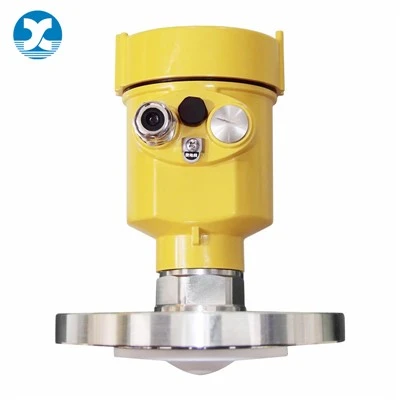
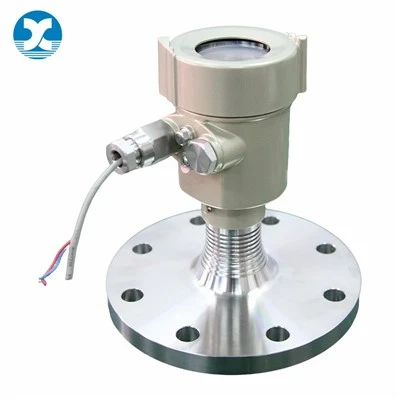
Radar level meters are measuring instruments based on the time-of-flight principle. With their advantages of non-contact measurement, strong anti-interference capabilities, high precision, low maintenance, and long lifespan, they have gradually become the preferred equipment in many liquid level measurement scenarios.
Radar level meters come in frequencies such as 6GHz, 26GHz, 80GHz, and 120GHz. Broadly speaking, radar level meters can also be divided into high-frequency and low-frequency types. 26G and 80G radar level meters are two common types. The main differences between 26G and 80G radar level meters lie in their modulation frequency, wavelength, measurement accuracy, resolution, and blind zone. Generally, higher frequency radar level meters are more expensive.
Modulation Frequency and Wavelength
Microwaves refer to the range of electromagnetic waves with frequencies from 300MHz to 300GHz, with corresponding wavelengths from 1mm to 1m. The electromagnetic spectrum includes three bands: decimeter waves (frequency range 300MHz~3GHz), centimeter waves (frequency range 3~30GHz), and millimeter waves (frequency range 30~300GHz).
The relationship between wavelength and frequency (c = λf, where c is the speed of light) is as follows:
26G radar level gauges:
Modulation frequency is generally between 24 and 26 GHz, wavelength is approximately 11.5 mm, belonging to the centimeter wave band.

80G radar level gauges:
Modulation frequency is generally between 78 and 82 GHz, wavelength is approximately 3.75 mm, belonging to the millimeter wave band.

Measurement Accuracy and Resolution
Generally, the higher the frequency (shorter the wavelength) of the radar, the higher its spatial resolution.
26G Radar Level Gauge:
This belongs to pulse radar (PTOF). The working principle of pulse radar is similar to "sonar detection": the transmitting unit periodically emits high-frequency pulse signals with extremely short durations (usually on the nanosecond level). After the pulse reaches the surface of the medium and is reflected, the receiving unit records the time difference (Δt) between transmission and reception, and then calculates the liquid level using the formula "distance = (speed of light × Δt) / 2". Its circuit design is relatively simple and the cost is low, but it is limited by the pulse width, has a blind zone at close range (usually 0.3-1m), and has low range resolution (generally ±5mm). It is suitable for scenarios with a wide measurement range and low accuracy requirements.
80G Radar Level Gauge:
This belongs to frequency-modulated continuous wave radar (FMCW). It transmits a continuous wave signal with a frequency that changes linearly with time, and the transmission frequency has a sawtooth or triangular wave relationship with time. When the echo signal is received, the transmission frequency has changed. The liquid level is calculated by measuring the frequency difference (Δf) between the transmitted and echoed waves, utilizing the property that "Δf is proportional to distance." Because it uses continuous wave signals, FMCW radar has a small blind zone, a range resolution of ±1mm, and stronger anti-interference capabilities, effectively distinguishing the echo from the liquid surface and nearby obstacles. However, its circuitry is complex and its cost is relatively high, making it suitable for high-precision or short-range measurement scenarios.
Beam Angle
A significant advantage of high-frequency microwaves is their extremely small beam angle. 80GHz radar typically has a beam angle of only 3°-5°, while 26GHz radar reaches 10°-15°. In confined spaces or complex conditions with obstacles, 80GHz radar can better focus on the liquid surface, reducing interference from container walls or other internal structures. This characteristic makes it perform exceptionally well in small storage tanks or when installed close to the tank wall.
Antenna Type
80GHz radar typically uses a planar matrix antenna. Compared to the horn-shaped antenna commonly used in 26GHz radar, it has stronger resistance to interference factors such as dust, steam, and condensation, and can maintain stable operation even under harsh conditions. For example, in agitated conditions, eddies, foam, splashing, and even false interfaces can occur on the liquid surface, placing extremely high demands on the anti-interference capability and signal focusing of the measuring equipment. 80GHz high-frequency radar, with its short wavelength, narrow beam, and strong signal penetration characteristics, combined with advanced signal processing technology, has become the mainstream solution for liquid level measurement in agitated tanks.
How to Choose Between 80GHz and 26GHz?
Situations where 80GHz radar level gauge is preferred:
Complex processes: The tank contains obstructions such as agitators, heating coils, and ladders.
Miniaturized containers: Reactors, small storage tanks, process vessels (diameter less than 1 meter).
Complex media characteristics: Liquids/solids that are prone to foaming, evaporation leading to condensation, or have low dielectric constants.
High-precision metering required: Used for trade settlement, precise batching, etc.
Limited installation conditions: Insufficient short pipe length, or unwilling/unable to install waveguides.
Solid material measurement, especially low dielectric constant particles and powders.
Situations where a 26GHz radar level gauge is preferred:
Standard large storage tanks: such as reservoirs, crude oil storage tanks, sewage pools, etc., with simple internal structures.
Limited cost budget and simple operating conditions without special challenges.
Measuring common liquids (water, oil, acids, alkalis, etc.) and slurries with high dielectric constants.
Summary
In general, 80GHz radar level gauges, with their superior focusing ability and anti-interference performance, are becoming the preferred choice for an increasing number of applications, especially in process industries and complex operating conditions. They reduce the total lifecycle cost through smarter installation and more stable measurement. Meanwhile, 26GHz radar level gauges, as a mature and reliable technology, still maintain strong viability in many standard and simple level measurement applications due to their economic advantages.
Radar level gauges are not necessarily better the higher the frequency, nor are they necessarily worse the lower the frequency. When making a selection, factors such as the complexity of the working conditions, accuracy requirements, installation conditions, media characteristics, and project budget should be considered comprehensively. The most suitable option is the one that is right for your working conditions.