If you have spent any time troubleshooting tank level instrumentation in process plants, you already know the value of a standard magnetic level gauge. It delivers clear, instant local visual indication, runs on simple magnetic coupling, and holds up reliably in high-temp, high-pressure liquid service. But traditional wired 4–20 mA remote transmitters create real pain points: lengthy cable runs, conduit routing, expensive hazardous-area wiring approvals, and extra labour when retrofitting older tanks. This is where the WirelessHART magnetic level gauge earns its place.
This instrument keeps the trusted mechanical magnetic display intact, while adding a certified WirelessHART transmitter module. The module pushes level readings, diagnostic flags and alarm signals back to your DCS, SCADA or asset management host - no hardwired field cable required. This is not some generic aftermarket wireless add-on. It follows the IEC 62591 WirelessHART standard, built exclusively for process automation, with mesh routing, adaptive channel hopping, AES-128 encryption and time-slotted communication engineered for electrically noisy plant environments.
For plant supervisors, EPC teams and system integrators, the core appeal is easy to see. You keep the local sight reference your field operators rely on, and dodge the heavy cost and schedule risk of pulling new instrument wiring through a live facility. WirelessHART is not a one-size-fix-all solution, though. In this post, we will walk through how these gauges operate, what separates them from other wireless level sensors, their biggest advantages, hard practical limits, and the field scenarios where they make the strongest technical and financial sense.
How a WirelessHART Magnetic Level Gauge Works
Core Magnetic Level Gauge Mechanics
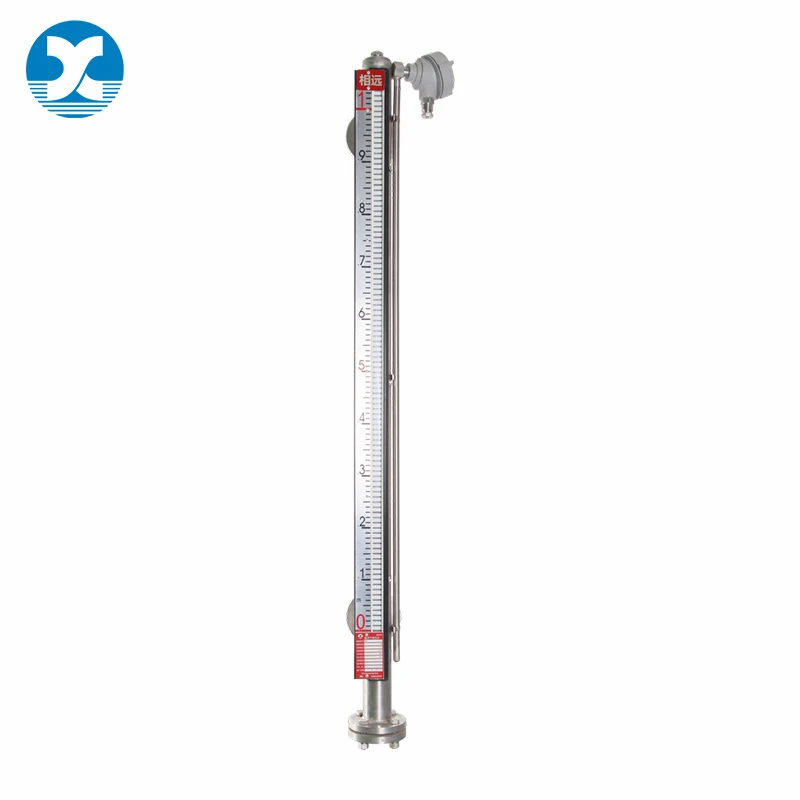
The base measurement principle stays identical to a conventional magnetic level gauge. A sealed float fitted with a permanent magnet rides up and down inside a bypass chamber mounted parallel to the process tank. As the liquid level shifts, the float follows the liquid surface. Its magnetic field passes through the chamber wall to flip the bi-colour indicator flaps on the gauge exterior, giving operators a continuous, at-a-glance visual reading.
This local display is fully passive. It works whether the wireless module has power, whether the network is online, or even during a full site power outage. That built-in redundancy is exactly why process engineers keep choosing magnetic level gauges for critical tank service, unlike radar, ultrasonic or guided-wave transmitters that go blind the second power or communications drop out.
The WirelessHART Transmitter Module
The WirelessHART transmitter mounts on the gauge housing, usually at the top or side of the bypass assembly. It tracks float position via an integrated reed chain or magnetostrictive sensing array along the measuring tube, converts that position into a calibrated level value, and packages the data into standard HART commands.
Instead of modulating a 4–20 mA current loop, the transmitter sends data packets across the 2.4 GHz ISM band using WirelessHART's TDMA, channel-hopping mesh protocol. Every WirelessHART device can double as a router. If direct line of sight to the gateway is blocked by pipe racks, concrete bulkheads or large pressure vessels, neighbouring instruments relay packets until they reach the WirelessHART gateway. This self-healing mesh behaviour sets WirelessHART apart from simpler point-to-point wireless options like LoRaWAN or Bluetooth, which lack native mesh routing built for dense process plant layouts.
Most field units run on long-life lithium battery packs. Many models offer multi-year service windows before a battery swap is needed, removing the requirement for hardwired 24 VDC power right at the tank.
End-to-End Data Flow
Level measurements, device health status, high/low level alarms, and optional temperature readings travel from the gauge through the mesh network to the WirelessHART gateway. The gateway then translates these HART variables into Modbus, OPC UA or native DCS protocol for your control system. Your control room team receives the same process variables they would get from a wired HART transmitter - minus the copper loop.
Key Benefits of WirelessHART Magnetic Level Gauges
Slash Installation Costs and Retrofit Risk
Instrument wiring is often the single largest expense when adding new level points to an existing plant. Conduit, cable, cable trays, explosion-proof junction boxes, skilled labour and inspection sign-offs add up fast. Brownfield installations bring extra headaches: hot work permits, narrow shutdown windows, and constant coordination with active production.
A WirelessHART magnetic level gauge cuts out all that field wiring work. You mount the bypass chamber, commission the wireless device to your existing WirelessHART gateway, and start capturing data. That makes it a natural fit for tank farms, remote storage yards or scattered vessels where running cable is impractical or cost-prohibitive. Many teams deploy these gauges to add secondary redundant level points on API 650 storage tanks without touching existing instrument wiring infrastructure.
Built-In Redundancy: Local Visual Read + Digital Remote Data
Most wireless level transmitters only feed a digital signal back to the control room. If the radio fails, the gateway drops offline or the battery dies, you lose all visibility. The WirelessHART magnetic level gauge avoids this single point of failure. The mechanical indicator continues showing liquid level for operators doing rounds, completely independent of electronics, battery state or network health.
This matters a lot for safety-focused tank monitoring, spill prevention and overfill alarm duties. Maintenance crews can still take manual readings during network outages, and the control system resumes logging automatically once communications recover.
Robust, Security-Focused Industrial Wireless
WirelessHART was built for process automation, not office IT networks. It uses AES-128 encryption for all wireless traffic, device whitelisting to authenticate new devices joining the network, and scheduled time slots that cut down on signal collisions and interference from nearby VFDs, two-way radios and heavy electrical gear. Channel hopping lets devices automatically shift away from congested frequencies - a critical feature in chemical plants and refineries where RF noise is persistent.
Since it is a HART variant, it also supports familiar device diagnostics. You can pull standard HART status codes, track battery voltage, watch link margin, and flag drift or stuck-float conditions directly from your asset management software. This is a clear contrast to consumer-grade IoT wireless, which rarely includes standardized diagnostic reporting.
Simple Scaling on Existing WirelessHART Infrastructure
If your site already runs a WirelessHART gateway for pressure, temperature or valve position transmitters, adding magnetic level gauges is straightforward. They join the same mesh alongside your other WirelessHART instruments. No separate cloud platform, independent radio hardware or cellular plan is required for each tank.
This is one of its strongest selling points for facilities already invested in the FieldComm Group HART ecosystem. Configuration workflows, host integration and maintenance training stay consistent across your entire wireless instrument fleet.
Low Ongoing Maintenance and Long Field Life
Quality WirelessHART magnetic level gauges use sealed, low-power radio modules. Standard battery packs deliver multiple years of service at typical update rates, and replacement is simple - no tank shutdown required. Without loop wiring to corrode, splices to fail or intrinsic safety barriers to inspect, routine maintenance narrows down to visual indicator checks and periodic battery health reviews.
One caveat: update rate directly impacts battery life. Faster publish intervals drain power quicker. Most users set 30-second to 5-minute cycles for supervisory tank monitoring, rather than sub-second rates reserved for closed-loop control.
Realistic Limitations You Need to Understand
WirelessHART magnetic level gauges are capable, but they are not suited for every level application. Knowing these boundaries keeps you from costly mis-specification.
First, WirelessHART is designed primarily for supervisory monitoring, not fast closed-loop regulatory control. The mesh network carries variable latency. If you need tight, deterministic control of a feed valve responding to level changes, a wired 4–20 mA HART transmitter remains the better choice.
Second, RF performance depends heavily on site layout. Thick steel vessel walls, dense pipe racks and heavy metal structures will reduce link margin. Always complete an RF site survey before deployment, especially in crowded tank farms. As a rule of thumb, target a link margin of at least 10–15 dB to account for seasonal weather, new equipment and shifting obstructions over time.
Third, like all magnetic level gauges, it has media constraints. Fluids carrying heavy suspended solids can coat the float or bypass chamber, slowing float travel and causing sticking. Very low specific gravity fluids demand custom float designs. Strong nearby magnetic fields can disrupt magnetic coupling and sensor readings, so avoid mounting close to large transformers or heavy electrical magnets.
Battery replacement scheduling is another operational item to plan for. Build battery swaps into your preventive maintenance schedule, rather than assuming the device runs indefinitely.
Common Applications for WirelessHART Magnetic Level Gauges
Its sweet spot is continuous level monitoring where you want both local operator sight and remote digital data, and wired cabling is difficult to install. Bulk chemical storage tanks, wastewater basins, fuel oil tanks, remote wellsite separators and LPG buffer tanks all fit well. Many EPC teams also specify them for secondary overfill protection loops as an independent, diverse level measurement, separate from a primary radar or pressure transmitter.
They are also popular for legacy tank sites where operators want to add digital monitoring without opening hazardous electrical permits or pulling new conduit. Food and beverage, pulp and paper, and general chemical facilities regularly deploy these gauges for non-critical up to SIL-2 capable supervisory monitoring, depending on the device certification package.
Practical Selection and Commissioning Checklist
Before ordering or commissioning a WirelessHART magnetic level gauge, work through these points with your vendor:
Confirm process temperature, pressure, fluid specific gravity and wetted material compatibility (316L, Hastelloy C-276, PTFE liner as required).
Verify the transmitter carries official WirelessHART certification to IEC 62591, not a proprietary wireless knock-off.
Match the update interval to your use case, balancing responsiveness against battery service life.
Run an RF site survey to map gateway placement and router instrument locations.
Define exactly which HART variables you need: level, float temperature, device status, alarm bits.
Confirm compatibility with your existing WirelessHART gateway and DCS/OPC server.
Validate local indicator function separately from wireless communications during startup.
Final Thoughts
A WirelessHART magnetic level gauge combines the proven mechanical reliability of a magnetic level gauge with the flexibility of standardized industrial wireless. It gives you two independent sources of level information: the simple, fail-safe visual display for field operators, and HART digital data for the control room, asset management platform and data historian.
It will not replace wired transmitters for fast closed-loop control, but for tank farm monitoring, brownfield retrofits, remote vessels and redundant safety monitoring, it often delivers the strongest total cost of ownership for the project. If your site already operates a WirelessHART network, it becomes an even more compelling upgrade path. Specified correctly, paired with an RF survey and realistic battery maintenance plan, it removes much of the wiring friction that slows expansion of level monitoring points.
References
- IEC 62591:2010, Industrial communication networks – Wireless communication network and communication profiles – WirelessHART, International Electrotechnical Commission
- FieldComm Group, HART 7.9 Specification Suite, WirelessHART Network Management Specification
- ISA, Automation Network Selection, Chapter 3: Introduction to Industrial Networks, ISA Technical Resources
- NIST, A Simulation Framework for Industrial Wireless Networks and Process Control Systems, WirelessHART and ISA100 performance guidance
- Lamont Controls, Installation Best Practices for Magnetic Level Gauges, Field calibration and indicator verification guidance