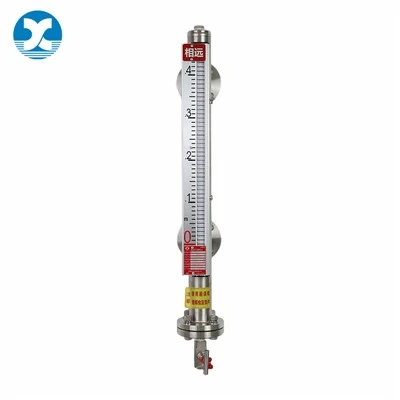
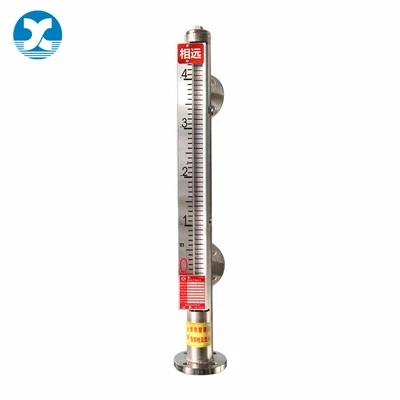
Product Overview
The Monel Magnetic Level Gauge is our side-mounted magnetic level indicator built with Monel 400 wetted parts - chamber pipe, flanges, and float - for plants running hydrofluoric acid, caustic soda, seawater, or other media that chew through stainless steel but don't necessarily need a nickel-molybdenum-chromium alloy like Hastelloy.
Monel 400 is a nickel-copper alloy (roughly 65% Ni / 32% Cu), and its corrosion behavior is genuinely different from stainless steel or Hastelloy - it's not just "another premium metal option." It holds up very well in non-oxidizing acids and alkaline environments, and it's one of the few materials that resists hydrofluoric acid across almost the full concentration range at moderate temperatures. That's a specific niche that stainless steel and even some higher-alloy materials don't cover well. The gauge itself uses the same communicating-tube, pressureless-float design as the rest of our range - what changes is the alloy, not the measuring principle.
Why Choose Monel Magnetic Level Gauge
- Built for hydrofluoric acid and alkaline service, specifically
If your process involves HF acid - alkylation units, HF pickling, glass etching - Monel is often the practical choice. Stainless steel corrodes quickly in HF, and while Hastelloy handles a broader range of oxidizing acids, Monel's resistance to HF specifically is harder to beat pound for pound.
- Strong performance in caustic and seawater environments
Monel doesn't stress-crack in caustic soda the way some stainless grades can under certain concentration/temperature combinations, and it has a long track record in marine and offshore equipment exposed to seawater and brine. If your application sits somewhere between "standard stainless is not enough" and "I need full Hastelloy-grade resistance," Monel is frequently the right middle ground - and typically more cost-effective than Hastelloy for that same window of service.
- Good mechanical toughness, including at low temperature
Monel retains decent strength and toughness down to cryogenic temperatures, which is part of why it shows up in low-temperature process equipment as well as chemical service.
- Not a universal substitute - worth checking against your actual media
To be direct about it: Monel is not the better choice for oxidizing acids like nitric acid or oxidizing chloride environments - that's Hastelloy or stainless territory, not Monel. Picking the alloy should come down to what's actually in the line, not just "which one is more expensive/premium." Our team can help you cross-check your media against the right alloy before you order.
Key Features and Benefits
- Wetted parts (chamber pipe, flanges, float) in Monel 400, suited to hydrofluoric acid, caustic, and seawater/brine service
- Pressureless float - no mechanical or magnetic guide pins to wear out or seize
- Full magnetic level indication with no external power required - the flap/column display keeps working through power outages
- Low sensitivity to density shifts, which matters for interface work on close-density media pairs
- Reading is unaffected by pressure, vacuum, foam, or viscosity swings in the process
- Double-sided red/white flap or column gives a clear read from a distance without needing a light source
- Low-temperature version with anti-icing indicator, for cold or cryogenic-adjacent service
- Adjustable switches for high/low alarms and pump start/stop, plus optional 4-20mA reed transmitter output
- Eccentric drain outlet, so the float doesn't sit in the way when you're draining the chamber
- Pressure boundary welds done by code-certified welders
Technical Specifications
Below are complete technical specifications of our Monel 400 bypass magnetic level gauge, specially engineered for hydrofluoric acid, brine and marine corrosive environments. All alloy configurations, pressure classes and temperature ratings are listed for your precise model matching.
|
Parameter |
Specification |
|
Pressure / Temperature Class |
PN16 – PN250, CLASS150 – CLASS1500 |
|
Operating Principle |
Communicating tubes with magnetic float coupling induction |
|
Measurement Type |
Single liquid level / Liquid-liquid interface |
|
Mounting |
Vertical, center-to-center (C-C) |
|
Measuring Range |
Up to 5500 mm in one sectionLonger ranges built in 2 or more spliced sections |
|
Pipe Size |
14 × 14 / 57 mm, or 14 × 14 / 60.3 mm |
|
Pipe Connection Method |
Welding stud or necked-down welding |
|
Pipe Wall Thickness |
Set by pressure rating requirement |
|
Process Connections |
Flange: DN15–DN50, PN16–PN320 (½"–1½", 150#–1500#)Alternative: welded or threaded stud |
|
Vent |
None, or R½" threaded plug vent |
|
Drain |
R½" plug drain, or drain valve available on request |
|
Pipe Material |
Monel 400 |
|
Flange Material |
Monel 400 (matched to pipe material) |
|
Float Material |
Monel 400 |
|
Operating Temperature |
-40°C to +400°C |
|
Operating Pressure |
Up to 250 bar (16–250 bar depending on flange class) |
|
Minimum Media Density |
0.4 kg/dm³Interface measurement: density difference ≥ 0.2 kg/dm³ |
|
Bolts / Nuts |
Carbon steel, stainless steelMonel fasteners available where full alloy matching is required |
|
Gaskets |
PTFE (up to 200°C) / Metal graphite (up to 400°C) |
|
Indicator Rail |
Aluminium alloy, service temperature up to 400°C |
|
Flap / Column Material |
PA plastic (up to 120°C) / Aluminium alloy (up to 400°C) |
|
Scale |
Aluminium alloy or stainless steel |
|
Float Type |
Cylindrical, fully sealed, Monel construction |
|
Float Length |
Sized and customized to the actual process medium density |
Applications
- HF alkylation units in oil refining, where HF acid is present at process concentrations
- Caustic soda (NaOH) production and handling lines, including concentrated caustic at elevated temperature
- Seawater intake and treatment systems, offshore platforms, marine process skids
- Hydrofluoric acid pickling and glass etching processes
- Salt and brine processing
- Low-temperature process units where mechanical toughness at reduced temperature matters alongside corrosion resistance
- Any line currently running 316L where the plant has seen pitting or attack from HF, caustic, or chloride-bearing seawater service

Frequently Asked Questions
Q1: How is the Monel gauge different from the Hastelloy or stainless steel versions?
Same gauge design and dimensions across the board - the difference is the wetted material. Monel 400 is chosen specifically for HF acid, caustic, and seawater service. Hastelloy is the better call for oxidizing acids and heavy chloride/oxidizer combinations. Stainless (304/316L) covers general, less aggressive media. It really comes down to what's in the pipe.
Q2: Can I use Monel for oxidizing acid service, like nitric acid?
Not recommended. Monel performs poorly in oxidizing conditions compared to Hastelloy or even standard stainless in some cases. If nitric acid or similar oxidizers are present, we'd steer you toward Hastelloy or an appropriate stainless grade instead.
Q3: Why choose Monel over Hastelloy if my media is HF acid?
For HF acid specifically, Monel has a very strong track record and is often more cost-effective than Hastelloy for that exact service. Hastelloy is the broader-spectrum alloy; Monel is the more targeted (and usually more economical) choice when HF or caustic is the main concern.
Q4: Does the Monel float affect measurement accuracy or response time?
No - it's the same pressureless float design used across our stainless steel and Hastelloy gauges. Switching materials doesn't change how the float behaves or how quickly it responds to level changes; it only changes what the wetted parts can chemically withstand.
Q5: What's the pressure and temperature range for the Monel gauge?
Up to 250 bar and from -40°C to +400°C, same envelope as the rest of the product line, though your actual limits will depend on the flange class and gasket material selected for the order.
Q6: Is interface measurement possible with the Monel version?
Yes, as long as the density difference between the two media is at least 0.2 kg/dm³ - same requirement as our other magnetic level gauges.
Q7: Can switches or a 4-20mA transmitter be added to the Monel gauge?
Yes. Adjustable magnetic switches for alarms/pump control and reed-type 4-20mA transmitters are both compatible with this version.
Not Sure If Monel Is the Right Alloy for Your Process?
Material selection is really where these projects get won or lost - pick wrong and you're looking at premature corrosion; pick a higher alloy than you need and you've overspent. Send us your actual process details - the medium, concentration, density, operating pressure and temperature, and the range you need to measure - and we'll tell you honestly whether Monel, Hastelloy, or stainless steel is the right fit, then put together a proposal and quote, usually within 24 hours.
Contact our engineering team to discuss your Monel Magnetic Level Gauge requirements.
Hot Tags: monel magnetic level gauge, China monel magnetic level gauge manufacturers, suppliers, factory, carburetor float height tool, float level indicator, Side Mounted Magnetic Level Gauge, Top Mounted PVDF Magnetic Level Gauge, Top Mounted Stainless Steel Magnetic Level Gauge, Vacuum jacketed Magnetic level gauge