Product Overview
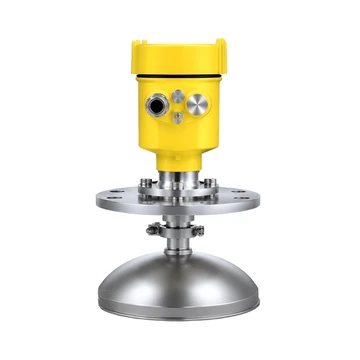
The 80GHz FMCW Radar Level Sensor with Parabolic Dish Antenna is engineered as a long-range, high-gain non-contact level transmitter for the most demanding solid bulk storage applications. Where conventional horn, lens and rod antenna radars begin to struggle - tall silos over 50 metres, severe dust clouds, internal structural interference - this model steps in with a parabolic reflector that concentrates microwave energy into an exceptionally tight beam and delivers signal gain far beyond what flat or curved surface antennas can achieve.
The result is a sensor that can accurately track material surfaces at distances up to 120 metres, reject false echoes from support beams and internal piping, and maintain measurement stability in environments where low-dielectric powders such as cement, fly ash and dry grain would normally cause signal loss on standard radar models. It is the go-to instrument for cement plants, grain elevators, mineral processing facilities and thermal power stations that need dependable inventory data from their largest vessels.
What Sets the Parabolic Antenna Apart
Choosing the right radar antenna for a silo is not a one-size-fits-all decision. The antenna geometry dictates beam width, signal gain, blind zone and susceptibility to internal obstructions - all of which determine whether a sensor will deliver usable data or noisy, drifting readings.
Lens antennas use a dielectric window to focus the beam. They work well in clean liquid tanks and moderate-height silos but their concave shape can trap dust and condensate, degrading performance over time in powder applications.
Horn antennas offer an open radiation path that resists material build-up. They are a solid general-purpose choice for medium-height silos and granular materials but their 3° beam, while narrow, still captures some wall reflections in very tall vessels.
Rod antennas are compact and fit through small nozzles.They perform well in confined-space liquid measurement but lack the gain needed for ultra-long-range solid detection.
Parabolic dish antennas take a fundamentally different approach. The curved reflector geometry acts like a satellite dish, reflecting and focusing microwave energy into the narrowest possible beam with the highest achievable gain at 80 GHz. This means:
Signal energy is directed precisely toward the material surface with minimal spread
Off-axis reflections from silo walls, brackets and internal structures are largely rejected
Weak echoes from low-dielectric, dry powders are amplified enough to produce a clean return signal
Measurement stability is maintained even at extreme distances where conventional radars lose lock
For silos exceeding 50 metres in height, or where internal structures create a complex echo environment, the parabolic antenna is not just an upgrade - it is often the only practical radar solution.
Engineering Highlights
Parabolic Reflector for Maximum Signal Gain
The precision-machined parabolic dish concentrates transmitted power into a tightly collimated beam. This high-gain configuration extends the effective detection range to 120 metres and improves the signal-to-noise ratio enough to resolve weak returns from dry, low-dielectric materials that would be invisible to lower-gain antennas.
3° Ultra-Narrow Beam for False Echo Rejection
The narrow beamwidth means the radar "sees" only what is directly ahead. Tank walls, support columns, level indicator rods and internal piping fall outside the beam envelope and do not generate false echoes. This is critical in tall silos where the round-trip time to the wall is long enough to be misinterpreted as a valid echo by less selective sensors.
Optional Pneumatic Seal & Air Purge System
In severely dusty environments - cement clinker handling, grain milling, mineral grinding - fine particulate can coat the dish surface and attenuate the signal over time. An optional compressed-air purge ring continuously blows clean air across the antenna face, keeping it free of deposits without requiring personnel to access the silo top for manual cleaning.
Wide Process Temperature Range
Operating from -40°C to +180°C, this sensor accommodates process conditions found in thermal power plants (hot ash handling), cement kiln circuits and chemically aggressive storage areas where standard instruments would exceed their thermal limits.
Intrinsic Safety for Hazardous Locations
The Ex ia IIC T6 Ga certification permits installation in Zone 0/1 flammable gas and dust atmospheres without additional explosion-proof enclosures, simplifying deployment in grain elevators, chemical powder plants and mining operations.
Rugged Industrial Construction
An IP67-rated aluminum alloy housing with anti-corrosion coating protects internal electronics from moisture, dust ingress and chemical vapours. The large-diameter flange connection provides mechanical stability for the dish assembly and seals reliably against process pressures up to 2.0 MPa.
Technical Specifications
This 80GHz parabolic antenna radar level sensor is professionally optimized for ultra-long-distance and high-interference tall silo working conditions. With ultra-narrow beam, high signal gain and strong anti-interference ability, it fills the performance gap of ordinary industrial radars in long-range solid measurement. All parameters comply with modern large-scale industrial engineering standards.
|
Parameter |
Specification |
|
Product Type |
80GHz FMCW Radar Level Sensor with Parabolic Dish Antenna (Non-contact) |
|
Working Frequency |
76GHz ~ 81GHz FMCW |
|
Applicable Media |
Cement, fly ash, lime, grain, mineral granules, various bulk solid powders |
|
Measuring Range |
0~120m |
|
Measuring Accuracy |
±5mm |
|
Beam Angle |
3° Ultra-Narrow Beam |
|
Antenna Type |
High-Gain Parabolic Dish Antenna |
|
Process Connection |
Large-Diameter Industrial Flange |
|
Process Temperature |
-40℃ ~ 180℃ |
|
Process Pressure |
-0.1MPa ~ 2.0MPa |
|
Housing Material |
Aluminum alloy anti-corrosion coating |
|
Power Supply |
2-wire DC 24V |
|
Signal Output |
4~20mA + HART / RS485 Modbus (optional) |
|
Protection Grade |
IP67 |
|
Explosion-Proof Grade |
Ex ia IIC T6 Ga |
|
Optional Configuration |
Antenna air purge device |
Parabolic vs. Horn vs. Lens vs. Rod - Quick Comparison
| Feature | Parabolic Dish | Horn | Lens | Rod |
|---|---|---|---|---|
| Best range | Up to 120 m | Up to 80 m | Up to 70 m | Up to 30 m |
| Beam angle | 3° ultra-narrow | 3° narrow | 5°–15° | 5°–15° |
| Signal gain | Very high | Moderate | Moderate | Low |
| Ideal for | Tall silos >50m, severe interference | Medium silos, general solids | Liquid tanks, clean solids | Small tanks, confined spaces |
| Blind zone | Very small | Small | Moderate | Very small |
| Anti-dust | Excellent (optional air purge) | Good | Fair | Good |
| Installation | Large flange required | Flange or thread | Flange or thread | Thread, small nozzle |
| Cost tier | Premium | Mid-range | Mid-range | Budget |
This comparison table helps buyers quickly identify which antenna type matches their specific vessel height, media characteristics and installation constraints.
Where This Sensor Delivers the Most Value
Cement & Building Materials
Ultra-high cement silos, fly ash storage bunkers and lime powder bins often exceed 60 metres in height. Internal support structures, vibration feeders and conveyor take-offs create a forest of false echoes for conventional radars. The parabolic dish's high gain and narrow beam cut through this interference pattern to deliver clean level data for inventory management and automated reclaim systems.
Grain & Feed Storage
Grain elevators and bulk feed storage facilities rely on accurate level data for stock management, first-in-first-out rotation and pest control monitoring. The parabolic radar handles dry, low-dielectric grains such as wheat, corn and soybeans with ease, and the optional air purge keeps the dish clean in flour-rich environments.
Mining & Mineral Processing
Ore crushers, mineral powder silos and limestone aggregate bins generate heavy dust and abrasive conditions. The parabolic radar's non-contact design means no wear parts in the process stream, while the high-gain antenna maintains lock on weak echoes from dry, coarse materials that attenuate radar signals significantly.
Thermal Power & Chemical
Ash silos at coal-fired power plants and chemical powder storage towers operate continuously under demanding thermal and chemical conditions. The wide temperature range (-40°C to 180°C) and intrinsic safety certification make this sensor suitable for these critical infrastructure applications where downtime is not an option.
Installation & Commissioning Notes
Proper installation is especially important for parabolic antenna radars due to the large dish size and directional sensitivity:
Mounting orientation. The dish must be installed perfectly level. Tilt angles greater than 2° can deflect the beam away from the material surface in tall vessels, causing signal loss.
Clear aperture. Ensure the silo top opening provides sufficient clearance around the dish perimeter. Obstructions within 300 mm of the dish edge can distort the radiation pattern.
Flange sealing. Use appropriate gasket material rated for the process temperature and pressure. The large-diameter flange requires evenly distributed bolt torque to prevent leakage.
Air purge connection. If ordering the optional purge system, route clean instrument air tubing to the rear connection port before mounting the sensor. Adjust flow rate to 0.5–1.0 L/min for optimal dust prevention without wasteful consumption.
Empty calibration. Perform tank empty calibration with the dish exposed to air (no material present). For filled calibration, use a known material level reference.
Echo map. Some advanced models support echo mapping - run a sweep during commissioning to identify and store fixed echo locations (brackets, stirrers) for automatic rejection.
Application Limitations
- This parabolic antenna model is purpose-built for ultra-tall solid silos and long-range bulk solid measurement. Using it on conventional small or medium liquid tanks is mechanically oversized and cost-ineffective - a lens or horn antenna model would be more appropriate.
- The large-diameter dish requires a correspondingly large flange nozzle and adequate overhead clearance. It is not suitable for narrow-necked vessels or confined installation spaces where a rod antenna would be more practical.
- For highly corrosive media (concentrated acids, caustic solutions), specify custom anti-corrosion coatings or lined constructions - standard aluminum alloy housing is suitable for general industrial environments.
- Media with extremely low dielectric constants (dry powders with εr < 1.5) may still produce weak echoes at the outer limits of the range; confirm minimum measurable range with your specific vessel geometry.
Customer Questions
Q1: How does a parabolic antenna radar differ from a horn antenna radar?
The horn antenna uses a flared waveguide structure to shape the beam, achieving a typical 3° spread. The parabolic dish uses a reflective curved surface to focus the energy, achieving the same nominal beam angle but with significantly higher gain - typically 15–20 dB more than a comparable horn. This gain advantage is what enables the 120 m range and reliable measurement of low-reflection materials at extreme distances.
Q2: Can this sensor measure dry, low-dielectric materials like cement powder or fly ash?
Yes - this is one of the parabolic radar's key strengths. The high-gain antenna amplifies weak echoes from low-dielectric powders, allowing stable measurement where standard radar sensors would report noisy or missing data. The optional air purge system further ensures consistent performance by keeping the dish surface free of accumulated dust.
Q3: Is the air purge system mandatory?
No. The sensor operates perfectly well without it in clean or moderately dusty environments. The air purge is recommended only for severely dusty applications where manual cleaning access is difficult or hazardous. It connects to a standard instrument air supply and consumes minimal compressed air.
Q4: Can I use this radar for liquid level measurement?
Technically yes - the radar signal reflects off liquid surfaces just fine. However, for most liquid tank applications, a lens or horn antenna model provides sufficient range and performance at a lower cost. The parabolic dish is over-specified for typical liquid storage and its large flange requirement may not fit standard liquid tank nozzles.
Q5: What maintenance does this sensor require?
In clean or moderately dusty environments, maintenance is minimal - essentially visual inspection once or twice per year. With the optional air purge installed, maintenance frequency drops further as the dish stays self-cleaning. No calibration drift is expected under normal operating conditions, but remote HART-based verification is available if needed.
All parameters listed above represent standard configurations. Final product specifications are tailored to your actual process conditions - including silo dimensions, medium type, dust density, operating temperature and pressure, and communication requirements. Please share your project details with our engineering team, and we will recommend the optimal parabolic antenna radar configuration and provide a competitive quotation.
Hot Tags: 80ghz parabolic dish radar level sensor | 120m long-range silo level transmitter, China 80ghz parabolic dish radar level sensor | 120m long-range silo level transmitter manufacturers, suppliers, factory