Product Overview
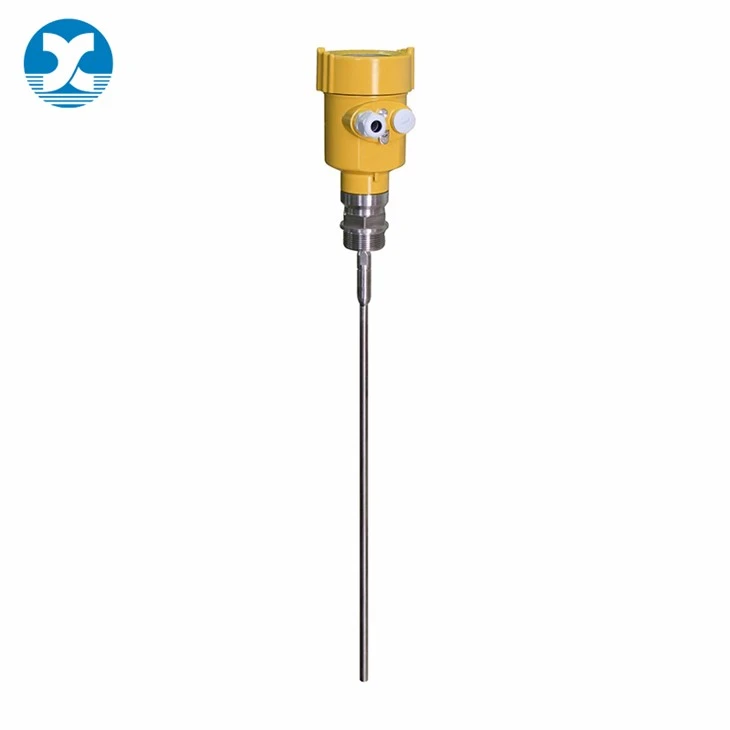
The 80GHz FMCW Radar Level Sensor with Rod Antenna is a compact, high-frequency non-contact level transmitter engineered for liquid measurement in space-constrained vessels. Unlike horn or lens antenna radars built for large storage tanks, this model uses a slim solid PTFE rod as its radiating element - a design choice that shrinks the installation footprint while concentrating the microwave energy into a tight beam.
The result is a sensor that fits through narrow tank nozzles as small as 2 inches, reaches down into short measurement zones with near-zero dead space, and maintains stable readings despite steam, light foam or gradual changes in liquid density. It is widely deployed in fine chemical dosing vessels, pharmaceutical process tanks, laboratory reactors and small-scale storage containers where traditional radar sensors simply cannot be mounted.
What Makes the Rod Antenna Design Different
When selecting an 80GHz radar for liquid level measurement, the antenna shape determines more than just beam pattern - it dictates where and how the sensor can be installed.
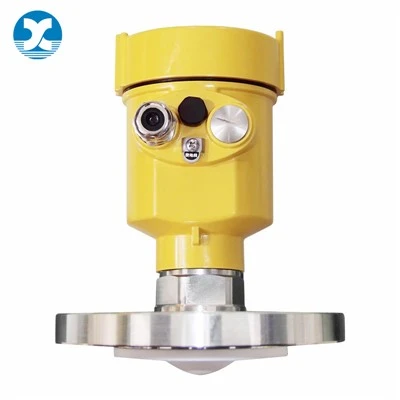
Horn antennas project a wider radiation cone and require a flange or large-thread opening. They in open silos and bulk solid handling but struggle in tight-necked containers.
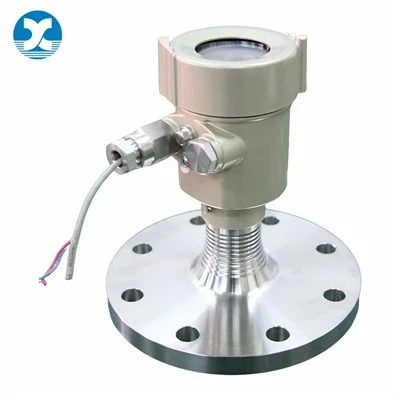
Lens antennas focus the beam through a dielectric window. They work well in large above-ground tanks but their concave surface can trap condensate or sticky residue, which is problematic in humid or product-splash environments.
Rod antennas take a completely different approach. The PTFE rod itself acts as both waveguide and radiating element. Its cylindrical geometry produces a narrowly focused beam while presenting a smooth, self-draining surface to the process. For small-diameter vessels where a flange mount is impractical and a lens radar would be over-engineered, the rod antenna offers the most pragmatic balance of performance and installability.
Core Advantages
Compact Form Factor for Confined Installations
The transmitter body and PTFE rod are designed to pass through standard 2-inch (NPT/BSP) tank nozzles. No flange welding, no custom brackets - just thread it in and seal. This makes retrofitting existing equipment faster and cheaper than replacing the tank or modifying the vessel head.
Near-Zero Dead Zone for Short-Range Precision
At 80GHz, the wavelength shrinks to roughly 3.75 mm. Combined with the rod antenna's geometry, the sensor's blind zone drops to just a few centimetres. That means the full tank depth - right down to the bottom - is measurable, even when the liquid level sits only a few inches above the nozzle. Traditional 26GHz pulse radars often lose the first 0.5–1 m of range to blind zone; this model recovers that lost stroke.
Stable Readings in Challenging Liquid Conditions
Steam, surface agitation, light foam and gradual density shifts are common in batch processing and reaction vessels. The 3° narrow beam of the 80GHz rod radar largely ignores these surface disturbances and reflects cleanly off the true liquid interface. The PTFE rod resists condensation build-up, so the signal path stays clear without manual wiping.
Chemical Compatibility for Mild Corrosive Liquids
The entire wetted surface of the antenna is PTFE - one of the most chemically inert engineering polymers available. It withstands weak acids, weak alkalis, solvents and most organic liquids encountered in fine chemical, dye-stuff and pharmaceutical manufacturing. For highly aggressive media (concentrated sulfuric acid, hydrofluoric acid, etc.), alternative materials such as Hastelloy or PFA-coated variants should be specified.
HART and Modbus Communication Options
Beyond the standard 4–20mA loop, the sensor supports HART protocol for remote configuration and diagnostics, and RS485 Modbus RTU for direct integration into PLC or SCADA networks. This flexibility avoids the need for separate protocol converters on site.
Intrinsic Safety for Hazardous Areas
The sensor carries Ex ia IIC T6 Ga intrinsic safety certification, permitting installation in Zone 0/1 flammable gas environments without additional explosion-proof enclosures.
Technical Specifications
This compact 80GHz rod antenna radar level sensor is optimized for small tanks, narrow nozzles and short-range high-precision measurement. With ultra-low blind zone, mini size and mild corrosion resistance, it fills the market gap of traditional radar in confined-space working conditions. All parameters meet modern fine chemical and pharmaceutical industrial standards.
|
Parameter |
Specification |
|
Product Type |
80GHz FMCW Radar Level Sensor with Rod Antenna (Non-contact) |
|
Working Frequency |
76GHz~81GHz FMCW |
|
Applicable Media |
Water, oil, solvents, weak acid and weak alkali mild corrosive liquids |
|
Measuring Range |
0~30m |
|
Measuring Accuracy |
±3mm |
|
Beam Angle |
3° Narrow Beam |
|
Antenna Type |
Integrated Solid PTFE Rod Antenna |
|
Process Connection |
NPT / BSP Thread |
|
Process Temperature |
-40℃ ~ 120℃ |
|
Process Pressure |
-0.1MPa ~ 1.6MPa |
|
Housing Material |
Aluminum alloy anti-corrosion coating |
|
Power Supply |
2-wire DC 24V |
|
Signal Output |
4~20mA + HART / RS485 Modbus (optional) |
|
Protection Grade |
IP67 |
|
Explosion-Proof Grade |
Ex ia IIC T6 Ga |
|
Electrical Entry |
M20×1.5 |
Where This Sensor Performs Best
Fine Chemical Manufacturing
Small reaction kettles, intermediate storage drums and dosing vessels often have limited top-access openings. The rod antenna's threaded mount and slim profile allow installation without vessel modification. PTFE compatibility covers most organic solvents and mild process liquids.
Pharmaceutical Process Tanks
Purified water storage, buffer solutions and solvent recovery tanks demand clean, non-contaminating level measurement. The smooth PTFE rod does not harbour bacteria and can be CIP-cleaned. Non-contact operation eliminates cross-contamination risk.
Water and Wastewater Treatment
Chemical dosing tanks, coagulant storage containers and small equalization basins benefit from the sensor's resistance to foam and surface turbulence. The IP67 housing handles outdoor or high-humidity plant rooms.
Laboratory and Pilot-Scale Equipment
Research reactors, bench-scale distillation columns and pilot-plant vessels frequently have non-standard geometries. The compact rod radar adapts to small nozzles and short measurement spans where larger radar models are impractical.
General Industrial Liquid Storage
Small above-ground tanks for lubricants, coolants, inks, adhesives and other process liquids can be instrumented quickly with the threaded rod radar, avoiding the cost and downtime of flange fabrication.
Application Limitations
- This rod antenna model is optimised for liquid level measurement. It is not recommended for dry bulk solids, powders or highly abrasive slurries, where a horn antenna or guided wave radar may perform better.
- The PTFE rod is suitable for mildly corrosive media only. For strong oxidising acids, hydrofluoric acid or highly caustic solutions, please consult our engineering team for material-compatible variants (e.g., Hastelloy or PFA-lined models).
- Ultra-high temperature (>120℃) or ultra-high pressure (>1.6 MPa) processes require customised high-spec radar models. Please provide your process conditions for a tailored recommendation.
- Media with very high dielectric constant (>15) may cause early signal saturation in extremely shallow tanks; confirm the minimum measurable range with your specific vessel geometry.
Frequently Asked Questions
Q1: Can I use this rod antenna radar for solid powder or granules?
This model is optimised for liquid level measurement. The slim rod antenna is not designed to handle the abrasion and build-up characteristics of dry bulk solids. For powders and granules, our horn antenna 80GHz radar is the recommended solution.
Q2: How does the rod antenna differ from a guided wave radar (GWR)?
A rod antenna radar is a non-contact device - the PTFE rod radiates microwaves through the air gap above the liquid. A guided wave radar uses a physical probe (rod or cable) that extends into the medium and measures the travel time of the microwave along the probe. The two technologies have different installation requirements, accuracy characteristics and suitability for specific process conditions.
Q3: What is the smallest tank nozzle this sensor can fit?
The standard NPT/BSP threaded connection fits common 2-inch (DN50) nozzles. For smaller openings, please contact our technical team for custom adapter options.
Q4: Does the sensor need calibration after installation?
Factory calibration is stored in the device memory. On-site calibration is usually not required, but the sensor supports remote HART-based calibration adjustment if process conditions change over time.
Q5: Can this radar handle viscous or sticky liquids?
Yes, provided the liquid does not coat the PTFE rod surface heavily. The smooth, non-stick nature of PTFE helps repel many sticky media. For highly viscous or polymerising liquids, periodic inspection or a heated jacket option may be advisable.
All parameters listed above represent standard configurations. Final product specifications are tailored to your actual process conditions - including medium type, tank geometry, operating temperature and pressure, and communication requirements. Please share your project details with our engineering team, and we will recommend the optimal rod antenna radar configuration and provide a competitive quotation.
Hot Tags: 80ghz fmcw radar level sensor with rod antenna – compact solution for small tanks & narrow nozzles, China 80ghz fmcw radar level sensor with rod antenna – compact solution for small tanks & narrow nozzles manufacturers, suppliers, factory, 26GHz Radar Level Sensor for Basic Applications, 80GHz Radar Level Sensor for Hydrographic process, Guided Wave Radar Bypass Tube Level Sensor, Guided Wave Radar Level Sensor, magnetic removable propane tank gauge, ultrasonic liquid level measurement