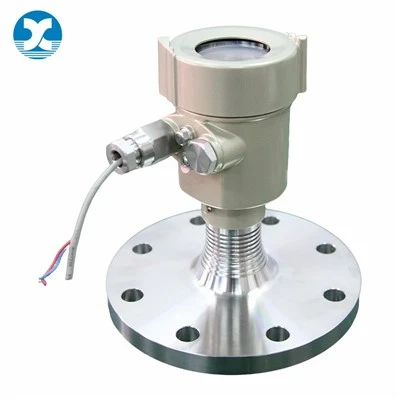
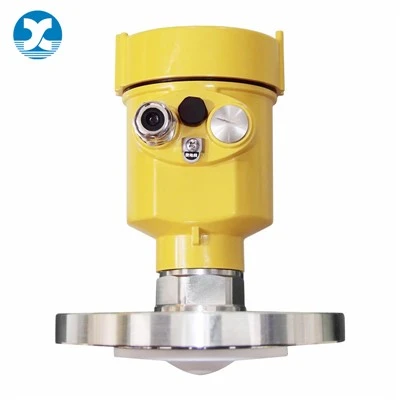
Why Choose Radar Level Transmitter for Liquid
Numerous industrial production sites require reliable liquid‑level monitoring for water, oil and mildly corrosive chemical fluids. Deploying high‑spec specialized radar devices designed for steam, high‑pressure or dusty silo conditions for these routine liquid applications often brings unnecessary feature overhead and higher project expenditure. Conventional ultrasonic instruments suffer from prominent blind‑zone limits and measurement deviation under liquid‑surface turbulence, while ordinary level transmitters cannot satisfy projects calling for high precision or extra‑long measuring span.
This liquid‑focused guided‑wave radar is purpose‑built for general‑purpose liquid working scenarios. Microwave pulses travel along the probe, rather than radiating freely through air, so signals remain concentrated and less disturbed by minor surface ripples or light vapour. Unlike 80 GHz non‑contact radar, whose performance is susceptible to subtle atmospheric changes, guided‑wave radar maintains consistent repeatability for daily liquid‑level tracking.
Positioned as our general‑use liquid‑level workhorse, this transmitter prioritizes high measuring accuracy, compact blind zone and wide range capacity. It covers the majority of non‑extreme liquid processes. Where applications involve strong corrosion, extreme temperature or heavy‑pressure service, our engineering team will recommend alternative suitable models from our product portfolio.
Key Features and Benefits
- Industry‑leading ±2 mm measuring precision for liquid media Delivers outstanding measurement resolution, capturing tiny liquid‑height variations. Well‑suited for fine inventory tally and closed‑loop liquid‑process control requirements.
- Extended measuring range up to 30 metres Handles deep liquid wells, extra‑tall vertical liquid tanks and large‑depth liquid containers that standard liquid‑level sensors cannot cover.
- Concentrated guided‑wave signal with strong anti‑interference capability 100MHz‑1.8GHz low‑frequency pulse radar propagates along the probe. Measurement remains stable in presence of mild liquid‑surface fluctuation, slight foam and light vapour, avoiding frequent data drift.
- Optimized ultra‑small blind‑zone performance Algorithm tuning minimises both top‑end and bottom‑end blind zones. Valid liquid‑level data can be obtained even when liquid is close to tank top or tank bottom.
- Flexible process connection for new build & retrofit projects Supports 3‑1/2‑inch thread and flange mounting options, matching standard nozzles of most liquid vessels, simplifying both new‑unit installation and legacy‑tank upgrade work.
- Multiple local & remote debugging approaches Equipped with on‑site LCD display plus physical keys for direct local setup. Bluetooth programmer and 5G remote network debugging are supported, bringing convenience for on‑site commissioning and remote equipment management.
Note: 5G remote debugging requires matching auxiliary gateway hardware, which is not built inside the transmitter.
- Flexible power supply and rich signal‑protocol options Works under 2‑wire / 4‑wire mode with DC24V or AC220V power input. Standard 4‑20 mA / HART output; RS‑485 Modbus is available, enabling seamless connection with PLC and DCS automation systems.
- Intrinsic‑safety explosion‑proof & reliable enclosure protection Ex ia IIC T6 Gb intrinsic‑safety rating fits hazardous liquid‑processing zones. IP67 housing offers solid defence against dust and moisture for indoor workshop and outdoor field deployment.
Technical Specifications
This guided‑wave radar transmitter is engineered for general‑purpose liquid‑level applications. Concentrated pulse‑signal design ensures dependable liquid‑height acquisition under common industrial liquid conditions. Full technical data are shown in the table below:
| Parameter | Specification |
|---|---|
| Application | Weakly‑corrosive liquids, water, oil products and general‑purpose liquid media |
| Measuring Range | 0‑30 m |
| Process Connection | 3‑1/2‑inch thread / flange |
| Display & Programming | LCD display, local key operation, Bluetooth programmer, 5G remote network debugging |
| Measuring Accuracy | ±2 mm |
| IP Protection Grade | IP67 |
| Working Frequency | 100 MHz‑1.8 GHz |
| Explosion‑proof Standard | Ex ia IIC T6 Gb |
| Signal Output | 4‑20 mA / HART (2‑wire standard); 4‑wire customized; RS‑485 Modbus protocol |
| Power Supply | 2‑wire / 4‑wire; DC24V / AC220V |
Applications
- Industrial oil storage vessels: Level monitoring for light‑oil storage tanks, oil intermediate containers and oil transfer buffer tanks, supporting daily stock management.
- Municipal water‑supply & circulating‑water tanks: Applied to clean‑water reservoirs, workshop circulating water pools and water‑treatment process tanks for continuous liquid‑level tracking.
- General‑chemical weakly‑corrosive liquid tanks: Suitable for tanks storing mildly corrosive solvent and chemical raw liquids within allowable medium scope.
- Deep liquid‑well and extra‑tall vertical liquid containers: Fits deep‑well liquid‑level measurement and over‑height liquid vessels where conventional transmitters cannot reach.
- Environmental‑protection intermediate liquid pools: Level measurement for regulating pools and intermediate storage tanks in wastewater‑treatment workshops for routine process supervision.
Note: For working conditions with strong‑corrosion medium, ultra‑high temperature or heavy‑pressure environment, please select other specialized transmitters from our product range.
Frequently Asked Questions
Q1: What is the main difference between this guided‑wave liquid radar and 80 GHz non‑contact radar for storage tanks?
A: This guided‑wave radar adopts contact measuring principle. Microwave pulses travel along the probe, providing outstanding precision for pure‑liquid scenarios, and it performs better when liquid surface has foam. Non‑contact 80 GHz radar is more oriented towards large storage tanks with vapour. Choose guided‑wave type when pursuing high‑precision liquid‑level reading for general‑purpose liquid media.
Q2: Can this transmitter work with foamy liquid surface?
A: It performs well for light foam over liquid surface. For thick, heavy foam layers, please share your on‑site medium information so our engineers evaluate whether alternative configuration is required.
Q3: Is 30 m measuring range available for practical site installation?
A: The 30 m range is the hardware‑supported maximum span. Actual effective measuring distance depends on probe selection and medium dielectric constant. Please provide tank height for our technical confirmation during inquiry.
Q4: Does 5G remote debugging require extra gateway hardware?
A: Yes, 5G remote network debugging function needs matching auxiliary gateway hardware. Please indicate your remote‑access requirement, we will list relevant accessories in quotation accordingly.
Q5: Can this unit be deployed for strong acid and strong alkali media?
A: This standard model targets weakly‑corrosive liquid only. For strong‑corrosive fluid, please refer to our corrosion‑resistant dedicated radar series.
If you are seeking stable, high‑precision level‑measurement instruments for general‑purpose liquid vessels, our Radar Level Transmitter for Liquid can meet most routine liquid‑monitoring demands. Please provide details including medium property, tank height, process connection requirement, power‑supply mode and signal‑output expectation. Our engineering team will check working‑condition compatibility and deliver factory quotation and technical proposal for you.
Hot Tags: radar level transmitter for liquid | low‑frequency guided wave level sensor, China radar level transmitter for liquid | low‑frequency guided wave level sensor manufacturers, suppliers, factory, 80GHz Radar Level Sensor, carb float height tool, float board type level gauge, guided radar level sensor, Guided Wave Radar Bypass Tube Level Sensor, ultrasonic liquid level measurement