When engineers and procurement teams specify temperature sensors for pipelines, reactors, furnaces and environmental control systems, one decision comes up time and again: pick a PT100 RTD, or go with a thermocouple. Both are staples of industrial contact temperature measurement. Even so, poor selection often leads to persistent measurement drift, endless calibration work and avoidable production downtime.
Many teams choose sensors based purely on upfront cost or old habits. They rarely match sensor capabilities to actual operating temperatures, precision targets and site conditions. A sensor that runs flawlessly on one production line can deliver inconsistent readings elsewhere, simply due to differences in vibration, electrical noise and temperature operating windows. This practical guide breaks down the core differences between PT100 and thermocouples, compares their strengths and limitations, includes a real field case, outlines suitable working scenarios and provides a clear pre-purchase checklist to prevent specification errors. All analysis follows international instrumentation standards and hands-on commissioning experience from industrial sites.
Basic Operating Principles
To understand performance gaps seen on site, start with how each sensor captures temperature data.
PT100 (Platinum Resistance Temperature Detector)
PT100 relies on a predictable trait of platinum: its resistance changes consistently with temperature. At 0°C, the platinum sensing element registers 100Ω. Resistance rises steadily as temperature increases. The control system sends a small excitation current and calculates temperature by tracking resistance variations.
PT100 outputs a resistance signal and cannot generate signals independently. External power is required to take measurements. Its resistance-temperature curve offers strong linearity. This simplifies signal processing and supports steady accuracy across its full working range.
Thermocouple
Thermocouples work on the Seebeck effect. Two dissimilar metal wires are welded together to form a measuring junction. When a temperature gap exists between the hot measuring tip and cold reference end, a tiny millivolt voltage forms along the circuit. Controllers convert this voltage difference into temperature values.
Thermocouples are passive sensors; they produce usable signals without external power supply. The catch is that measured voltage only reflects temperature difference between the two junctions. Reliable readings depend entirely on stable cold junction compensation, which adds extra complexity to wiring and controller configuration.
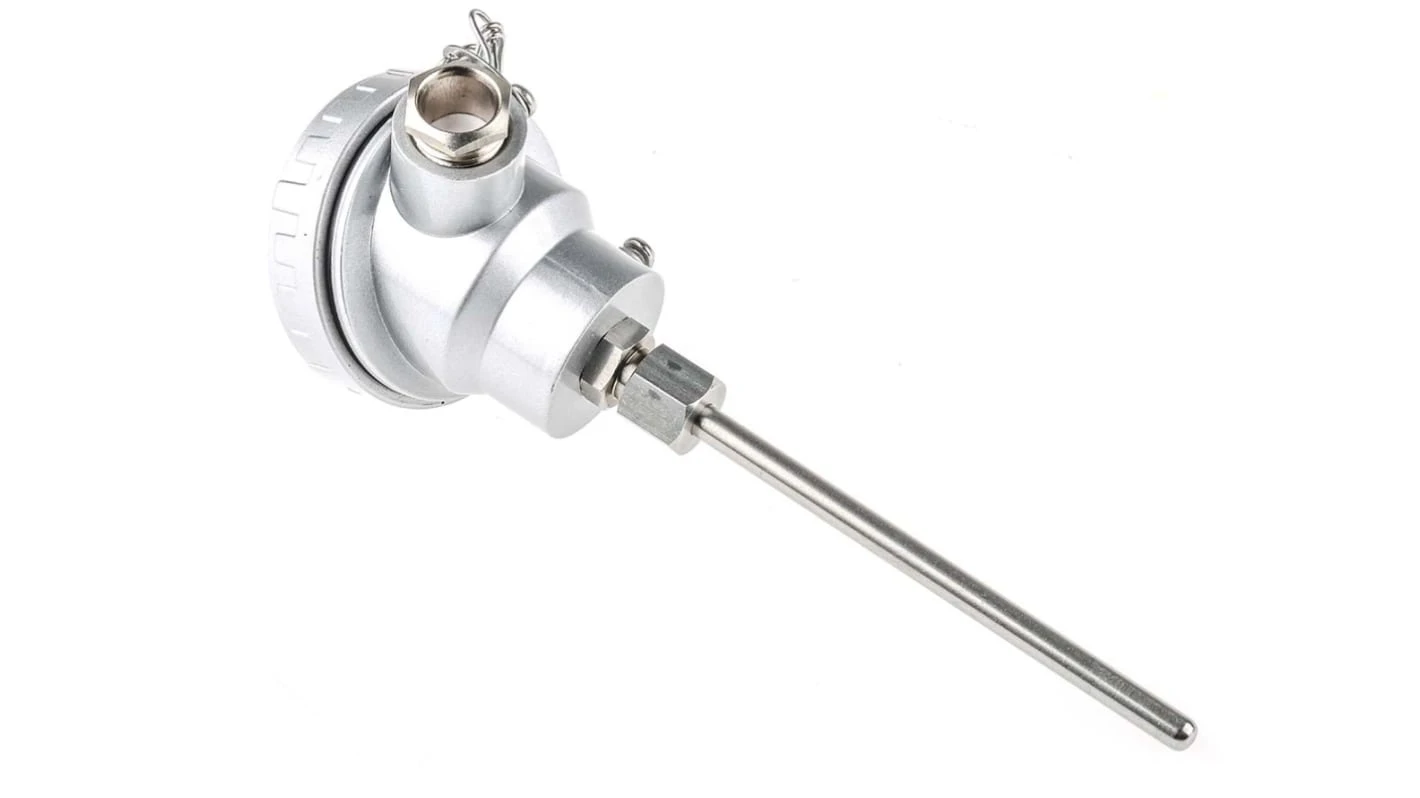
Core Performance Comparison Between PT100 and Thermocouple
Temperature Measurement Range
Standard PT100 covers -200°C to 600°C. Heavy-duty variants can push the upper limit to roughly 850°C. If exposed to continuous temperatures above this threshold, platinum elements oxidize gradually. Measurement drift worsens over time, and service life shortens dramatically.
Thermocouples support a far broader temperature spectrum. Common Type K thermocouples operate reliably from -200°C up to 1300°C. High-grade S-type and B-type models withstand continuous service above 1600°C. That makes them the only viable option for ultra-high-temperature processes including kilns, thermal treatment furnaces and high-temperature flue gas monitoring.
Accuracy and Long-Term Stability
PT100 delivers noticeably higher precision. Class A PT100 carries a tolerance of ±0.15°C at 0°C, while Class B reaches ±0.3°C. Platinum maintains stable material characteristics through long continuous operation, with minimal drift under suitable environmental conditions. This consistency matters for processes requiring repeatable temperature control and strict product quality standards.
Thermocouples offer moderate accuracy. Typical Type K probes have errors ranging from ±1°C to ±2.5°C. Alloy wires slowly oxidize under sustained high heat, triggering gradual measurement drift. Readings also shift easily if cold junction compensation fails or mismatched extension cables are installed. For high-precision closed-loop control, thermocouples frequently cannot meet tight tolerance requirements.
Response Speed and Vibration Resistance
Thermocouple sensing junctions can be built into small, compact structures. They react quickly to sharp temperature fluctuations. Mineral-insulated thermocouple probes are mechanically robust and hold up well under constant vibration on engine exhaust lines and heavy rotating machinery.
PT100 elements consist of fine platinum wire wound around ceramic cores. The internal structure is comparatively fragile. Persistent strong vibration may damage platinum windings, resulting in erratic signals or permanent sensor failure. PT100 also has greater thermal mass, so its response to sudden temperature shifts is noticeably slower than equivalent thermocouple probes.
Signal Transmission and Wiring Requirements
PT100 transmits resistance signals. Industry-standard three-wire or four-wire designs effectively offset resistance errors introduced by long extension cables. Resistance signals stand up better to electromagnetic noise compared to weak millivolt outputs. This makes PT100 suitable for long-distance signal transmission without obvious data degradation.
Thermocouples output low-level mV signals, extremely vulnerable to electrical interference. Installations must use matched compensation cables instead of standard copper wire. Improper wiring creates extra thermal voltage and introduces hidden measurement errors. Shielded cables are strongly recommended for sites close to variable frequency drives and high-power motors.
Cost Considerations
Standard thermocouple probes come with lower upfront procurement costs, especially for projects requiring dozens of monitoring points. They remain a cost-effective choice whenever high precision is not a priority.
PT100 sensors demand higher initial investment. Supporting transmitters or dedicated PLC input modules add further expense. Even so, outstanding long-term stability cuts calibration frequency and early replacement. Over the full service lifecycle, overall operational costs drop for precision monitoring systems.
Real Field Case: Incorrect Sensor Selection Leads to Persistent Control Deviation
A medium-sized processing plant carried out temperature monitoring upgrades on medium-temperature mixing reactors. The engineering team initially fitted Type K thermocouples to all measurement points to control hardware spending. The reactors ran steadily between 40°C and 180°C, and production required temperature tolerance held within ±0.5°C to maintain consistent product quality.
After installation, operators spotted recurring problems. Recorded temperature values regularly diverged from handheld reference measurements, with fluctuations sometimes exceeding 1.2°C. The team tweaked controller parameters repeatedly, yet unstable readings created inconsistent product batches. Maintenance staff spent significant time each week calibrating probes and inspecting compensation wiring.
A technical review uncovered the root cause. The process demanded tight precision within a medium-temperature band, where thermocouples' inherent accuracy limits could not satisfy control standards. Moderate electromagnetic interference from mixing motors amplified signal fluctuation further.
The plant rolled out a phased replacement plan. Thermocouples stayed in place for high-temperature exhaust duct monitoring above 600°C, while all reactor measuring points were upgraded to Class A three-wire PT100 sensors. After modification, measurement deviation fell below ±0.3°C. Batch inconsistency vanished, and weekly routine calibration work was eliminated entirely. This case makes one point clear: temperature range alone cannot dictate sensor type. Precision targets and process stability requirements need heavy weighting during selection.
Suitable Applications for PT100
Choose PT100 sensors if your application matches the following conditions:
- Continuous operating temperature falls between -200°C and 600°C; no sustained temperature above 850°C
- Processes require high precision, repeatability and stable long-term measurement
- Pharmaceutical production, food & beverage lines, HVAC systems, water treatment, precision chemical reaction tanks
- Long cable runs or locations exposed to moderate electromagnetic interference
- Measurement points requiring low maintenance and infrequent calibration cycles
Suitable Applications for Thermocouples
Thermocouples become the preferred option when:
- Continuous working temperature exceeds 850°C, such as industrial furnaces, kilns, boiler flue gas pipelines
- Processes undergo fast, dramatic temperature swings
- Heavy vibration occurs around the measuring point
- Multiple low-precision monitoring points with strict budget constraints
- High-temperature exhaust pipelines, metal heat treatment, combustion equipment
Common On-Site Selection Mistakes to Avoid
Using PT100 under continuous high-temperature conditions
Running PT100 above 850°C speeds up platinum oxidation. Measurement drift builds steadily, and sensors often fail prematurely. For sustained high-temperature service, select appropriate thermocouple grades.
Specifying thermocouples for precision medium-temperature control
Many engineers opt for thermocouples purely to save initial costs on medium-temperature tanks. If product quality relies on narrow temperature tolerance, accumulated measurement errors will eventually create larger losses from defective batches.
Using ordinary copper wire as thermocouple extension cables
This ranks among the most widespread field errors. Mismatched metal combinations generate extra thermal voltage, leading to permanent offset that cannot be fixed through controller parameter adjustments.
Overlooking vibration risks for PT100 installation
Mounting standard PT100 probes directly on heavily vibrating equipment gradually damages internal platinum windings. If vibration cannot be eliminated, either switch to thermocouples or select specially reinforced vibration-resistant PT100 versions.
Pre-Purchase Selection Checklist
Work through this checklist before finalizing sensor specifications:
- Confirm maximum continuous operating temperature: >850°C → thermocouple; ≤600°C with precision requirements → PT100
- Define allowable measurement error: Tolerance better than ±0.5°C usually requires PT100
- Evaluate site conditions: vibration intensity, cable length, electromagnetic interference
- Confirm manpower available for regular calibration and maintenance
- Calculate total cost, covering sensors, cables, controller modules and long-term servicing
Frequently Asked Questions
Can PT100 and thermocouple signals connect to the same controller channel?
No. PT100 transmits resistance signals; thermocouples output millivolt voltage. Controllers use separate input circuits. Mixing sensor types requires matching corresponding input modules.
Which sensor performs better for cryogenic applications below -100°C?
PT100 maintains excellent stability under low-temperature conditions. T-type thermocouples can also handle cryogenic measurement. Even so, PT100 generally delivers higher precision for stable low-temperature monitoring.
Is a signal transmitter required for PT100 installation?
Not mandatory. Modern PLC and DCS systems support direct PT100 resistance input. Transmitters are recommended for extremely long signal cables or areas with strong field interference, converting resistance signals into standard 4–20mA outputs.
Do thermocouples always need cold junction compensation?
Yes. Temperature measurement only captures the difference between measuring junction and cold junction. Without proper compensation, readings shift continuously as ambient temperature around the control cabinet changes.
Final Summary
PT100 and thermocouples each occupy distinct positions in industrial temperature measurement. There is no universally "better" sensor - only a more suitable choice for specific process conditions.
PT100 excels for medium and low-temperature applications demanding high precision, stability and reliable long-term operation. Thermocouples remain the primary solution for ultra-high temperatures, rapid temperature variation and locations with heavy vibration.
The most costly mistake in instrumentation procurement is prioritizing upfront price over matching sensor performance to process requirements. Carefully evaluate temperature range, accuracy targets and site environmental factors. This avoids post-installation instability and unnecessary maintenance overheads.
If you are unsure which sensor fits your pipeline, reactor or furnace application, share your process operating parameters, temperature range and precision requirements. Our technical team can provide targeted specification recommendations and cost comparisons.
References
- International Society of Automation (ISA). (2025). Industrial Temperature Sensor Selection Handbook. Research Triangle Park, NC: ISA.
- Endress+Hauser Process Solutions. (2024). RTD and Thermocouple Application & Installation Guide.
- ABB Measurement & Analytics. (2023). Comparison of PT100 RTD and Thermocouple for Process Industry.
- IEC 60584-2:2021. Thermocouple Voltage-Temperature Tables.
- IEC 60751:2022. Platinum Resistance Thermometers and PT100 Standards.
- Siemens Process Instrumentation. (2026). Temperature Sensor Troubleshooting and Field Commissioning Manual.