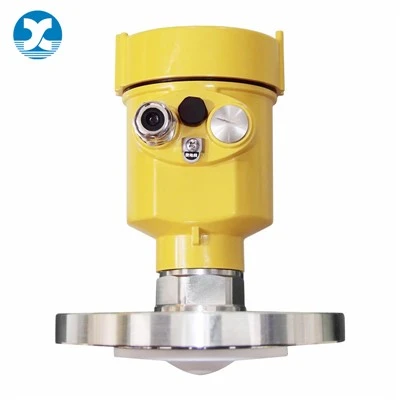
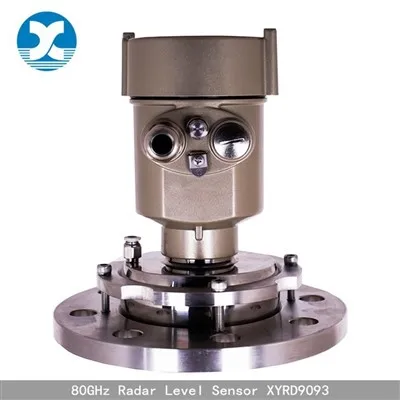
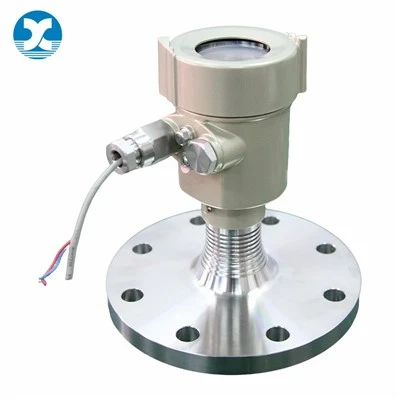
Why Choose Radar Level Sensor for Reactors and Agitated Vessels
Level measurement inside reactors and agitated vessels is one of the most challenging applications in industrial process control. Unlike static storage tanks, these vessels contain rotating agitator blades, internal baffles, heating/cooling coils, dip tubes and manway nozzles - all of which generate unwanted reflected signals that confuse conventional radar sensors. During reaction processes, foam formation, vapor condensation and surface turbulence further degrade signal quality. Many plant operators experience persistent problems: readings jump erratically when the agitator starts, false alarms trigger from internal structure echoes, and sensors lose measurement entirely during foaming reactions.
Standard non-contact radar sensors with wider beam angles (8°–10°) cannot avoid agitator blades and internal baffles - their broad signal field captures echoes from multiple internal structures simultaneously, making it impossible to distinguish the true liquid surface. Guided wave radar probes, while offering contact measurement, risk mechanical damage from rotating agitators and are difficult to install in vessels with limited top nozzle space.
This reactor-dedicated radar level sensor solves those problems through targeted hardware and algorithm upgrades. The 3° ultra-narrow beam concentrates signal energy on the liquid surface center, steering clear of agitator shafts, baffles and coil structures. The advanced false-echo tracking algorithm learns and maps fixed internal reflections during commissioning, then continuously subtracts them from real-time measurements - even when the agitator rotates at variable speeds. The fully enclosed PTFE lens antenna resists foam, vapor and condensate, while the optional purge connection keeps the lens clean during sticky or crystallizing reaction processes.
This unit fills a distinct niche in the radar product portfolio:
- Unlike storage-tank radars optimized for large, empty vessels with simple interiors, this model prioritizes agitation resistance, false-echo mapping and narrow-beam obstacle avoidance for complex internal environments.
- Unlike small-vessel/narrow-tank radars focused on compact dimensions and minimal blind zone, this model emphasizes algorithmic interference suppression for moving agitators and dynamic process conditions.
- Unlike high-temperature or high-pressure radars defined by extreme process envelopes, this model is defined by its ability to operate reliably in mechanically complex, dynamically agitated vessels.
The sensor supports both standard and hazardous-area installations, with intrinsic safety and flameproof certification options available. It integrates seamlessly with PLC, DCS and batch control systems for reactor level monitoring, interlock protection and inventory management.
Key Features and Benefits
3° Ultra-Narrow Beam for Agitator Avoidance
The compact 3° emission angle concentrates radar energy on the vessel center, steering clear of agitator shafts, mixing blades, internal baffles and heating coils. This minimizes structural interference even in vessels with complex internals, ensuring the signal targets the true liquid surface rather than rotating or fixed components.
Advanced False-Echo Tracking & Mapping Algorithm
During commissioning, the sensor learns and stores fixed echo positions from internal structures (baffles, coils, nozzles). In operation, it continuously subtracts these mapped false echoes from real-time measurements. The algorithm also tracks dynamic agitator blade reflections and suppresses them, maintaining stable readings regardless of agitator speed changes or start-stop cycles.
Foam, Vapor & Condensate Resistance
The 80GHz FMCW high-frequency signal penetrates thin-to-moderate foam layers and vapor clouds commonly generated during exothermic reactions, mixing and fermentation. The fully enclosed PTFE lens surface resists condensate adhesion and chemical attack, maintaining signal integrity in humid, reactive environments.
Optional Purge Connection for Sticky & Crystallizing Media
An integrated air-purge port can be specified for vessels handling sticky, crystallizing or high-solids reaction media. Periodic compressed-air cleaning keeps the PTFE lens surface free from buildup, preventing signal attenuation caused by material coating on the antenna.
Wide Process Envelope Compatibility
Standard configuration covers process temperatures from -40℃ to +180℃ and pressures from -0.1 MPa to 2.0 MPa. For higher-temperature or higher-pressure reactor applications, optional thermal isolation flanges and pressure-rated flange upgrades are available.
Multi-Mode Commissioning for Complex Vessels
Local 128×64 dot-matrix LCD with 4 keys supports on-site parameter setup and false-echo mapping. Dedicated PC configuration software enables detailed echo curve analysis and remote parameter adjustment, simplifying commissioning in vessels with complex internal structures.
Flexible Signal Output & Control Integration
Standard 4-20mA / HART two-wire output; RS-485 Modbus available. Seamless connection to PLC, DCS and batch control systems for reactor level monitoring, high-low level interlock protection and batch process automation.
Dual Explosion-Proof Certification
Certified Ex ia IIC T6 Ga (intrinsically safe) and Ex db IIC T6 Gb (flameproof), covering Zone 0/1/2 hazardous areas for flammable solvent reactions and combustible vapor environments common in chemical and pharmaceutical production.
Technical Specifications
This reactor-dedicated 80GHz FMCW radar level sensor combines ultra-narrow beam geometry with advanced false-echo suppression algorithms, optimized for level measurement in mechanically complex, dynamically agitated process vessels. Complete technical parameters are listed below:
|
Parameter |
Specification |
|
Target Application |
Reactors, agitated vessels, mixing tanks, fermenters, dosing vessels with internal agitators and structures |
|
Working Frequency |
76 ~ 81 GHz FMCW |
|
Beam Angle |
Approx. 3° ultra-narrow beam |
|
Measuring Range |
0 ~ 60 m |
|
Measurement Accuracy |
±3 mm |
|
Resolution |
±1 mm |
|
Antenna Type |
Fully enclosed PTFE lens antenna |
|
Wetted Material |
PTFE |
|
Process Connection |
Stainless steel flange with PTFE lining, DN50 / 2" and above; optional purge connection |
|
Process Temperature |
-40℃ ~ +180℃ (standard); higher temperature with thermal isolation flange optional |
|
Process Pressure |
-0.1 MPa ~ 2.0 MPa (standard); high-pressure flange upgrade optional |
|
Housing Material |
Aluminum alloy with anti-corrosion powder coating; stainless steel optional |
|
Power Supply |
2-wire / 4-wire, DC 24V |
|
Signal Output |
4~20mA + HART (2-wire standard); RS-485 Modbus optional |
|
Electrical Entry |
M20×1.5 / 1/2"NPT |
|
Ambient Temperature |
-40℃ ~ +80℃ |
|
IP Rating |
IP67 |
|
Explosion-proof Standard |
Ex ia IIC T6 Ga |
|
Local Operation |
128×64 dot-matrix LCD + 4 operation keys |
|
Remote Configuration |
Dedicated PC configuration software |
|
Key Algorithm |
False-echo mapping & tracking, agitator echo suppression, foam/vapor filtering |
|
Optional Accessories |
Air purge fitting, thermal isolation flange, high-pressure flange, Bluetooth adapter |
Applications
Chemical Batch Reactors
Level monitoring for glass-lined and stainless-steel batch reactors handling exothermic reactions, solvent mixing and polymerization processes. Stable measurement despite agitator rotation, internal baffles and reflux condenser dip tubes.
Pharmaceutical Fermenters & Bioreactors
Reliable level measurement for stainless-steel fermenters and bioreactors with top-mounted agitators, spargers and internal baffles. Resists foam generated during aerobic fermentation and vapor from sterilization cycles.
Fine-Chemical Mixing & Blending Tanks
Level control for mixing tanks producing paints, coatings, adhesives and specialty chemicals. Handles viscous media, surface turbulence from high-shear mixers and internal cooling coils.
Food & Beverage Processing Vessels
Level monitoring for cooking vessels, blending tanks and CIP-process containers with agitators and internal scrapers. Hygienic PTFE wetted surface resists food residue adhesion.
Petrochemical Stirred Reaction Vessels
Level measurement for stirred reactors in petrochemical and refinery applications, including alkylation units, hydrotreater feed tanks and catalyst mixing vessels. Dual explosion-proof certification for hazardous-area installation.
Cosmetic & Personal Care Mixers
Reliable level reading for vacuum mixers, homogenizers and cream manufacturing vessels with complex agitator assemblies (anchor + turbine + disperser combinations).
Frequently Asked Questions
Q1: How does this reactor radar differ from standard storage-tank radar?
Storage-tank radars use wider beam angles (8°–10°) and basic echo processing, designed for vessels with simple, empty interiors. This reactor-dedicated model uses a 3° ultra-narrow beam to avoid agitators and internal structures, plus an advanced false-echo mapping algorithm that learns and suppresses fixed and rotating interference. It is purpose-built for vessels with complex internals and dynamic agitation.
Q2: Can it measure reliably when the agitator is running at high speed?
Yes. During commissioning, the sensor maps fixed internal echo positions and learns the agitator blade reflection pattern. In operation, the false-echo tracking algorithm continuously suppresses both fixed structural echoes and dynamic agitator blade reflections, maintaining stable readings regardless of agitator speed, including start-stop transitions and variable-speed operation.
Q3: What if the reaction generates thick foam?
The 80GHz FMCW signal penetrates thin-to-moderate foam layers effectively. For very thick, dense foam (common in some fermentation and surfactant reactions), please provide foam characteristics during inquiry - our engineers will evaluate whether additional configuration (such as a stilling well or specialized algorithm parameterization) is recommended.
Q4: Is the PTFE lens suitable for all chemical solvents?
PTFE is compatible with most organic solvents, acids and alkalis. For highly aggressive media at elevated temperature (e.g., concentrated strong acids, certain halogenated solvents), please provide the full medium composition, concentration and temperature for our engineering review to confirm material compatibility.
Q5: Can the purge connection be retrofitted after installation?
The purge connection is integrated into the flange assembly during manufacturing and cannot be retrofitted in the field. If your process involves sticky, crystallizing or high-solids media, please specify the purge option at the time of order.
Q6: How is false-echo mapping performed during commissioning?
Using the local LCD/keypad or PC configuration software, the operator performs an "empty vessel" or "known-level" echo scan. The sensor identifies and stores all fixed internal reflection points (baffles, coils, nozzles, agitator shaft). These mapped echoes are then continuously subtracted from real-time measurements. The process typically takes 5–10 minutes per vessel.
If you need reliable level measurement for reactors, fermenters or agitated vessels with complex internals and rotating agitators, our reactor-dedicated radar level sensor delivers agitation-resistant, false-echo-suppressed performance you can trust.
Please provide your vessel type, agitator configuration (number and type of blades, speed range), internal structures (baffles, coils, dip tubes), medium properties (foaming tendency, viscosity, corrosivity), process temperature and pressure, and flange requirements. Our engineering team will verify configuration suitability - including false-echo mapping feasibility and purge necessity - and deliver a tailored technical proposal with competitive factory quotation.
Hot Tags: radar level sensor for reactors and agitated vessels, China radar level sensor for reactors and agitated vessels manufacturers, suppliers, factory, 26GHz Radar Level Sensor for Corrosive Liquids, 80GHz Radar Level Sensor for Hydrographic process, float and board type level indicator, Guided Wave Cable Radar Level Sensor, radar level sensor, ultrasonic liquid level measurement