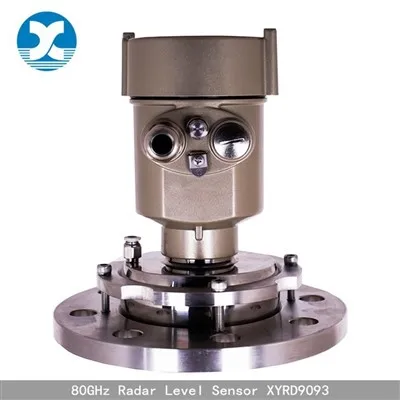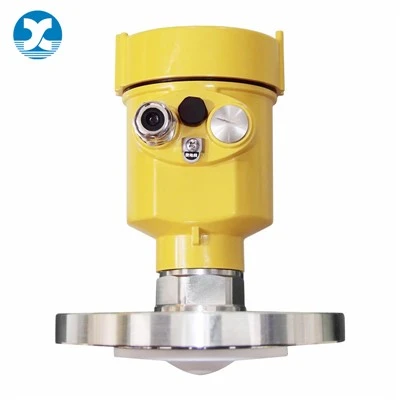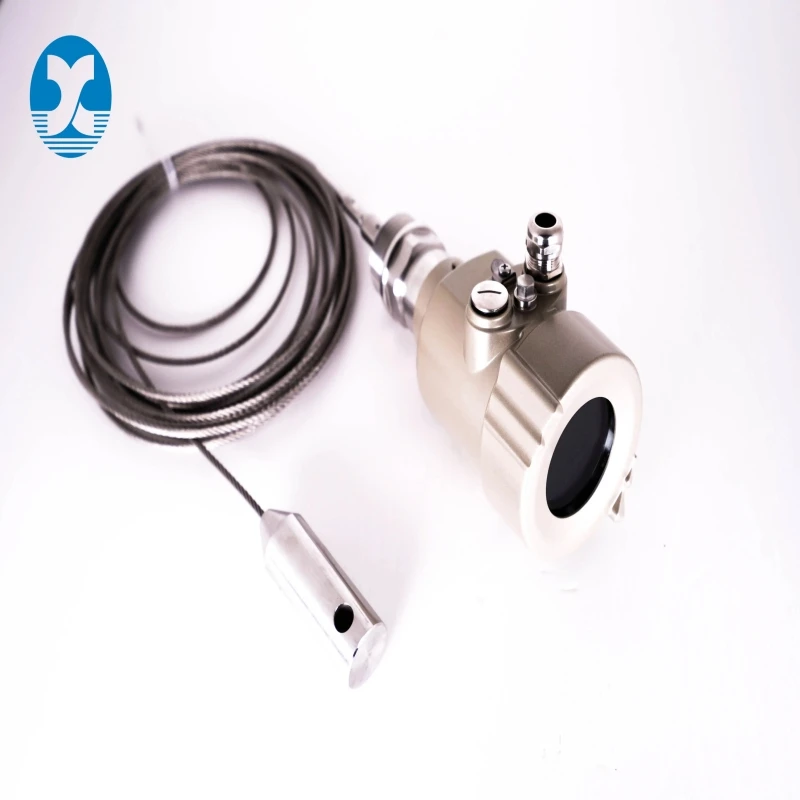
Product Overview
The PTFE-Lined Guided Wave Radar Level Sensor is a contact TDR (Time Domain Reflectometry) level measuring instrument specially engineered for corrosive industrial liquid applications. Different from standard guided wave radar equipped with conventional metal antenna, this model adopts a PTFE-lined antenna assembly, delivering reliable corrosion resistance when exposed to aggressive process media.
Designed for strong acid, strong alkali, organic solvents and easily crystallized chemical liquids, it achieves stable, high-precision liquid level and interface measurement. Its measuring performance remains barely affected by foam, vapor, condensation and medium density variations. This transmitter acts as a dependable long-term monitoring solution for chemical process tanks where ordinary level instruments cannot withstand corrosive conditions.
Why Choose Our PTFE-Lined Guided Wave Radar
Standard guided wave radar with bare metal antenna can only serve weak-corrosion and common-liquid working conditions. When exposed to highly corrosive chemicals, metal antenna components tend to suffer pitting, oxidation and premature degradation, which further leads to measurement drift and frequent instrument replacement.
In many chemical production sites, process fluids are prone to crystallization and medium deposition. Build-up on the antenna surface will interfere with microwave signal transmission and cause unstable level readings. Complicated working conditions accompanied by steam, foam and pressure fluctuation further increase failure risk for conventional level transmitters.
Our PTFE-lined guided wave radar solves these typical site challenges. The PTFE-lined antenna assembly offers excellent chemical inertness against most corrosive liquids. Its smooth surface reduces medium adhesion and crystallization accumulation, helping maintain stable signal output over long operating cycles. Based on mature TDR guided-wave principle, microwave pulses propagate along the antenna assembly with strong anti-interference capability, resisting disturbance from steam, foam and pressure shifts. It supports low-maintenance continuous operation for corrosive storage and process tanks.
Core Product Features
PTFE-Lined Antenna Assembly for Corrosive Service
The antenna assembly adopts PTFE lining construction to cope with aggressive chemical media. Both rod-type and cable-type antenna versions are available to match different tank installation depth requirements. The PTFE lining protects key wetted components from erosion by strong acid, strong alkali and organic solvents.
Anti-Adhesion & Anti-Crystallization Characteristic
The smooth PTFE surface minimizes sticking and crystallization of process medium. It reduces signal deviation caused by material deposits on antenna surfaces and lowers the frequency of on-site cleaning work.
Dual Measurement for Liquid Level & Interface
Supports continuous liquid-level measurement as well as oil-water interface detection. It reliably identifies layered liquids with different dielectric constants, meeting monitoring demands for chemical separation tanks and sedimentation vessels.
Strong Anti-Interference Performance
TDR guided-wave signal propagates along the antenna assembly. Measurement results are not disturbed by surface foam, tank vapor, condensation, temperature and pressure fluctuation, securing consistent accuracy in complex chemical processes.
Robust Industrial-Grade Construction
Optimized for long-term field operation in chemical plants. Intrinsic-safety explosion-proof option is available for hazardous-area deployment. IP67 housing provides reliable protection against moisture and ambient dust.
Flange-Mount Installation
Adopts flange-mount process connection, suitable for installation on standard atmospheric-pressure chemical storage and process tanks for easy on-site assembly.
Technical Specifications
This guided wave radar level sensor is equipped with PTFE-lined antenna assembly targeting corrosive-liquid working scenarios. All parameters follow industrial standards for engineering selection and system matching. Detailed specifications are listed below:
|
Parameter |
Specification |
|
Product Type |
PTFE-Lined Guided Wave Radar Level Sensor (TDR Principle) |
|
Applicable Media |
Strong acid, strong alkali, organic solvent, crystallizable liquid, oil-water mixed liquid |
|
Measuring Function |
Liquid level measurement / Oil-water interface measurement |
|
Measuring Range |
Rod type: 0~6 m; Cable type: 0~20 m |
|
Measuring Accuracy |
±3 mm |
|
Working Principle |
Time Domain Reflectometry (TDR) Guided Wave Radar |
|
Antenna Structure |
PTFE-lined antenna assembly (rod / cable optional) |
|
Process Connection |
Flange connection |
|
Process Temperature |
-40℃ ~ 120℃ |
|
Process Pressure |
Atmospheric pressure |
|
Housing Material |
Aluminum alloy anti-corrosion coating |
|
Power Supply |
2-wire DC 24V |
|
Signal Output |
4~20mA + HART / RS485 Modbus (optional) |
|
Protection Grade |
IP67 |
|
Explosion-Proof Grade |
Ex ia IIC T6 Ga |
Industrial Applications
Fine Chemical Industry
Level and interface monitoring for strong-acid & strong-alkali storage tanks, solvent reaction vessels and corrosive dosing tanks.
Petrochemical Industry
Suitable for oil-water separation tanks and sedimentation vessels, realizing accurate interface identification and continuous liquid-level tracking.
Pharmaceutical & New Energy Industry
Level measurement for corrosive raw-material tanks and reaction containers, suitable for process environments requiring anti-contamination properties.
Water Treatment Industry
Liquid-level monitoring for corrosive wastewater tanks and chemical agent dosing pools.
Limitations & Notes
This PTFE-lined guided wave radar is designed primarily for corrosive liquid and liquid-interface measurement.
- It is not recommended for solid bulk-material silos. Hard lump materials may cause mechanical impact and damage to the PTFE-lined antenna assembly.
- Avoid continuous operation beyond 120℃ maximum process temperature, to prevent aging and performance degradation of PTFE lining material.
- Not applicable for media containing highly corrosive fluorine-based substances.
Frequently Asked Questions
Q1: What is the difference between PTFE-lined guided wave radar and ordinary guided wave radar?
Standard guided wave radar uses bare metal antenna for general-purpose, weak-corrosion liquids. This variant adopts PTFE-lined antenna assembly, specially built for highly corrosive chemical media. It also brings anti-crystallization and anti-adhesion advantages for harsh chemical-process conditions.
Q2: Can this sensor measure oil-water interface?
Yes. Based on TDR principle, it detects dielectric-constant discontinuity between two liquid layers, widely applied for interface monitoring inside separation and sedimentation tanks.
Q3: Will sticky chemical media build-up on antenna surfaces?
The smooth PTFE-lined surface reduces medium adhesion and crystallization. Maintenance frequency can be greatly reduced under normal corrosive-liquid operating conditions.
Q4: Can I select rod-type or cable-type PTFE-lined antenna?
Both rod-type and cable-type PTFE-lined antenna assemblies are optional. Rod-type for 0-6 m measuring range; cable-type for 0-20 m measuring range, selected according to actual tank depth.
If you need reliable level or interface measurement for corrosive-liquid storage tanks, our PTFE-Lined Guided Wave Radar Level Sensor delivers targeted corrosion-resistant performance.
Please provide medium type, working temperature, pressure, measuring range and connection requirements. Our engineering team will offer matched configuration solution and competitive factory quotation.
Hot Tags: ptfe-lined guided wave radar level sensor, China ptfe-lined guided wave radar level sensor manufacturers, suppliers, factory, 26GHz Radar Level Sensor for Hydrographic, 80GHz Radar Level Sensor, carb float height tool, guided radar level measurement, Guided Wave Coaxial Tube Radar Level Sensor, radar level sensor