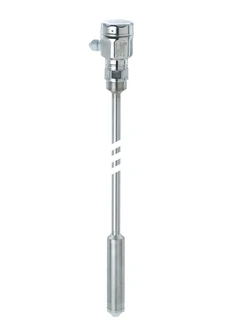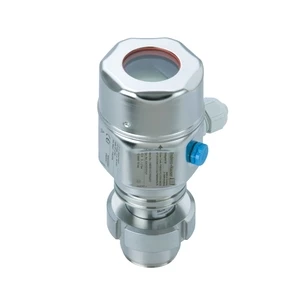
A customer once sent us photos of a radar level transmitter on an ethanol storage tank. The tank had an agitator running most of the day, and the level reading jumped around every time it started. The sensor itself was fine. The problem was the beam: too wide, aimed right across the agitator shaft, so the receiver kept catching a strong echo from a spinning piece of steel half a meter below the liquid surface.
Swapping the antenna fixed it in an afternoon. No new electronics, no reprogramming. That job taught me something I now repeat to almost every customer: beam angle is not a datasheet footnote. It is often the single biggest factor in whether a radar level sensor works in your tank or fights with it.
This guide explains what beam angle actually is, when you need a narrow one, when a wide one is fine, and how to decide in a few minutes using information you already have about your tank. If you are still comparing technologies, our 80GHz radar level sensor series covers both ends of the range with a 3° and an 8° option, and I will reference specific models as we go.
What beam angle actually means
The beam angle is the cone of radar energy leaving the antenna. Most manufacturers quote the full cone angle, so a 3° sensor concentrates its energy inside a 3° cone. Everything outside that cone gets almost no energy, and almost nothing outside it sends a usable echo back.
Two things determine the angle: antenna diameter and frequency. Bigger antenna, narrower beam. Higher frequency, narrower beam, at the same antenna size. That second part is why 80 GHz changed the market. A 75 mm lens antenna at 26 GHz gives you roughly a 10° beam; the same physical size at 80 GHz gives you about 4°, as VEGA documents for its VEGAPULS 69 solid radar . Frequency buys you focusing without buying you a bigger flange.
Numbers help here. Beam radius grows with distance:
|
Beam angle |
Spread at 5 m |
Spread at 10 m |
Spread at 20 m |
|
3° |
±0.13 m |
±0.26 m |
±0.52 m |
|
8° |
±0.35 m |
±0.70 m |
±1.40 m |
|
10° (26 GHz, 75 mm horn) |
±0.44 m |
±0.88 m |
±1.76 m |
So on a 10-meter tank, an 8° sensor "sees" a circle about 1.4 m across. A 3° sensor sees a circle half that size. Whether that matters depends entirely on what else lives inside the tank, which brings us to the real question.
Why narrow is not automatically better
Sales pages push narrow beams hard, and I understand the temptation to think 3° beats 8° every time. It does not. A narrow beam concentrates energy in a small spot, which is exactly what you want over an agitator and exactly what you do not want when the liquid surface is calm, flat, and slightly tilted. A perfectly vertical narrow beam hitting a mirror-flat surface can bounce straight back down into the tank and return nothing useful. Foam, ripples, and vapor actually help wide beams because they scatter some energy back to the receiver.
Wide beams are also more forgiving of aiming errors. Nobody installs a sensor perfectly plumb on a real construction site. With a 3° beam, a small tilt can push part of your cone into the tank wall, where buildup reflects a false echo. With an 8° beam, that same tilt is usually absorbed.
The honest answer, after a few hundred installations: choose the narrowest beam your application needs, not the narrowest beam that exists.

Four situations where a narrow beam earns its keep
1. Tanks with internals
Agitators, heating coils, ladders, baffle plates, thermowells. Anything metallic inside the tank is a candidate reflector. This is the classic case, and it is where the ethanol story from the start of this article comes from. An 80 GHz signal reflects almost exclusively from the product surface, while a wider 26 GHz beam also returns echoes from fixtures and struts in the beam path . If you know the beam will pass close to an agitator shaft, take the 3° option. On our own series, that means the XYRD9092-NCR or XYRD9093-NCR with the Ø78 mm lens rather than the compact 8° model.
2. Small nozzles and retrofits
Old tanks rarely cooperate. You want to add level monitoring, and the only entry point is a 1½-inch threaded boss that used to hold a sight glass. A traditional radar needs a horn big enough to focus, which means an 80 or 100 mm nozzle you do not have. High frequency solves this by focusing through a tiny lens. The Ø22 mm lens on the XYRD9091-NCR fits through a G1½ thread and still holds an 8° beam, which used to require a much larger 26 GHz horn.
Endress+Hauser makes the same point in their custody-transfer selection white paper: the 3° beam and 2-to-4-inch antennas of 80 GHz instruments let them mount into existing small nozzles and much closer to the tank wall than lower-frequency models. Their published table shows an 80 GHz sensor with a 4-inch antenna mounting just 0.95 m from the wall on a 15 m tank, where a 26 GHz unit would need roughly twice that clearance.
3. Low dielectric media
Liquid hydrocarbons, LNG, dry powders: these reflect radar weakly. Dielectric constant of gasoline sits around 2, and plastic pellets can go lower than 1.5. A weak reflector needs a strong, focused signal. High frequency helps twice over, because the shorter wavelength interacts better with small surface irregularities, and the narrower beam sends more energy onto the exact patch of surface you are targeting. VEGA's VEGAPULS 64 documentation credits the high dynamic range and tight focusing of 80 GHz for reliable measurement on hydrocarbons from crude oil down to liquefied gases.
4. Dusty silos
Cement, fly ash, flour, plastic powder. Dust does two bad things: it absorbs signal and it builds up on the antenna. A narrow beam pushes more energy through the dust cloud to the actual material surface, and modern 80 GHz sensors compensate for lens buildup digitally. On our solids model, the XYRD9093-NCR pairs the 3° beam with an air-purge interface, because in a working cement silo the lens will get dirty no matter what you do. The purge keeps it honest between maintenance windows.
When a wider beam is the better choice
If your tank is clean inside, reasonably large, and the media reflects well, an 8° beam will outperform a 3° in several ways. It tolerates imperfect aiming. It returns a stronger composite signal from slightly disturbed surfaces. It costs less, because the antenna is smaller and the optics simpler. Water tanks, cooling basins, glycol storage, and most food-grade vessels fall into this category.
I would add one more: small tanks. On a 2 m diameter vessel, a 3° beam at 4 m distance covers a circle about 20 cm across. That is great until the surface tilts or foams unevenly, and then the narrow beam may lose the surface entirely. We often spec the 8° lens on small hygienic vessels for exactly this reason, including the all-PTFE XYRD9095-NCR for food and pharma duty.
A five-minute selection routine
When an inquiry lands in our inbox, we ask four questions. You can run the same check yourself before you ever contact a supplier.
Step 1: measure the nozzle
If the nozzle is 2 inches or smaller, your choice is mostly made. You need a compact lens antenna, which in practice means 80 GHz. Fighting this with a large 26 GHz horn leads to adapters, stub extensions, and corner cases you do not want.
Step 2: list the internals
Sketch the tank from above and mark anything metallic within reach of the beam cone. Remember the spread table above: at 10 m, an 8° cone reaches 0.7 m off-center. If an agitator shaft, coil, or ladder falls inside that circle, narrow the beam or move the nozzle.
Step 3: check wall clearance
Measure the distance from nozzle center to the nearest wall. Compare it against the expected beam spread at the maximum level. If the cone touches the wall at any fill height, either the beam must narrow or the sensor must move.
Step 4: judge the media
Low dielectric constant, heavy dust, or steam all push you toward 80 GHz focusing. Clean water and most aqueous products run happily on either frequency.
Then combine the answers:
|
Your situation |
Sensible choice |
Example from our range |
|
Small nozzle, clean liquids, tank under 10 m |
80 GHz, 8°, compact lens |
XYRD9091-NCR (Ø22 mm, G1½ thread) |
|
Agitator or internals, large tank |
80 GHz, 3°, big lens |
XYRD9092-NCR (Ø78 mm) |
|
Bulk solids, heavy dust |
80 GHz, 3°, air purge |
XYRD9093-NCR |
|
Steam over corrosive liquid |
80 GHz, 3°, fully enclosed PTFE lens |
XYRD9094-NCR (up to 180 °C) |
|
Hygienic small vessel, foam-prone |
80 GHz, 8°, all-PTFE |
XYRD9095-NCR (clamp connection) |
Three mistakes we keep seeing in the field
Beam angle gets chosen at the desk, but failures show up on site. These three account for most of the service calls we get that turn out not to be sensor faults.
First, mounting above the filling stream. The falling liquid curtain is a dense cloud of echoes. No beam angle survives it. Keep the nozzle away from fill points, or accept a noisy signal.
Second, center-of-cone mounting on conical bottoms. On a tank with a cone, the natural instinct is to bolt the sensor dead center. That is where the cone apex sits, and a narrow beam pointed at the apex catches reflections from the sloped wall as the level falls into the cone. Off-center mounting, aimed at the flat liquid surface, works better.
Third, forgetting condensation. A film of water on the lens looks, to the radar, like a surface worth measuring. Encapsulated lens designs, the fully enclosed PTFE antenna on our steam-rated model, deal with this mechanically rather than hoping software filters it out.
Wrapping up
Beam angle selection is tank geometry homework more than it is radar theory. Measure the nozzle, list the internals, check wall clearance, judge the media. If two of those four answers point at "tight focusing", you want an 80 GHz sensor with a 3° beam. If they point the other way, the cheaper 8° option will serve you better and forgive more installation sins.
If you want a second opinion on a specific tank, send us the sketch with dimensions and media data. Our engineers review it and come back with a recommended model and antenna, usually within three working day. You can start from the 80GHz radar level sensor specifications page or go straight to the quote form.
References
- Endress+Hauser, "Selecting Radar Level Instruments for Custody Transfer" (white paper WP01044FEN), 2024. endress.com
- VEGA Instruments, "First radar level sensor for liquids with 80 GHz – VEGAPULS 64" (product and technology page). vega.cn
- VEGA Instruments, "VEGAPULS 69 – The new radar sensor for bulk solids" (product and technology page). vega.com