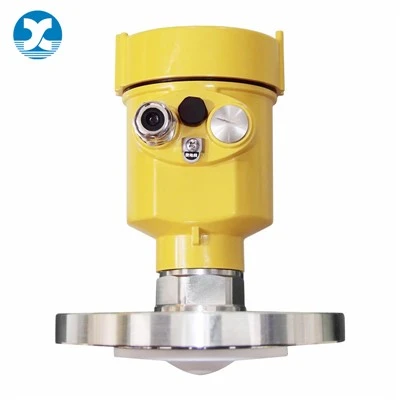
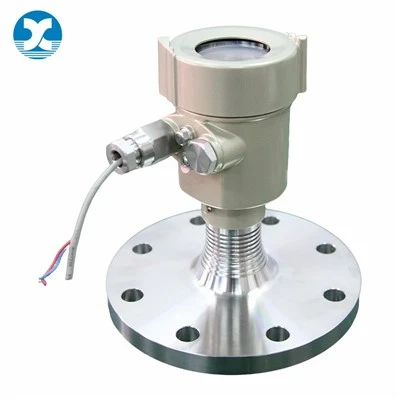
A magnetostrictive level transmitter is a type of level sensor. Internally, it utilizes the magnetostrictive principle and combines it with modern electronic technology to measure the time between pulse waves, achieving accurate level measurement. Magnetostrictive level gauges operate using waveguide pulses. During operation, the measured displacement is determined by measuring the time between the start and end pulses, resulting in high measurement accuracy.
Working Principle of Magnetostrictive Level Transmitters
Level transmitters employing the high-resolution magnetostrictive measurement principle are used for continuous liquid level measurement. Their principle is based on the position of a magnetic levitation body determined by the magnetostrictive principle. These level transmitters are installed externally to bypass the level indicator.
The measurement process is triggered by a current pulse. This current generates a circular magnetic field on a conductor made of magnetostrictive material, which is stretched within the sensor tube. At the measured point (liquid level), a cylindrical float with a permanent magnet serves as a position sensor, its magnetic field lines perpendicular to the pulsed magnetic field. The float's magnetic field causes a force in the conductor. The superposition of these two magnetic fields induces a mechanical wave in the conductor. At the end of the sensor housing, a piezoelectric ceramic pickup converts this mechanical wave into an electrical signal. The measured propagation delay determines the starting point of the mechanical torsional wave, thus determining the float's position and achieving high-precision measurement.
Magnetostrictive Level Gauge Circuit Design
Pulse Generation Circuit
In this magnetostrictive level gauge system, the pulse generation circuit acts as its signal transmitter, specifically responsible for sending crucial action commands-current pulses. This command plays a vital role in the sensor's accurate measurement of the liquid level height.
The core member of this signal transmitter is the FPGA, which acts like the stationmaster. The FPGA has a highly precise time management tool and task planning system.
During operation, the FPGA, based on pre-set requirements, precisely generates a pulse signal of a specific width and frequency using the time management tool and task planning system. This is similar to instructing a station manager to emit a signal wave of a specific duration at regular intervals. For example, we could set it to emit a pulse signal lasting 0.1 seconds every second.
However, the newly generated pulse signal is relatively weak and cannot travel smoothly along the waveguide wire to the desired location. This is where another important member of the signal transmitting station comes in-the power amplifier. The power amplifier acts like a signal powerhouse, its task being to amplify the weak pulse signal generated by the FPGA. After amplification, the originally weak pulse signal becomes strong enough to propagate quickly and stably along the waveguide wire, providing strong support for subsequent liquid level measurement.
Detection Circuit In the team of this intelligent little detective-the magnetostrictive level gauge-the detection circuit acts like a signal hunter, its task being to capture the weak signals transmitted from the waveguide wire. These signals are crucial clues for measuring the liquid level.
When a waveguide wire is subjected to a magnetic field and generates a torsional wave pulse, it emits a very weak signal. These signals are like distant whispers, typically only millivolts or even microvolts in intensity. Furthermore, there is a lot of surrounding noise interference, such as electromagnetic interference from operating equipment, which acts like background noise and easily drowns out the useful signal. Therefore, the signal acquisition and detection circuit must be both sensitive and interference-resistant.
The first powerful tool in the detection circuit is a low-noise operational amplifier (LNA). When a weak signal arrives, the LNA carefully amplifies it, making it clearer for subsequent processing.
However, the amplified signal still contains a lot of unwanted noise. This is where a bandpass filter comes in; it acts like a smart signal filter. The bandpass filter only allows signals with frequencies close to the torsional wave pulse frequency to pass through, blocking noise signals of other frequencies. After amplification by the LNA and filtering by the bandpass filter, the remaining signal is the clean signal we need. This signal is sent to the next stage, where the sensor's "brain" further analyzes and processes it to calculate the accurate liquid level height.
Signal Processing Circuit
In the team of the magnetostrictive level gauge, this intelligent little detective, the signal processing circuit acts like a clue analysis expert. Its job is to deeply analyze and process the signal clues transmitted from the detection circuit, ultimately determining the accurate liquid level height.
The signal from the detection circuit is an analog signal, like clues recorded with a special ancient code, which is not easily understood directly by the computer and sensor's brain. This is where the A/D converter comes in. It acts like a code translator, specifically responsible for translating this ancient code of analog signals into the modern language of digital signals that both the computer and the brain can understand.
The translated digital signals are like a jumbled pile of clues, requiring further sorting. This is where the FPGA, the analysis master, begins its work. The FPGA first performs digital filtering on these digital signals, much like using a sieve to remove any remaining impurities, making the signal purer.
Next, the FPGA needs to find the key information in the signal-the arrival time of the torsional wave-like finding the most important time point among a pile of clues. FPGA, through peak detection and other operations, essentially performs a signal check-up, accurately pinpointing the moment when the torsional wave signal reaches its strongest point-the arrival time of the torsional wave.
Finally, the FPGA, the analysis master, also acts as a mathematical expert. Based on the known conditions-the timing of the current pulse transmission, the propagation speed of the torsional wave in the waveguide wire, and the length of the waveguide wire-it uses specific mathematical algorithms to calculate the position of the float on the waveguide wire. Since the float's position corresponds to the liquid level, the accurate liquid level in the container can be determined.
Communication Circuit In the family of intelligent detectives in the magnetostrictive level gauge, the communication circuit acts as a busy information messenger. Its job is to quickly and accurately deliver the liquid level information measured by the sensor to where this information is needed.
This information courier is fluent in multiple languages, such as RS485 and CAN bus, much like speaking different languages. It can choose the appropriate language to transmit information based on different delivery addresses and shipping requirements.
Magnetostrictive Level Gauge Performance Analysis
Linearity
Linearity is a crucial indicator of accuracy in measuring liquid levels. Ideally, a magnetostrictive level gauge should measure water levels at different heights. For every 1 cm increase in liquid level, the output signal should change uniformly. For example, a 1 unit increase in the value corresponds to a 2 cm increase in the signal. In this ideal state, the liquid level and the output signal have a perfect linear relationship – this is what we call linearity. However, in reality, even intelligent detectors can make mistakes. Even with uniform liquid level changes, the output signal change may differ from the ideal state. This difference is called nonlinearity error.
If the maximum error throughout the measurement process does not exceed 1 cm, meaning the nonlinearity error is less than ±0.1%, then the magnetostrictive level gauge has excellent linearity. In practical applications, such as in large liquid storage tanks in factories, good linearity is essential for accurately determining the true liquid level, ensuring production safety and normal operation.
Sensitivity
The sensitivity of a magnetostrictive level gauge reflects its ability to detect changes in liquid level. Imagine a container filled with liquid. When the liquid level changes, a magnetostrictive level gauge will output a corresponding signal. A highly sensitive level gauge can react quickly to even slight increases or decreases in the liquid level, resulting in a noticeable change in the output signal.
In practical life and work, highly sensitive magnetostrictive level gauges are very useful. For example, in precision chemical production, the liquid level requirements in many chemical reaction vessels are extremely strict; even slight changes in the liquid level can affect product quality. In this case, a magnetostrictive level gauge with extremely high sensitivity is needed to detect minute changes in the liquid level promptly.
Repeatability
The repeatability of a magnetostrictive level gauge is a test of its reliability. Given a task to measure the liquid level at a fixed height in a storage tank, if the gauge is reliable, then regardless of the number of measurements taken, as long as the liquid level does not actually change, the measurement result should be approximately the same. This is good repeatability.
In practical applications, magnetostrictive level gauges with good repeatability are particularly important. For example, in food and beverage production lines, precise control of the raw material level in storage tanks is required to ensure consistent material usage for each batch of products. If the sensor has poor repeatability, measuring inconsistent levels, such as high or low levels, it will lead to unstable raw material usage. A level gauge with excellent repeatability can provide stable and reliable results every time it measures the same level.
Features of Magnetostrictive Level Transmitters
Magnetostrictive level transmitters are available in three types: soft probe, hard probe, and external float isolation. The transmitter body consists of two main parts: the electronic part and the sensing part. The advantages of magnetostrictive level transmitters are:
1. High Reliability: Because magnetostrictive level transmitters use waveguide principles, there are no moving mechanical parts. Therefore, there is no friction or wear. The entire converter is encapsulated in a stainless steel tube and does not come into contact with the measured medium. The sensor operates reliably and has a long service life.
2. High Precision: Because magnetostrictive level transmitters operate based on waveguide pulses, the displacement is determined by measuring the timing of the start and end pulses. Therefore, it boasts high measurement accuracy, with a resolution better than 0.01%FS.
3. High Safety: Magnetostrictive level gauges have high explosion-proof performance. They are inherently safe and explosion-proof, ensuring safe use. They are particularly suitable for measuring chemical raw materials and flammable liquids, eliminating the need to open the tank lid during measurement and avoiding the safety risks associated with manual measurement.
4. Convenient Installation and Maintenance: Magnetostrictive level gauges are generally installed through existing pipe openings on the top of the storage tank. They are particularly suitable for underground storage tanks and existing operational tanks. Installation should not disrupt normal production.
5. Promotes System Automation: The secondary instrument of the magnetostrictive level gauge uses a standard output signal, facilitating computer signal processing. This allows for easy networking and improves the automation level of the entire measurement system.
Where are magnetostrictive level gauges used?
Applications of Magnetostrictive Level Transmitters: High-tech magnetostrictive level sensors are used for level measurement in various types of storage tanks. This type of level gauge features high accuracy, strong environmental adaptability, and convenient installation, making it widely used in level measurement fields such as petroleum and chemical industries. It is gradually replacing other traditional sensors, becoming a high-quality product in level measurement.
Typical applications and installation of magnetostrictive level sensors:
Measuring the level of horizontal storage tanks: The magnetostrictive level sensor is installed at the top.
For intermediate liquid level control in production: Magnetostrictive level sensors are installed side-by-side.
Vertical oil tank applications: The magnetostrictive level transmitter is installed at the top using a flexible cable.
The magnetostrictive level transmitter can also be used in conjunction with a magnetic float level gauge.
Magnetostrictive level transmitter, asphalt storage tank, and other applications and installation schemes.
How to order a magnetostrictive level transmitter?
Selection considerations for magnetostrictive level transmitters:
1. The level gauge should be compatible with the on-site medium environment. This includes ambient temperature, pressure, vibration, shock, structural materials, and the compatibility of the medium. 2. When the temperature of the measured medium is high (100~200℃), it is recommended to use an external float probe with side flange installation.
3. Magnetostrictive level gauges have measurement blind zones at both the upper and lower ends of the measuring rod; this should be considered when selecting the measuring range.
4. The commonly used stainless steel magnetic float size for level gauges is Ф45×Ф56×Ф15, requiring a flange connection of DN50 or higher. For threaded level gauges, users need to install flanges or brackets.