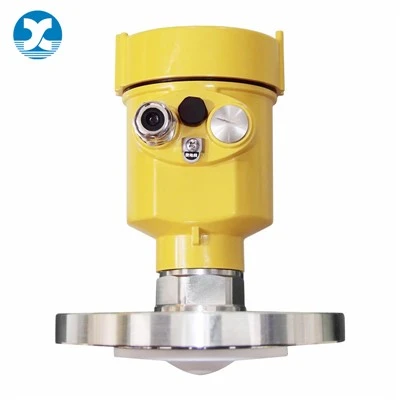
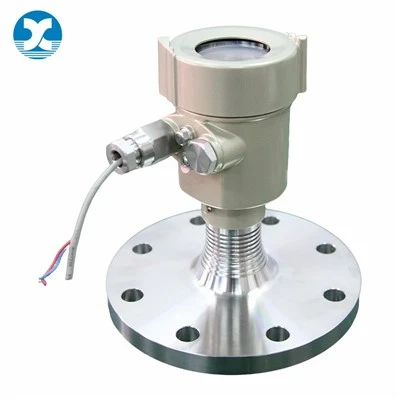
A radar level sensor is a level sensor that uses radar technology to measure the level of liquids or solids in tanks or containers. Its working principle is to emit radar signals, which are reflected back to the sensor from the material surface. The sensor calculates the level based on the signal's time of flight or frequency shift. Radar level sensors are non-contact, requiring no contact with the measured material, and are therefore commonly used in applications requiring extremely high accuracy and reliability. Even under complex conditions where thin layers of foam or dust can hinder traditional ultrasonic measurement methods, these sensors can accurately measure the level.
Working Principle of Radar Level Sensors
Radar level sensors utilize advanced radar technology to measure the level of liquids or solids in tanks or containers. The measurement process begins with the sensor head emitting continuous radar energy waves that illuminate the material surface. This radar energy is reflected back to the sensor head, detected, and processed to determine the material level.
The core principle of radar level sensors is the time-of-flight method. This involves calculating the time required for the radar signal to travel from the sensor head to the material surface and back. This time measurement is then converted into distance, indicating the material level. Furthermore, these sensors can detect changes in the dielectric constant of the material, which affects measurement accuracy. One of the key features of radar level sensors is their adaptability to environmental factors such as temperature, pressure, and humidity. This makes them versatile and suitable for a wide range of applications. They are also designed to resist interference from other devices, ensuring reliable operation even in harsh environments.
The measurement range of a radar level sensor is affected by the radar energy frequency and the sensor head power. Higher radar energy frequencies provide more accurate measurements, but may result in a shorter measurement range. The measurement range and accuracy for a specific application can be optimized by fine-tuning the sensor head.
Why Choose a Radar Level Sensor?
Radar level sensors are particularly important in continuous level measurement applications, where real-time monitoring of material levels is crucial. They are also favored by industries with high precision and reliability requirements, such as chemical and pharmaceutical manufacturing. Radar level sensors, utilizing radar technology, offer numerous advantages, including low maintenance requirements, high accuracy, and strong resistance to environmental factors. These sensors are easy to install and can be integrated with various devices, including IO-Link master stations, for remote monitoring.
In addition to continuous level measurement, these sensors are also well-suited for non-contact level measurement applications. In these applications, the sensor head does not need to contact the material, providing a safe and reliable method for measuring liquid or solid levels in tanks or containers.
In summary, radar level sensors offer a reliable and accurate solution for measuring liquid or solid levels in a variety of industrial environments. The radar technology they employ ensures low maintenance, high accuracy, and resistance to environmental factors, making them a valuable asset in any operation.
Advantages of Radar Level Sensors
Maintain high accuracy and reliability even in harsh environments or complex process conditions.
Low maintenance costs because there are no moving parts and the sensor does not need to contact the material.
Capable of measuring a variety of materials, including liquids, solids, and slurries.
Resistant to environmental factors such as high temperature, pressure, and humidity.
Compatible with IO-Link, allowing for easy integration with other devices and systems.
Advantages of Continuous Level Measurement
Continuous level measurement allows for real-time monitoring of material levels, enabling rapid response to changes or anomalies.
Because the sensor continuously measures the level, even minute changes can be detected, resulting in higher accuracy and reliability.
Sensors alert operators when material levels change, reducing the risk of overfilling or underfilling.
Operators can focus on other tasks while the sensor monitors material levels, improving efficiency and productivity.
Choosing the Right Radar Sensor
Consider the type of material being measured, process conditions, and environmental factors.
Select a sensor with a measurement range and accuracy suitable for the application.
Consider the required output signal type, such as analog or digital.
Select an IO-Link compatible sensor for easy integration with other devices and systems.
Common Applications of Level Sensors
Liquid level measurement in tanks and containers.
Solid level measurement in silos and hoppers.
Slurry level measurement in mining and wastewater treatment.
Level measurement in food and beverage processing.
Level measurement in chemical and pharmaceutical processing.
Radar level sensors provide a reliable and accurate solution for continuous level measurement in a wide range of applications.
With their non-contact design and tolerance to environmental factors, these sensors are well-suited for use in harsh environments and complex process conditions.
By selecting the appropriate radar sensor and considering specific application requirements, operators can improve operational efficiency, productivity, and safety.