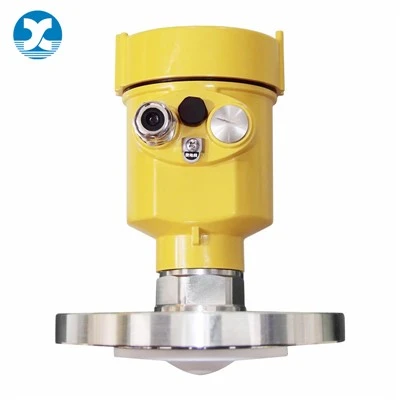
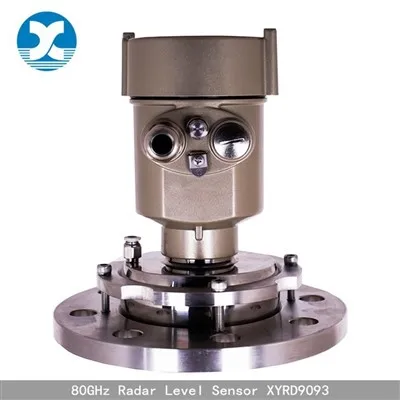
Why Choose Radar Level Sensor for High Temperature Applications
High-temperature process environments create unique measuring difficulties: hot vapor distorts microwave propagation, thermal dust clouds weaken echo signals, and sustained heat can degrade antenna materials and electronic components over time. Standard radar sensors often suffer signal drift, unstable readings or shortened service life in such conditions. This high-temperature application radar level sensor tackles these problems through high-frequency narrow-beam technology, a thermally stable PTFE lens antenna and a purgable flange design. The focused radar beam cuts through hot vapor and thermal dust to lock onto the material surface. The PTFE lens retains dimensional and dielectric stability under heat, and the purge interface allows regular cleaning to prevent heat-affected material caking on the antenna. Different from general-purpose solid radars, this version prioritizes thermal stability and heat-environment adaptability. It fits hot powder silos, thermal process bins and high-temperature material storage facilities. The standard configuration covers process temperatures up to 200℃; when your process runs hotter, our engineering team will specify alternative radar models with appropriate cooling accessories and thermal ratings.
Key Features and Benefits
High-Frequency Narrow-Beam Thermal Penetration
76–81GHz focused radar beam penetrates hot vapor and thermal dust layers, maintaining stable echo signals in elevated-temperature process environments.
Thermally Stable PTFE Lens Antenna
78mm integrated PTFE filled lens antenna retains dimensional and dielectric stability under heat, supporting process temperatures up to 200℃ in standard configuration.
Higher Temperature With Cooling Structure
For process conditions exceeding 200℃, optional cooling structures (heat sink extension, air or water cooling) can be configured to protect electronic components and extend service life.
Purgable Universal Flange with Heat Management
Universal flange with air purge interface enables on-line cleaning of heat-affected material buildup. Antenna orientation can be adjusted to optimize signal alignment in hot silos.
Stable Accuracy Under Thermal Stress
±5mm measuring accuracy is maintained through optimized signal processing that compensates for temperature-induced signal variations, reducing reading drift in hot environments.
Multi-Mode Commissioning for Hot Sites
Local LCD keypad, Bluetooth programmer and optional 5G remote debugging allow configuration without prolonged exposure to high-temperature on-site areas.
Wide 120m Measuring Range
Covers small hot process bins to tall thermal storage silos, suitable for unified monitoring across high-temperature production lines.
Flexible Power & Signal Output
Standard two-wire 4-20mA / HART; customized four-wire and RS-485 Modbus optional. DC24V and AC220V power supply options match different site electrical schemes.
Intrinsically Safe Explosion-Proof Rating
Ex ia IIC T6 Ga certification supports deployment in high-temperature zones with combustible dust or flammable vapor hazards.
IP67 Dust & Moisture Protection
Sealed housing resists dust and moisture intrusion, ensuring reliable operation in hot, dusty industrial environments.
Technical Specifications
This high-temperature radar level transmitter utilizes 76–81GHz FMCW radar paired with a PTFE lens antenna and purge-compatible flange. The standard PTFE lens version withstands process temperatures reaching 200℃. For applications demanding higher temperature ratings, consult our engineering team for properly matched models and cooling assemblies. Full technical specifications can be found below:
|
Parameter |
Specification |
|
Applicable Media |
Solid powder, granular materials, lump materials |
|
Measuring Range |
0 ~ 120 m |
|
Process Connection |
Universal flange with purge interface |
|
Antenna Specification |
78mm PTFE integrated filling lens antenna |
|
Process Temperature |
Up to 200℃ (standard PTFE lens); higher temperature available with cooling structure, confirm with factory |
|
Display & Programming |
LCD display, keypad adjustment; optional Bluetooth programmer, 5G remote network commissioning |
|
Measuring Accuracy |
±5 mm |
|
Protection Class |
IP67 |
|
Frequency Range |
76 ~ 81 GHz |
|
Explosion Proof Grade |
Ex ia IIC T6 Ga |
|
Signal Output |
Standard: 4-20mA / HART two-wire; Optional: customized four-wire, RS-485 Modbus |
|
Power Supply |
Two-wire / four-wire, DC24V / AC220V |
Applications
High-Temperature Powder Silos
Stable level monitoring for hot fly ash, cement clinker powder and thermal process powder storage in cement and power plants.
Metallurgical Hot Material Bins
Reliable measurement for hot granular slag, sintered materials and high-temperature mineral storage in metallurgical processes.
Building Material Thermal Process Lines
Continuous level tracking for hot gypsum, lime and clinker silos in building material production.
Chemical High-Temperature Reaction Bins
Level monitoring for hot chemical powder and granular intermediates discharged from reactors and dryers.
Food & Feed Thermal Processing
Level measurement for hot grain, roasted feed pellets and dried food powder storage after thermal processing.
Industrial Hot Dust Collection Systems
Reliable level detection in high-temperature dust collector hoppers and thermal ash storage facilities.
Frequently Asked Questions
Q1: What is the maximum process temperature this radar can handle?
A: The standard PTFE lens configuration supports process temperatures up to 200℃. For hotter conditions, optional cooling structures such as heat sink extensions, air cooling or water cooling can be configured. Please provide your actual process temperature so our engineers can confirm the suitable model and thermal accessories.
Q2: How does this high-temperature radar differ from a standard solid radar?
A: This model emphasizes thermal stability: the PTFE lens antenna maintains performance under heat, the high-frequency beam penetrates hot vapor and thermal dust, and the purge interface prevents heat-affected material caking. Standard solid radars may lack these thermal-adaptive configurations and suffer signal drift in hot environments.
Q3: Does hot vapor affect the radar measurement accuracy?
A: The 76–81GHz high-frequency narrow beam is less susceptible to vapor interference than lower-frequency radars. Combined with optimized signal processing, it maintains stable readings even in hot vapor environments.
Q4: How is the antenna cleaned in high-temperature dusty conditions?
A: The universal flange includes a purge interface for compressed-air cleaning, which can be operated periodically or continuously to remove heat-affected dust buildup without disassembling the instrument.
Q5: Can I adjust the antenna angle in hot silos with irregular material surfaces?
A: Yes. The universal flange allows on-site antenna orientation adjustment to aim the radar beam at the material surface and avoid silo wall or internal structure interference.
Q6: What if my process temperature exceeds 200℃?
A: We supply multiple radar models with different thermal ratings and optional cooling accessories. Share your process temperature, medium type and silo dimensions, and our team will recommend the appropriate high-temperature configuration.
If you need reliable level measurement in high-temperature process environments, especially hot powder silos, thermal material bins and dusty hot industrial facilities, our Radar Level Sensor for High Temperature Applications offers a targeted solution. Please provide your process temperature, medium type, silo dimensions, installation conditions and power/communication requirements. Our engineers will confirm the suitable model, cooling accessories and purge configuration, then deliver a customized technical proposal and competitive quotation.
Hot Tags: radar level sensor for high temperature applications, China radar level sensor for high temperature applications manufacturers, suppliers, factory