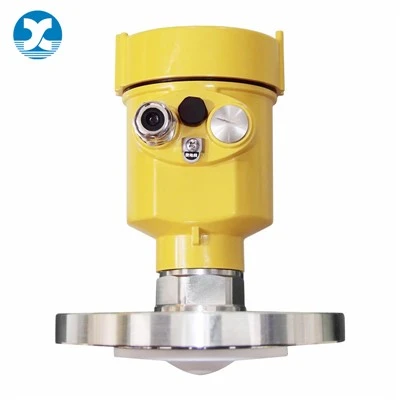
Why Choose Radar Level Sensor for Interface Measurement
Most standard level transmitters and non-contact radar devices are engineered solely to register the uppermost liquid surface. Where two immiscible liquids coexist, or solid particles settle out from suspension, generic instruments cannot distinguish the transition zone between different media. This creates blind spots for separation processes, batch formulation and tank inventory control, often leading to sub-par product quality and process inefficiency.
This guided-wave interface sensor addresses that exact limitation. Microwave pulses propagate down the physical cable probe, enabling the transmitter to pick up reflections at medium-to-medium boundaries. Low-frequency guided-wave signals are far less impacted by tank-side disturbances such as foaming, boiling vapor or ongoing mixing activity. Readings stay consistent regardless of normal shifts in process temperature and pressure.
Its slim-profile cable probe fits locations where bulky horn or lens antennas cannot physically install. Threaded and flanged process connections simplify retrofitting onto existing tank nozzles. Total cost-of-ownership stays low thanks to minimal servicing requirements. For extreme ranges, aggressive media or heightened pressure-temperature envelopes, our application engineers can propose alternative hardware variants tailored to your process.
Key Features and Benefits
Targeted Stratified-Media Interface Detection
Optimised to capture liquid-liquid and liquid-solid boundary positions. Detects the height of separation layers that conventional level sensors fail to register, supporting continuous monitoring of interface thickness and boundary elevation.
Superior Immunity to Process Disturbances
Guided pulsed-wave technology minimises measurement drift caused by foam build-up, vapour clouds and mechanical agitation. Stable readings persist even when tank contents are stirred or experience turbulent surface movement.
Broad Operating Envelope
Handles process temperatures spanning -40 ℃ up to 250 ℃, together with pressures from full vacuum-0.1 MPa through to 2.1 MPa. Covers the majority of general-purpose atmospheric, negative-pressure and moderate-pressure vessels for liquids and granular solids.
Reliable Measuring Precision
Delivers consistent ±5 mm measurement accuracy, furnishing dependable data for automated separation workflows, recipe batching and closed-loop process regulation.
Slim Stainless-Steel Cable Probe
High-tensile stainless-steel cable probe requires very little overhead clearance. Well-suited for horizontal vessels, compact tanks and installations constrained by limited vertical headroom.
Flexible Field Mounting Options
Supports threaded or flanged inlet connections for straightforward fitting to standard tank nozzles. Quick commissioning reduces on-site labour and equipment downtime.
Multiple Commissioning & Communication Paths
Local on-tank display plus keypad operation; Bluetooth-enabled on-site configuration; optional 5G remote access for off-site parameter adjustment and diagnostics. Offers multiple output protocols for seamless integration into distributed control systems.
Intrinsically Safe with Solid Environmental Protection
Certified Ex ia IIC T6 Gb for hazardous-area deployment; IP67 enclosure rating withstands damp plant environments and airborne contamination for long-term unattended operation.
Technical Specifications
This interface-focused guided wave radar leverages proven low-frequency pulse radar technology, tuned to resolve medium-to-medium boundaries rather than only top-surface level. It balances precision, noise immunity and wide condition coverage for mainstream industrial tank applications. Please consult our engineering team for highly aggressive or extreme-range scenarios.
|
Parameter |
Specification |
|
Applicable Media |
Liquids, solid particles, liquid-liquid stratified media, liquid-solid stratified media |
|
Measuring Range |
0 ~ 30 m |
|
Process Connection |
Thread / Flange |
|
Medium Temperature |
-40 ℃ ~ 250 ℃ |
|
Process Pressure |
-0.1 MPa ~ 2.1 MPa |
|
Measuring Accuracy |
±5 mm |
|
Protection Class |
IP67 |
|
Frequency Range |
100 MHz ~ 1.8 GHz |
|
Explosion Proof Grade |
Ex ia IIC T6 Gb |
|
Signal Output |
Standard: 4-20mA / HART two-wire; Optional: custom four-wire, RS-485 / Modbus protocol |
|
Power Supply |
Two-wire / Four-wire, DC24V / AC220V |
|
Antenna / Probe Type |
High-strength stainless steel cable probe |
Applications
Oil-Water Separator Tanks
Track oil-water boundary levels inside separator vessels to support automated draw-off control. Widely deployed across petrochemical facilities and industrial wastewater workflows.
Stratified-Liquid Chemical Storage Vessels
Monitor density-differentiated chemical layers. Supplies accurate boundary data for blending, purification and reaction control to stabilise production formulation accuracy.
Liquid-Solid Mixing Reaction Tanks
Suitable for tanks where granular solids settle out of liquid suspension. Reliably captures both total level and the sediment-liquid transition interface.
Horizontal Process Storage Tanks
Compact cable probe copes with restricted vertical installation space typical for horizontal vessels, delivering stable level and interface monitoring.
Water Treatment Sedimentation & Holding Tanks
Monitor water depth alongside sludge-water interfaces inside settling basins and intermediate process tanks. Maintains stable readings under turbulence and surface foaming.
General-Purpose Moderate-Pressure Vessels
Fits most manufacturing-sector tanks working under normal-to-moderate pressure and temperature for liquid and granular-solid inventory measurement.
Frequently Asked Questions
Q1: In what way does interface-measuring guided-wave radar differ from regular liquid radar transmitters?
A: Ordinary non-contact radar instruments can only read the top liquid surface. This guided-wave unit uses low-frequency pulses travelling down the probe, passing through upper-layer media and identifying subsurface boundaries between two dissimilar materials. That capability is essential for oil-water separation, chemical stratification and sediment-layer monitoring and cannot be replicated by surface-only radar sensors.
Q2: Will foam or tank stirring upset measurement output?
A: Far less so than free-space radar. Since signals travel along the physical probe path, surface foam, vapour and mixing turbulence exert minimal influence. Both level and interface readings remain steady through these process events.
Q3: How durable is the stainless-steel cable probe under continuous service?
A: The high-tensile stainless-steel cable probe offers good tensile strength alongside broad temperature-pressure tolerance. It resists mechanical fatigue across long operational cycles and keeps maintenance overhead low.
Q4: What options exist for setup and remote diagnostics?
A: Operate locally via on-board display and keys; configure wirelessly on-site over Bluetooth; or select optional 5G remote connectivity for off-site parameter tuning and fault checking, supporting centralised plant asset management.
Q5: Which signal outputs can be supplied?
A: Standard configuration is two-wire 4-20 mA / HART compatible with most industrial control hardware. Custom four-wire and RS-485 Modbus communication are available to satisfy varied automation system requirements.
Q6: Can the unit be adapted for highly challenging operating conditions?
A: This baseline model covers most general-purpose interface measurement cases. For extreme temperature, elevated pressure, aggressive media or extra-long measuring spans, share your full process data so our team can recommend suitable alternative probe materials and assembly designs.
If your site requires dependable detection of liquid-liquid interfaces, liquid-solid sediment layers or standard level measurement - especially where foam, vapour, mixing agitation or cramped nozzle space present difficulties - our interface-measurement guided wave radar provides a practical solution. Kindly supply medium details, stratification conditions, process temperature-pressure values, target measuring range and installation constraints. Our application-engineering group will advise the most appropriate configuration and furnish a custom-tailored technical proposal together with competitive pricing.
Hot Tags: radar level sensor for interface measurement | guided wave radar transmitter, China radar level sensor for interface measurement | guided wave radar transmitter manufacturers, suppliers, factory, guided radar level measurement, guided radar level sensor, Guided Wave Cable Radar Level Sensor, Guided Wave Coaxial Tube Radar Level Sensor, oil tank sight gauge float, radar ultrasonic sensor