Product Overview
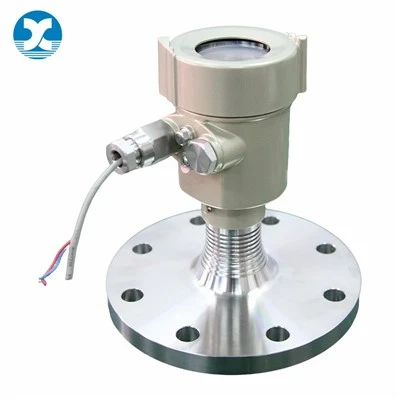
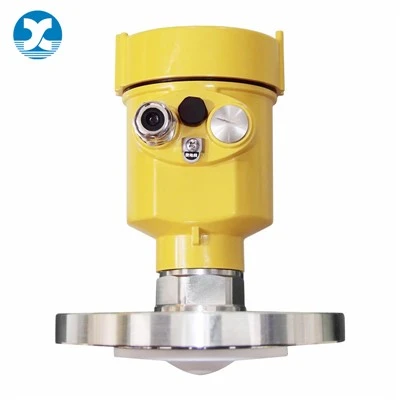
The High-Pressure FMCW Radar Level Sensor is an industrial-grade non-contact measurement instrument engineered specifically for liquid level detection in sealed process vessels operating under elevated pressure conditions. Unlike conventional radar level meters designed for atmospheric storage, this instrument incorporates a precision-forged pressure-rated flange assembly, multi-seal barrier architecture, and a pressure-compensated antenna system that together enable reliable operation at process pressures reaching 10.0 MPa. The device leverages 80 GHz FMCW radar technology to deliver ±3 mm measurement precision across a 0–60 m range, making it ideally suited for sealed reactors, pressure storage drums, and closed-loop process containers found in petrochemical, refining, and specialty chemical manufacturing.
Engineering Advantages for Pressurized Service
Conventional radar level transmitters typically rely on standard PN16/PN25 flange connections and basic gasket seals-configurations that work adequately in atmospheric tanks but become vulnerable when subjected to the mechanical stresses of pressurized environments. Under sustained internal pressure, standard flanges can warp, gaskets can extrude, and signal paths can distort, resulting in measurement drift, frequent recalibration, and in worst-case scenarios, hazardous medium release.
Closed vessels used in high-pressure synthesis, refined product storage, and pressurized process streams demand instrumentation that maintains both mechanical integrity and signal fidelity across thousands of pressure cycles. Pressure-induced density variations and surface agitation further complicate measurement stability, while inadequate flange ratings create persistent leakage pathways.
Our high-pressure radar level sensor addresses these challenges through a purpose-built mechanical architecture. The integrally forged flange eliminates weld joints that could become weak points, while the multi-layer sealing stack provides redundant containment barriers. An onboard pressure-adaptive signal processing routine continuously compensates for density shifts and surface turbulence induced by pressure changes, preserving measurement consistency without manual intervention. Being a non-contact FMCW device, it avoids all wetted-part failures-no probe to foul, coat, or corrode-offering a maintenance advantage over guided-wave alternatives in demanding pressurized liquid service.
Core Technical Advantages
Precision-Forged Pressure-Rated Flange Assembly
The sensor utilizes a one-piece forged flange body available in PN40, PN63, PN100 and Class150 through Class600 ratings. The monolithic construction resists warping and bolt-load relaxation even after prolonged exposure to cyclic pressure loading, eliminating the leakage paths that plague bolted standard flange assemblies.
Multi-Layer Redundant Sealing Architecture
A combination of high-integrity pressure gaskets and a multi-channel mechanical lock creates a sealing system that tolerates repeated pressurization and depressurization cycles without degradation. This architecture prevents process medium escape and blocks external contaminant ingress, preserving both product integrity and environmental compliance in sealed tank service.
Pressure-Compensated 80GHz FMCW Detection
An embedded compensation algorithm continuously monitors and corrects for pressure-induced signal deviations within the closed vessel environment. The 3-degree narrow-beam radar energy remains tightly focused on the liquid interface, rejecting false returns from vapor layers, agitator currents, and internal structural reflections to produce stable, repeatable level data.
Contact-Free Measurement Principle
Because the radar beam travels through the vapor space above the liquid without physical contact, there are no immersed components to accumulate deposits, suffer erosion, or require replacement. This contact-free approach dramatically reduces lifecycle maintenance costs compared to contact-based level instruments in aggressive liquid service.
Broad Liquid Medium Compatibility
The pressure-rated antenna assembly can be specified with PTFE or high-purity ceramic wetted surfaces, accommodating a wide spectrum of liquid media including petroleum fractions, organic solvents, and weak-to-moderate corrosive chemical solutions. The sensor performs reliably in environments combining elevated pressure with light vapor generation and mild chemical attack.
Extended Pressure and Temperature Envelope
Standard configurations cover vacuum through 4.0 MPa working pressure, with custom-forged options extending to 10.0 MPa. Process temperature capability spans -40°C to 180°C, with ceramic antenna upgrades available for more extreme thermal environments. This range encompasses the majority of industrial pressurized liquid handling scenarios.
Dual Certification Safety & Environmental Protection
The instrument carries both intrinsic safety (Ex ia IIC T6 Ga) and flameproof (Ex db IIC T6 Gb) certifications, permitting installation in Zone 0, 1, and 2 hazardous areas where flammable vapors may be present. An IP67-rated enclosure provides complete dust tightness and protection against temporary water immersion, suitable for both indoor process bays and exposed outdoor installations.
Versatile Configuration and Communication Options
Field commissioning is supported through local LCD interface with keypad, Bluetooth wireless programmer, and remote PC-based configuration software. Process communication defaults to 4–20mA with HART protocol, with RS485 Modbus available as an option, enabling straightforward integration into PLC and DCS architectures for centralized monitoring and automated control.
Technical Specifications
|
Parameter |
Specification |
|
Suitable Media |
Liquid chemicals, petroleum products, solvents, corrosive liquids |
|
Operating Frequency |
76–81 GHz FMCW |
|
Beam Spread |
3° narrow beam |
|
Measurement Range |
0 – 60 m |
|
Measurement Accuracy |
±3 mm |
|
Resolution |
±1 mm |
|
Working Pressure (Standard) |
-0.1 MPa to 4.0 MPa |
|
Working Pressure (Custom) |
Up to 10.0 MPa (requires forged flange) |
|
Process Temperature |
-40°C to 180°C (ceramic antenna for higher temperatures) |
|
Ambient Temperature |
-40°C to 80°C |
|
Wetted Materials |
PTFE / High-purity Ceramic (selectable) |
|
Pressure Connection |
Forged stainless steel flange: PN40 / PN63 / PN100; Class150–Class600 (custom) |
|
Housing |
Corrosion-coated aluminum alloy / Stainless steel (selectable) |
|
Power Supply |
2-wire / 4-wire, DC 24V |
|
Signal Output |
4–20mA + HART / RS485 Modbus (optional) |
|
Cable Entry |
M20×1.5 / 1/2" NPT |
|
Ingress Protection |
IP67 |
|
Hazardous Area Certifications |
Ex ia IIC T6 Ga |
|
Commissioning Methods |
Local LCD keypad, Bluetooth wireless, remote PC |
|
Available Accessories |
High-pressure gasket kit, pressure-rated antenna assembly, purge connection kit |
Target Industries & Use Cases
High-Pressure Synthesis Reactors
Delivers precise liquid level monitoring in closed synthesis reactors and pressurized mixing vessels used in fine chemical, pharmaceutical, and battery material production, where sustained pressure cycling is routine.
Refinery Pressure Storage Infrastructure
Provides dependable level detection in crude oil buffer drums, pressurized refined product tanks, and intermediate process vessels within petroleum refining complexes.
Process Industry Pressure Vessels
Applicable to pressurized heating drums, sealed evaporators, and pressure equalization tanks across continuous process lines, resolving measurement instability caused by internal pressure swings.
Corrosive Liquid Pressure Storage
The PTFE and ceramic antenna material options enable reliable level monitoring of pressurized weak and moderately corrosive solvent and chemical storage tanks, avoiding the seal failures and signal loss common with conventional radar instruments.
Modular Pressure Package Systems
Designed for skid-integrated pressure vessel arrays in chemical and energy plants, enabling consolidated level monitoring across multiple pressurized process units from a single instrumentation platform.
Common Technical Questions
Q1: How does this instrument differ from standard industrial radar level meters?
Standard radar level meters typically employ low-pressure flange ratings and are intended for atmospheric or near-atmospheric tank service (generally below 2.0 MPa). Our high-pressure variant incorporates a forged pressure-rated flange and reinforced sealing system engineered explicitly for sealed vessels. The mechanical design and signal processing are optimized to withstand pressure-induced measurement disturbances that ordinary instruments cannot handle.
Q2: Will internal pressure damage the electronic components?
The electronic enclosure operates at ambient atmospheric pressure and is physically isolated from the process medium. All pressure-bearing loads are carried by the flange and sealing assembly; the sensitive electronics remain in a protected, non-pressurized compartment, ensuring long-term operational reliability.
Q3: How does the sensor perform during rapid pressure transients?
The integrated pressure-adaptive compensation routine continuously tracks and corrects for signal shifts caused by sudden pressure changes inside the vessel. This enables the sensor to maintain stable, accurate level readings without requiring periodic recalibration after pressure events.
Q4: Are non-standard flange dimensions available?
Yes. We supply metric flanges in PN40, PN63, and PN100 ratings, as well as ASME Class150 through Class600 flanges. Custom pressure ratings and flange dimensions can be manufactured to match specific vessel nozzle configurations.
Q5: Is this sensor suitable for high-temperature pressurized service?
The baseline model supports process temperatures up to 180°C. For combined high-temperature and high-pressure applications, a ceramic antenna paired with a thermal isolation sleeve can be specified to meet demanding thermal and pressure requirements simultaneously.
Q6: Why select a non-contact radar over a guided-wave radar for pressurized liquid service?
Non-contact radar eliminates the risk of probe fouling, coating, and corrosion because nothing is immersed in the process medium. This makes it particularly advantageous for pressurized vessels handling materials prone to scaling or rapid vaporization. Guided-wave radar remains a better choice only for very low-dielectric liquids or precise interface measurement between immiscible layers.
If your facility operates sealed reactors, pressurized storage drums, or closed process vessels handling liquid media, our High-Pressure FMCW Radar Level Sensor provides a purpose-engineered solution to the measurement instability and sealing vulnerabilities that plague conventional level instruments in pressurized environments. Please share your operating pressure, medium type, process temperature, flange specification, and any special requirements. Our engineering group will propose an optimally configured pressure-rated instrument and provide a competitive factory-direct quotation with full technical documentation.
Hot Tags: high-pressure fmcw radar level sensor for sealed vessel level monitoring, China high-pressure fmcw radar level sensor for sealed vessel level monitoring manufacturers, suppliers, factory, 26GHz Radar Level Sensor for Basic Applications, 80GHz Radar Level Sensor, carb float height tool, Guided Wave Radar Bypass Tube Level Sensor, magnetic level indicator with transmitter, magnetic removable propane tank gauge