


Drawing on twenty years of field instrumentation commissioning, fault diagnosis and technical after-sales work across global chemical, oil & gas, food processing and bulk solids industries, I have witnessed countless costly issues stemming from non-standard radar level transmitter installation. Many overseas procurement teams and on-site maintenance technicians regard installation as a simple mounting task, overlooking the strict industry specifications behind it.
I have handled multiple overseas project cases where newly delivered high-quality radar units suffered unstable echo signals, persistent reading drift or flange leakage shortly after commissioning. In serious scenarios, improper assembly voids the manufacturer's official warranty, forcing factories to halt production for repeated disassembly and re-installation. For overseas facilities, cross-border after-sales travel, spare part re-delivery and unplanned downtime will push up operational costs significantly.
There is no doubt that modern FMCW and guided wave radar boast excellent adaptability to harsh industrial conditions. Yet their long-term stability, measurement accuracy and service life all depend entirely on standardized installation. A well-executed installation not only guarantees consistent performance for 5 to 8 years, but also cuts down routine maintenance workload and potential safety hazards in the later stage.
This guide is compiled from practical experience accumulated in thousands of on-site projects worldwide. I will walk you through the complete workflow covering pre-install verification, mounting position selection, physical assembly, cabling, parameter configuration and post-commissioning testing. Whether you are deploying new radar transmitters for newly built production lines, or repositioning existing units to resolve measurement failures, these field-proven rules will help you complete installation in compliance with international standards and maximize the value of your instrumentation investment.

1. Pre-Installation Planning & Preparation
Adequate pre-work is the foundation of trouble-free installation. Rushing to unbox and mount equipment without full confirmation is the main cause of most hidden faults. Before starting any on-site operation, take time to verify all core parameters and prepare tools and accessories in place.
1.1 Confirm Actual Working Conditions & Matching Specifications
Clarify on-site operating parameters one by one, as these details determine installation methods, accessory selection and subsequent parameter debugging. The following checklist covers all key items for field verification.
|
Parameter |
Key Details to Confirm |
Impact on Installation Work |
|
Vessel structure & size |
Tank shape, overall height, inner diameter, internal components including agitators, support beams and heating coils |
Define safe mounting offset and clear signal path requirements |
|
Medium characteristics |
Dielectric constant, operating temperature, working pressure, viscosity and tendency to generate foam |
Determine antenna style, gasket material and whether a stilling well is required |
|
Process operation status |
Continuous stirring, frequent material feeding/discharging, turbulent liquid surface |
Judge the necessity of anti-interference auxiliary components |
|
Site environment |
Indoor or outdoor layout, corrosive atmosphere, mechanical vibration and hazardous area classification |
Select matched cable glands, lightning protection parts and follow explosion-proof installation codes |
As a key reminder for global users: The minimum dielectric constant for standard non-contact radar is 1.4. For media with lower dielectric values, you must adopt guided wave radar or customized special models, whose installation requirements are completely different from conventional products. For hazardous zones with ATEX or IECEx certification requirements, all installation steps must comply with explosion-proof regulations from the very beginning.
1.2 Choose the Right Radar Type for Installation
Two mainstream radar types dominate industrial level measurement, and their installation criteria have clear distinctions. Confirm the product model before construction to avoid mismatched operation.
Non-contact radar including 26GHz and 80GHz models is widely applied to conventional storage tanks and process vessels. The 80GHz variant features an ultra-narrow beam angle, making it ideal for small tanks or vessels with dense internal structures, while it also has stricter rules for mounting positions.
Guided wave radar adopts rod or cable probes extending directly into the medium. It performs outstandingly in liquid interface measurement and low-dielectric medium applications. The most critical rule for this type is keeping the probe perfectly vertical after installation, which cannot be ignored under any circumstances.
1.3 Gather Tools & Supporting Accessories
Prepare all tools and standard accessories in advance to avoid frequent work interruptions. Essential items include standard flanges, corrosion-resistant gaskets, calibrated torque wrenches, spirit levels, multimeters and personal protective equipment for elevated work.
Never replace original factory supporting parts with random generic accessories. In particular, gaskets and cable glands with mismatched specifications will directly lead to sealing failure, signal interference or even invalidation of explosion-proof certification. Keep the manufacturer's official installation manual on site for reference throughout the whole process.
2. Mounting Position Selection (Most Critical Step)
Based on decades of fault statistics, more than 60% of radar measurement abnormalities are caused by improper mounting positions. Choosing a qualified installation spot is far more important than simple assembly work. Below are universal positioning rules summarized from long-term global field service.
2.1 General Mounting Rules for All Vessels
Never install radar at the geometric center of cylindrical tanks. The central area tends to generate multiple reflected echoes from tank walls and internal parts, resulting in false level readings.
Keep the transmitter 1/6 to 1/4 of the tank's inner diameter away from the tank wall, with a minimum safe distance of 300mm. This layout effectively prevents the radar beam from hitting the side wall and creating interference signals.
Ensure a completely unobstructed signal path directly below the antenna. No pipelines, brackets or heating coils are allowed within the beam coverage area.
Maintain a minimum distance of 2 meters from feeding ports, discharging ports and agitators. Material inflow and mechanical stirring will create violent liquid turbulence and distort radar signals severely.
2.2 Positioning Tips for Different Vessel Types
Adjust the mounting position according to different tank structures. For standard cylindrical tanks, strictly follow the 1/6 ~ 1/4 diameter offset rule. For spherical or elliptical vessels, install the radar at half the tank radius from the center, to ensure the signal can reach the lowest liquid level stably. For rectangular tanks, set the unit more than 300mm away from all side walls, and select the midpoint of the shorter side for better signal performance.
For open-air tanks affected by wind and rain, or vessels with severe foam and liquid turbulence, a stilling well is highly recommended. It can form a stable liquid surface for detection and greatly improve measurement reliability.
2.3 Special Notes for Guided Wave Radar
For guided wave radar installation, use a spirit level to ensure the rod or cable probe is fully vertical after assembly. The probe should terminate approximately 50mm above the tank bottom and must not come into contact with any internal structures. For cable-style guided wave radar, maintain proper tension to prevent cable swinging caused by liquid flow and process vibration.
3. Physical Assembly & Installation Steps
After confirming the mounting position, carry out physical assembly in strict accordance with standard procedures. Every detail in this stage affects sealing performance, structural stability and long-term service life of the equipment.
3.1 Pre-check on Mounting Nozzle
First conduct a full inspection on the tank nozzle and connecting flange. Thoroughly remove rust, dirt and residual medium on the surface, and reject any nozzles with cracks or deformation.
Select gaskets matching the medium's temperature, pressure and corrosiveness. Never use oversized gaskets that protrude into the tank cavity, as they will block the radar beam and trigger signal failure. Meanwhile, verify nozzle height: the antenna must extend 10mm to 50mm below the nozzle lip, to eliminate false reflections from the nozzle edge.
3.2 Flange & Threaded Installation Operations
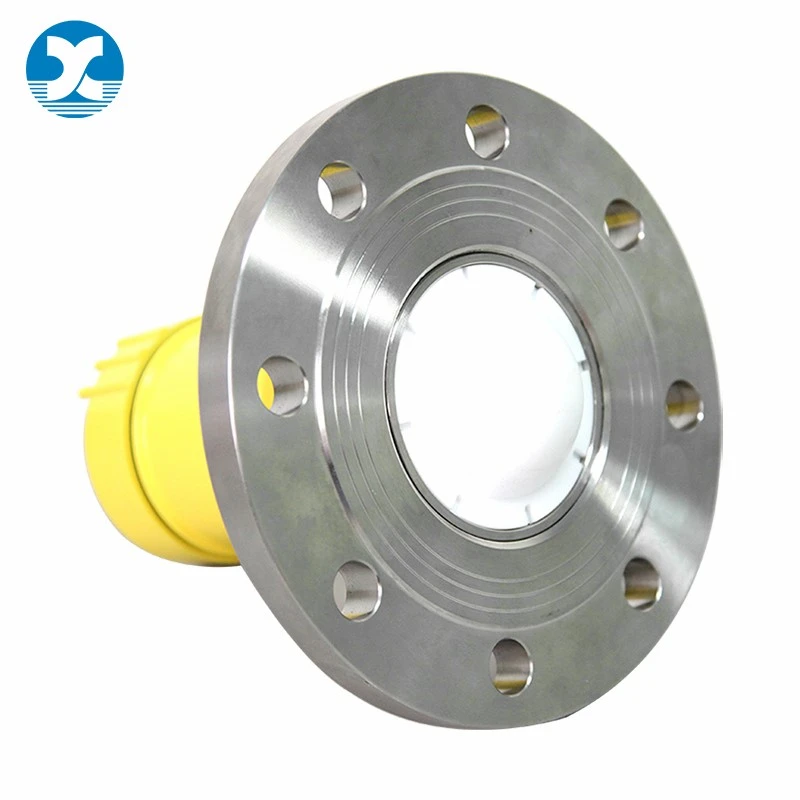
Flange connection is the mainstream design for export-oriented industrial radar. Align the radar flange with the tank flange and match all bolt holes precisely. Tighten all bolts by hand first, then use a torque wrench for final fastening. For standard PN16 flanges, the recommended torque ranges from 25 to 35 Nm; increase torque appropriately for high-pressure PN40 and above flanges. Over-tightening will crush the gasket and damage the sealing structure.
Use a spirit level to check the antenna perpendicularity to the liquid surface, with a maximum allowable deviation of ±0.5°. For swivel-type radar, do not exceed the factory-specified 10° adjustable angle.
For threaded connection models, wrap PTFE tape evenly on male threads. Take extra care to avoid adhesive or tape residue sticking to the antenna. Screw the main body tight by hand first, then apply force only on the hexagonal part of the housing with a wrench. Never twist or apply pressure on the antenna to prevent permanent structural damage.
3.3 Install Auxiliary Protective Accessories
Select and install supporting accessories based on actual site conditions. For dusty environments and vessels with dense steam, install an air purge system and connect the air pipeline properly to keep the antenna clean all year round.
For outdoor installations, arrange all cable glands facing downward to prevent rainwater ingress. For areas prone to thunderstorms, equip surge protectors for both power and signal lines to shield internal circuits. For explosion-proof radar deployed in chemical and oilfield hazardous zones, all supporting accessories must be original certified explosion-proof parts; unauthorized replacement is strictly prohibited.
4. Electrical Wiring & On-site Configuration
Standard cabling and parameter debugging guarantee stable signal transmission and accurate data output. This section is also one of the most frequent error points for on-site technicians.
4.1 Wiring Specifications
Adopt shielded cables for signal lines to suppress electromagnetic interference. Separate power cables and signal cables by more than 300mm, and do not lay them in the same pipeline.
Follow the polarity markings on terminal blocks strictly during wiring. Wrong connection will burn out internal circuits and cause irreversible equipment damage. All grounding wires must be connected to an independent dedicated grounding point, and never share the grounding circuit with large mechanical equipment.
For outdoor and corrosive sites, use heat-shrink tubing or sealed junction boxes to wrap wiring joints, achieving full waterproof and anti-corrosion protection. For intrinsically safe radar in hazardous areas, all wiring must comply with intrinsic safety circuit standards.
4.2 Basic Parameter Configuration
Power on the radar and wait 2 to 5 minutes for complete initialization. Complete basic settings via the local display, HART or Modbus communicator.
First set the total tank height and upper/lower measurement range, then input the accurate dielectric constant of the measured medium. Next select the output signal type including 4-20mA, HART or Modbus according to the on-site control system.
The core step is echo processing configuration. Adjust the signal threshold to filter out false echoes generated by tank walls and internal obstacles, so the radar only captures valid liquid level signals. Finally set high and low level alarms in line with production safety regulations.
4.3 Preliminary Signal Inspection
After configuration, check the echo curve displayed on the device. A clear and stable curve indicates good signal status. If the curve is disordered or signal strength is too low, recheck the mounting position and wiring immediately to eliminate hidden problems.
5. Post-Installation Testing & Troubleshooting
Never put the radar into formal operation right after installation. Complete full-range performance testing first to eliminate potential faults.
5.1 Multi-scene Functional Testing
Start with an empty tank test to verify the zero-point reading and confirm the blind zone meets technical requirements. Then fill the tank with medium gradually, and compare radar readings with manual measuring tools such as dipsticks or sight glasses to verify full-range measurement accuracy.
Simulate normal operating conditions including material feeding and stirring to test the radar's anti-interference capability under turbulent liquid surfaces. For outdoor units, conduct additional waterproof and dustproof inspection.
5.2 Common Installation Faults & Solutions
The table below summarizes typical on-site faults induced by non-standard installation, together with root causes and targeted solutions for quick field reference.
|
Fault Phenomenon |
Root Cause |
Recommended Solution |
|
Fluctuating and unstable readings |
Antenna out of perpendicular angle, or mounting position too close to tank wall |
Readjust installation angle or relocate the radar to the qualified position |
|
Extremely weak signal or no reading |
Obstacles in the signal path, or incorrect dielectric constant setting |
Clear internal obstructions and re-calibrate medium parameters |
|
Persistent false high level reading |
Oversized gasket protruding into the tank cavity |
Replace with matched thin gasket that does not block the signal path |
|
Signal loss at high liquid level |
Antenna fully retracted inside the nozzle |
Adjust installation height to extend the antenna outward |
|
Severe interference from foam |
Conventional radar with weak anti-foam performance |
Upgrade to 80GHz high-frequency radar or install a stilling well |
I recommend recording all installation parameters, test data and adjustment details completely. These documents will provide great convenience for subsequent routine maintenance and fault diagnosis.
6. Routine Maintenance Suggestions for Long-term Stable Operation
Qualified installation lays a solid foundation, and regular scientific maintenance can further extend the equipment's service life. Formulate a targeted maintenance plan based on on-site working conditions.
Carry out monthly visual inspections to check for shell damage, condensed water inside the housing and dirt accumulation on the antenna. Clean the antenna every quarter with a soft cloth and neutral detergent; abrasive brushes and corrosive solvents are forbidden.
Complete accuracy comparison tests every six months, and perform recalibration in a timely manner if minor deviation occurs. Check the aging status of gaskets and sealing parts every 2 to 3 years and replace worn components to prevent medium leakage. In addition, pay attention to official firmware updates, and conduct reasonable upgrades to optimize overall equipment performance.
7. Frequently Asked Questions (FAQ)
Q1: Is there a unified standard for radar mounting distance from the tank wall?
The general rule is 1/6 to 1/4 of the tank inner diameter, with a minimum distance of 300mm. 80GHz narrow-beam radar has relatively loose requirements, while guided wave radar and radar for high-precision measurement need stricter position control.
Q2: Can I use ordinary gaskets for explosion-proof radar installed in hazardous areas?
Absolutely not. Explosion-proof radar must adopt original factory certified sealing accessories. Random replacement with ordinary gaskets will damage the explosion-proof structure and invalidate relevant certification, bringing serious safety risks.
Q3: What solutions are available if radar signals are easily disturbed by liquid foam?
You can choose 80GHz high-frequency radar with stronger anti-foam capability, or install a stilling well to form a calm liquid surface for stable detection. For extreme foam conditions, we suggest customized parameter debugging combined with structural optimization.
Q4: Does the antenna need extra protection for outdoor installed radar?
Arrange cable glands facing downward for basic waterproofing. Add protective covers for sites exposed to strong sunlight or extreme low temperature. Clean dust and ice on the antenna regularly in harsh outdoor environments.
Q5: Is recalibration required after repositioning the radar?
Yes. Any change to the mounting position will alter signal reflection paths. Full zero-point and full-range calibration must be completed before the equipment is put back into operation.
8. Conclusion
Standardized installation is the prerequisite for radar level transmitters to deliver their designed performance. From pre-install verification and position selection, to physical assembly, cabling and post-commissioning testing, every procedure follows mature industry specifications. Following these field-tested rules can effectively avoid rework, production downtime, warranty disputes and safety hazards.
The guidance above is sufficient for conventional storage tanks and ordinary process vessels. However, many complex working conditions pose higher challenges: low-dielectric medium measurement, high-pressure high-temperature reactors, Class I explosion-proof hazardous zones, large dust silos and vessels with persistent foam all require professional customized installation schemes. Improper operation in these scenarios will easily lead to recurring faults.
If you are faced with complex on-site conditions, or need professional guidance for installation specification confirmation, parameter debugging and fault elimination for your radar level transmitters, please feel free to contact our professional technical team. We provide one-stop customized solutions, remote technical guidance and long-term after-sales support tailored to your actual project requirements.
9. References
- Radar Level Transmitter Installation Standard, International Society of Automation (ISA)
- VEGAPULS Series Radar Installation & Operation Manual, VEGA Grieshaber KG (2024)
- Guided Wave Radar Field Installation Specification, Endress+Hauser (2023)
- Industrial Instrument Wiring & Explosion-proof Installation Code, Global Automation Industry Association
- Best Practices for Radar Measurement in Turbulent & Foamy Media, Industrial Instrument Technical Journal (2025)


