1. Introduction
Reliable industrial level measurement is the foundation of daily inventory control, automated process operation and site safety compliance. This applies across oil and gas, chemical manufacturing, food processing, power plants and many other heavy industries. With more than 15 years working in industrial instrumentation export, I have talked with thousands of plant managers, maintenance technicians and procurement engineers worldwide. One question comes up time and again: just how precise are modern radar level transmitters in real working conditions?
Radar technology has advanced greatly over the years. Today's mainstream FMCW and high-frequency 80GHz radar units deliver far better stability and precision than early pulse radar models. That said, the accuracy figures printed on official datasheets often differ from actual on-site performance. Many buyers only refer to nominal parameters before purchasing, and end up facing unstable readings or failed measurement after installation.
Drawing on massive field installation records, long-term troubleshooting cases and after-sales service experience, this guide will break down the real accuracy performance of industrial radar transmitters. We will also cover key influencing factors, practical selection rules and maintenance tips. Whether you plan to replace old ultrasonic or float sensors, or source radar devices for brand-new projects, this content will help you avoid misleading marketing claims and make sensible purchasing decisions.
2. What Does "Accuracy" Mean for Industrial Radar Level Transmitters?
Before comparing product performance, it is necessary to clarify how the industry defines accuracy for industrial radar sensors. Unlike high-precision laboratory equipment, industrial instruments are designed to adapt to complex on-site environments, so their accuracy specifications have clear practical meanings.
2.1 Accuracy Specifications Explained
Manufacturers usually mark two types of accuracy on product manuals: absolute error and percentage of full scale (FS). For most industrial storage tanks and production vessels, absolute error is the more valuable reference. For instance, a radar with ±3mm absolute error works much better for a 10-meter tall tank than a model marked ±0.1% FS, which equals around ±10mm deviation in the same scenario.
The standard accuracy data is tested under ideal lab conditions: steady ambient temperature, normal atmospheric pressure, calm liquid surface and qualified medium dielectric constant above 1.4. In actual factories, working conditions are never perfect. This is why you need to learn what factors will cause accuracy loss in daily operation.
2.2 Key Accuracy Metrics to Compare
When you shortlist different radar models, focus on three core indicators closely related to measurement precision:
Basic Error: The fundamental accuracy value measured under standard reference conditions (20°C, normal pressure and static medium surface).
Repeatability: The sensor's ability to output identical readings for the same material level. Normally, repeatability is better than basic accuracy, commonly within ±0.5mm.
Linearity: It reflects whether measurement data changes evenly across the full measuring range. This metric is critical for custody transfer applications where level data directly links to trading volume.
For custody transfer and fiscal measurement projects, select radar transmitters certified to international standards such as API 2350 or OIML R85. These certified products maintain ultra-tight accuracy within ±0.5mm to meet commercial measurement requirements.
3. Typical Accuracy Ranges by Radar Type and Frequency
Overall measurement accuracy varies obviously based on radar working frequency and structural type. Below is the real performance and application scope of mainstream industrial radar products you can refer to.
3.1 Frequency Matters: Low vs. High Frequency Radar
Working frequency is one of the core elements deciding radar accuracy and beam performance. The comparison table below shows their practical differences:
|
Radar Frequency |
Typical Accuracy |
Best Applications |
Key Advantages |
|
6–26 GHz (low to mid) |
±3mm to ±10mm |
Large storage tanks, flat liquid surfaces, high-dielectric media |
Long measuring range up to 70m, cost-effective for large-scale deployment |
|
80 GHz (high frequency) |
±1mm to ±3mm |
Small vessels, bulk solids, uneven material surfaces, dusty silos |
Ultra-narrow beam angle (3°–5°), effectively avoids interference from internal tank structures |
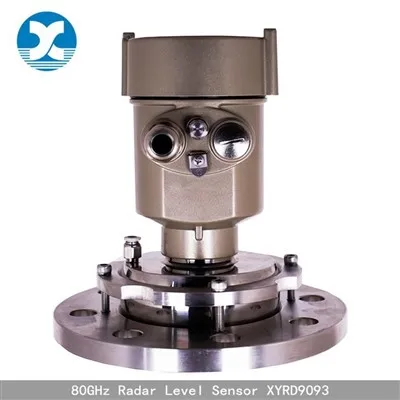
The narrow beam of 80GHz radar is a huge advantage for complex tanks and silos. It rarely picks up false echoes from tank walls, brackets and pipelines, so it keeps stable precision all the time.
3.2 Non-Contact vs. Guided Wave Radar Accuracy
The two mainstream radar designs also present different accuracy characteristics for industrial use:
- Non-contact FMCW Radar: 80GHz models offer ±1mm to ±3mm accuracy, while 26GHz versions range from ±3mm to ±10mm. It is widely used for large tanks, corrosive liquids and scenarios that forbid direct medium contact.
- Guided Wave Radar (GWR): Its typical accuracy stays at ±1mm to ±2mm, not affected much by vessel size. It is the top choice for low-dielectric media, liquid interface measurement and small tanks with severe liquid turbulence.
- Please note that guided wave radar relies on physical probes for signal transmission. We do not recommend it for tanks with large, hard solid particles, as falling materials may bend or damage the probe over time.
4. Factors That Degrade Radar Level Transmitter Accuracy
I have handled hundreds of accuracy-related after-sales cases over the years. Even high-grade radar transmitters will lose precision if applied improperly. The following factors are the most common causes of measurement deviation on site.
4.1 Medium Properties: Dielectric Constant and Surface Conditions
The dielectric constant (εr) of measured media directly affects microwave signal reflection. Media like water (εr≈80) have strong reflection performance, so radar can capture clear echoes and maintain high accuracy. Low-dielectric substances such as LPG and special solvents (εr < 1.4) generate weak return signals, which requires customized radar models or guided wave solutions.
Material surface conditions also bring interference. Rolling liquid and waves will create unstable echoes; thick foam absorbs microwave signals; bulk solids with a steep angle of repose scatter signals in all directions. All these issues will lead to fluctuating readings.
4.2 Installation Mistakes: The #1 Accuracy Killer
Based on our statistics, more than 60% of accuracy complaints root in incorrect installation. These frequent errors are easy to ignore but cause persistent problems:
- Mounting the radar too close to tank walls or internal support structures, against the 1/6 tank diameter installation rule
- Installing directly above feeding or discharging ports, where liquid splashing and turbulence disrupt normal signal reception
- Leaving the antenna too short, without proper protrusion below the tank roof
- Ignoring the dead zone, where the highest material level exceeds the sensor's effective measuring range
For example, a 26GHz radar with a 10° beam angle installed 30cm away from the wall of a 3-meter tank will have half of its beam hitting the wall, resulting in continuous false echoes and data drift.
4.3 Environmental and Process Conditions
Radar outperforms ultrasonic sensors in harsh environments, but extreme working conditions still impact its performance:
Rapid temperature changes may affect internal electronic components; continuous high temperature above 150°C needs high-temperature resistant antennas or cooling accessories. In vacuum or high-pressure sealed vessels, special sealed process connections are required. Besides, condensed water on antennas, floating dust and dense steam will all weaken microwave signals and reduce measurement precision.
4.4 Calibration and Maintenance Neglect
Factory default settings cannot fit all on-site conditions. Many plant operators skip professional on-site calibration after installation, which directly causes initial deviation. In addition, failing to suppress false echoes, leaving antennas covered with sticky dust, and skipping regular calibration checks will gradually make radar readings unreliable.
5. Practical Tips to Maximize Radar Level Transmitter Accuracy
Combined with years of on-site commissioning and troubleshooting experience, here is a complete set of practical guidelines to help you get the best precision from your radar devices.
5.1 Select the Right Radar for Your Application
- For common liquids with εr ≥2: Choose 80GHz non-contact radar for small vessels, and 26GHz models for large storage tanks to balance performance and cost.
- For low-dielectric liquids (εr <1.4): Adopt guided wave radar or professional low-DK non-contact radar.
- For bulk solids and dusty silos: Prioritize 80GHz narrow-beam radar with dust-proof design.
- For custody transfer and fiscal measurement: Pick FMCW radar with API 2350 or OIML R85 certification.
5.2 Installation Best Practices
- Keep the sensor 1/6 to 1/4 of the tank diameter away from tank walls.
- Reserve at least 1 meter distance from inlets, outlets and stirring equipment.
- Install stilling wells for tanks with severe liquid turbulence or thick foam.
- Ensure the antenna extends 10~50mm below the tank roof, following product manuals.
5.3 Calibration and Commissioning Steps
- Complete empty tank mapping first to identify and suppress all false echoes.
- Finish calibration based on actual empty and full height of the tank, instead of factory default data.
- For critical production lines, cross-verify readings with dipsticks or laser distance meters.
- Adjust signal gain properly to optimize signal-to-noise ratio for your specific medium.
5.4 Ongoing Maintenance Schedule
- Clean antennas every quarter; increase cleaning frequency to monthly for sticky media and heavy dust.
- Perform full calibration verification once a year with standard reference tools.
- Check probe integrity for guided wave radar and antenna alignment for non-contact radar regularly.
- Update device firmware in time when official upgrades are released.
6. Accuracy Comparison: Radar vs. Traditional Level Measurement Technologies
To help you make a clearer comparison, we list the accuracy and applicable scenarios of mainstream industrial level sensors below. You can judge which solution suits your project better:
|
Technology |
Typical Accuracy |
Best For |
Limitations |
|
80GHz FMCW Radar |
±1mm to ±3mm |
General industrial tanks, silos, bulk solids and small vessels |
Higher procurement cost than ultrasonic sensors |
|
26GHz FMCW Radar |
±3mm to ±10mm |
Large storage tanks with calm liquid surfaces |
Wide beam angle is easy to receive interference |
|
Ultrasonic Sensor |
±3mm to ±0.25% FS |
Open channels and non-critical low-precision measurement |
Easily affected by temperature, dust and steam |
|
Hydrostatic Level Sensor |
±0.25% to ±0.5% FS |
Deep tanks and high-pressure vessels |
Deviation increases as tank height rises |
|
Float Level Gauge |
±5mm to ±20mm |
Simple low-budget measurement tasks |
Prone to mechanical wear and stuck faults |
Thanks to excellent dust and vapor resistance, radar level transmitters maintain stable accuracy in harsh industrial environments, which makes them the preferred choice for most critical measurement tasks.
7. Common Misconceptions About Radar Level Transmitter Accuracy
In daily communication with global buyers, I have found many widespread misunderstandings about radar accuracy. These wrong views often lead to improper selection and extra project costs.
7.1 "All radar transmitters offer the same accuracy"
This is totally incorrect. Accuracy differs greatly by frequency, working principle and brand quality. Low-cost pulse radar can never match the precision of premium 80GHz FMCW radar, especially in complex working conditions.
7.2 "Radar works perfectly with any dielectric constant"
False. Standard non-contact radar requires a minimum dielectric constant of 1.4. It cannot capture effective echoes for ultra-low-DK media. In this case, you have to switch to guided wave radar or customized low-DK radar models.
7.3 "Once installed, radar maintains accuracy forever"
No industrial instrument can keep performance unchanged permanently. Component aging, medium adhesion and environmental erosion will gradually affect radar precision. Regular cleaning and calibration are indispensable for long-term stable operation.
7.4 "Accuracy specs in datasheets reflect real-world performance"
Manufacturer parameters are tested under ideal lab environments. Real on-site accuracy depends on three key points: correct model selection, standard installation and professional calibration.
8. Frequently Asked Questions (FAQ)
Q1: What's the minimum dielectric constant for reliable non-contact radar measurement?
A1:Most standard non-contact radar transmitters require a minimum dielectric constant (εr) of 1.4 to receive steady echo signals. For materials with εr below 1.4 such as LPG and light solvents, guided wave radar or dedicated low-DK radar is your ideal pick.
Q2: Can radar level transmitters maintain accuracy in dusty or vapor-filled environments?
A2:Yes. Microwave signals pass through dust and vapor far better than sound waves or optical signals. If your site has extremely heavy dust, equip the radar with an air purge unit to keep the antenna clean and sustain long-term precision.
Q3: How often should I calibrate my radar level transmitter?
A3:Annual calibration is enough for regular industrial applications. For custody transfer and high-precision process control, we suggest semi-annual calibration. Re-calibration is also required after equipment modification or major process adjustment.
Q4: Is 80GHz radar always more accurate than 26GHz radar?
A4:It is true for most complex scenarios. The ultra-narrow beam of 80GHz radar avoids interference from internal structures effectively. But for large tanks with wide space and calm liquid surfaces, 26GHz radar can deliver qualified accuracy at a more competitive price.
9. Conclusion
To sum up, modern industrial radar level transmitters deliver outstanding measurement accuracy when matched with proper working conditions. Premium 80GHz FMCW radar can reach ±1mm to ±3mm precision, outperforming traditional ultrasonic, float and hydrostatic sensors in harsh industrial sites.
High accuracy never comes from products alone. It relies on reasonable model selection, standard installation, professional on-site calibration and routine maintenance. Before placing orders, take time to sort out your medium properties, tank size and environmental conditions. Follow the installation and maintenance rules we shared, and your radar devices will run stably for years.
Always remember: accuracy is not just a number on a datasheet. It matters a lot to your production efficiency, inventory management and operational safety. If you are looking for suitable radar level transmitters, or troubled by unstable readings of your existing equipment, feel free to get in touch with our team. We will provide targeted product recommendations and technical support based on your actual on-site conditions.
10. References
- Radar Level Measurement Accuracy Guide, International Society of Automation (ISA)
- FMCW Technology White Paper, Emerson Automation Solutions (2024)
- Effects of Dielectric Constant on Radar Measurement, InstruNexus Technical Journal (2025)
- API 2350 Standard for Tank Level Measurement, American Petroleum Institute
- Radar Level Transmitter Installation Best Practices, VEGA Grieshaber KG (2024)
- Non-Contacting Radar vs. Guided Wave Radar: Application Guide, KROHNE Group (2023)