


1. Introduction
Silos are the primary bulk storage facilities across agriculture, chemical production, building materials, feed processing and plastic manufacturing industries. From grain, cement and mineral ores to plastic pellets and various industrial powders, bulk solids make up the majority of raw material storage for modern production plants. Keeping track of real-time material levels inside silos is essential for accurate inventory management, stable feeding control and smooth production scheduling.
That said, level measurement for bulk solids has long been a major headache for on-site technicians and procurement teams worldwide. Unlike liquids that form a flat, stable surface, bulk solids bring a host of tricky on-site issues. Flying dust, uneven piled surfaces, material bridging and rat-holing inside silos often render conventional sensors ineffective. Over years of client communication, we've seen countless factories deal with constant sensor malfunctions, erratic readings and extra labor costs caused by poorly matched level monitoring solutions.
Today, radar level transmittershave become a go-to choice for tough industrial measurement tasks. One question we get asked repeatedly by global buyers is quite clear: can radar sensors deliver reliable performance for solid materials in silos? Drawing on our long-term field installation experience, after-sales support records and real-world project cases, we will break down radar's performance, pros and cons, plus practical selection rules for silo solid level measurement in this guide.
2. Key Challenges of Measuring Solid Materials in Silos
To understand why many standard sensors fail in silo environments, let's first walk through the unique interference factors brought by bulk solids. These common on-site problems are the main cause of measurement errors and unexpected equipment downtime.
2.1 Heavy and Persistent Dust
When materials are loaded into or discharged from silos, large volumes of fine dust will fill the entire internal space. Tiny powder particles can block optical sensors, absorb sound waves and stick firmly to sensor surfaces. For most traditional detection devices, dense floating dust is the top threat that leads to total signal loss.
2.2 Uneven Surface and Material Angle of Repose
Liquids always settle into a horizontal surface, but bulk solids naturally form sloped piles after accumulation. This so-called angle of repose keeps changing during feeding and discharging cycles. Irregular surfaces scatter detection signals in all directions, making it difficult for ordinary sensors to lock onto a steady echo point for calculation.
2.3 Silo Bridging and Rat-Holing
Sticky materials or ultra-fine powder often form hollow bridges or narrow hollow channels inside silos during discharge. In this case, sensors will only detect the surface of the material bridge, rather than the actual material level below. This false data will disrupt material supply schedules and even trigger production interruptions.
3. Limitations of Traditional Silo Level Sensors
Before radar technology gained wide popularity, factories relied on several classic sensors for silo level monitoring. Every type comes with obvious flaws when facing the harsh working conditions mentioned above.
Ultrasonic level sensors are popular for their low price and simple installation, yet they fully depend on sound wave transmission. Dust absorbs acoustic signals heavily, resulting in weak echoes and wildly fluctuating readings. In silos with thick powder dust, ultrasonic sensors can barely run stably for long-term use.
Rotary paddle level switches and plumb bob sensors are only designed for high/low level alarm, instead of continuous real-time level tracking. Rotary paddles frequently get jammed by piled solids, while plumb bob cables are prone to breakage and impact damage from falling materials. Both require regular on-site inspection and part replacement.
Capacitance level sensors are another contact-style option. Their probes must stay in direct contact with bulk solids, so dust and sticky powder keep building up on the surface. Gradual measurement drift is inevitable, and frequent manual cleaning becomes a daily workload for plant operators.
4. Why Radar Level Transmitters Adapt to Solid Material Measurement
Radar level transmitters operate based on microwave electromagnetic wave technology, which has natural advantages over sound waves and optical signals. Microwaves feature strong penetration and excellent dust resistance, and their performance will not be affected by air density or suspended fine particles.
Microwave signals travel straight through floating dust inside silos without noticeable signal attenuation. Even if a thin layer of dust settles on the antenna, it will not block signal transmission the way it does for ultrasonic or optical devices. Besides, microwaves can form stable reflections on solid surfaces. Whether the material pile is flat or sloped, qualified radar transmitters can capture valid echo signals and calculate accurate level data.
Another big advantage is the mechanical structure. Radar sensors have no moving parts at all, so there is no risk of jamming, abrasion or breakage caused by falling bulk solids. This design effectively cuts down equipment failure rates and long-term maintenance costs, perfectly matching the demand for 24/7 continuous operation of industrial silos.
5. Non-Contact vs Guided Wave Radar for Silo Applications
Just like liquid level measurement, radar level transmitters for silo use are mainly divided into two categories: non-contact FMCW radar and guided wave radar. Each type fits different silo sizes, material types and dust densities.
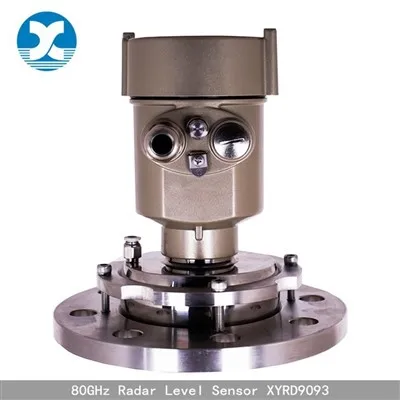
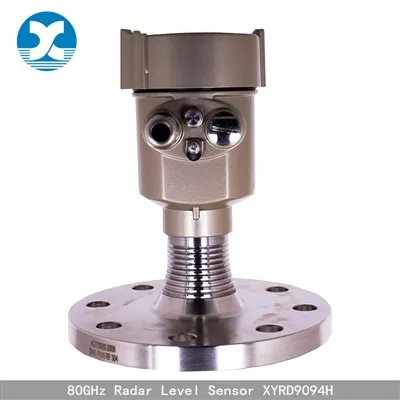
Non-contact FMCW Radar is the most widely adopted solution for large and medium-sized silos. Among all models, 80GHz high-frequency radar stands out the most. It is built with an ultra-narrow beam angle, which effectively avoids false signals reflected from silo walls, internal support frames and structural brackets. It works perfectly for grain, plastic pellets, coarse ore and other materials with ordinary dust levels. Since no probe extends into the silo interior, the sensor will never be hit or worn by falling solids. For silos taller than 10 meters, non-contact radar is always our top recommendation.
Guided Wave Radar uses a rod or cable probe to guide microwave signals. It performs better in small silos or sites with extremely dense dust and ultra-fine powder. The dedicated probe ensures stable signal transmission and is less affected by irregular material surfaces. However, we do not suggest using it for silos storing large, hard solid particles. Heavy falling materials may bend or damage the probe over time. It is more suitable for cement powder, fine chemical powder and similar media within a measuring range of 10 meters.
6. Practical Selection and Installation Tips for Global Buyers
After handling hundreds of silo matching projects worldwide, we have summed up a set of practical guidelines to help overseas buyers avoid common procurement mistakes and make the most of radar performance.
First, clarify material properties and silo dimensions in advance. Pick 80GHz non-contact radar for large silos, coarse particles and normal dust conditions. If you work with ultra-fine powder, heavy dust and small-scale silos, guided wave radar will deliver much more stable readings.
Second, pay close attention to installation positions. Never mount the radar antenna directly above material feed inlets. Material impact and strong dust surges in these areas will interfere with normal signal reception. We recommend choosing a position on the upper side of the silo top, far away from feeding and discharging zones. Meanwhile, keep a safe distance from internal silo structures to prevent false echo signals.
Third, equip supporting accessories when needed. For silos with extremely heavy dust, install an air purge unit for the radar antenna. Continuous air blowing keeps the antenna clean all year round and guarantees long-term stable signal transmission. If the silo stores heated materials, high-temperature resistant antennas are also required.
7. Common Misconceptions About Radar for Silo Measurement
Many buyers hold misunderstandings when selecting radar sensors for solid material measurement, and these wrong views often lead to improper model selection.
Some users assume all radar transmitters can work equally well for any bulk solid. This is not the case. Low-frequency radar with a wide beam angle will pick up massive interference signals in large silos, resulting in unstable data. It can never replace professional high-frequency radar designed for solid level detection.
Others believe radar can completely solve silo bridging and rat-holing issues. In fact, radar can only detect the surface of formed material bridges. To tackle bridging fundamentally, you need to optimize silo structure or add material flow assistance devices. Radar is a reliable measuring tool, but not a solution for abnormal material flow.
8. Frequently Asked Questions (FAQ)
Q1: Can radar level transmitters work normally in silos filled with heavy dust?
Yes. Microwave signals are barely affected by floating dust. Equipped with an air purge accessory, the radar can maintain continuous and accurate measurement even under long-term dusty working conditions.
Q2: Does the sloped surface of bulk solids affect radar measurement accuracy?
Modern FMCW radar is equipped with powerful signal processing algorithms. It can calculate the average material level based on multiple echo points on sloped surfaces. The impact from material angle of repose is kept within an acceptable error range for industrial production.
Q3: Which type of radar is more cost-effective for grain silos?
80GHz non-contact radar is the ideal choice for grain silos. It features easy installation, zero contact with grain, low maintenance and long service life, striking a perfect balance between performance and procurement budget.
Q4: Will hard solid particles damage radar sensors?
Non-contact radar has no parts extending into the silo, so it will not be damaged by falling particles. For guided wave radar, large and hard particles may impact and deform the probe, so it is not recommended for coarse hard solids.
9. Conclusion
To wrap it up, professional radar level transmitters are fully capable of measuring all types of bulk solid materials inside industrial silos. Compared with traditional ultrasonic sensors, rotary paddles and plumb bob devices, radar products show outstanding advantages in dust resistance, operational stability and overall service life.
The key to getting ideal measurement results lies in correct model selection and standard installation work. Choose high-frequency non-contact radar for large silos and coarse materials, and go for guided wave radar for small silos and ultra-fine powder. With matched accessories and proper installation layout, radar level transmitters will become a long-term trustworthy solution for your silo level monitoring work.
If you have procurement demands for radar level transmitters dedicated to silo solid material measurement, feel free to get in touch with us. We will recommend the most suitable products and supporting solutions based on your actual on-site working conditions.
10. References
- Silo Level Monitoring Technology Application Guide, International Society of Automation (ISA)
- Performance Test Report of Microwave Radar in Dust and Solid Material Environments
- Industrial Bulk Solid Storage & Measurement Solution Manual
- Field Application Case Collection of Radar Level Transmitters for Silos


