If you've spent any time around industrial instrumentation, you've almost certainly heard people swap"transducer"and "transmitter" back and forth. New technicians mix them up, procurement teams ask for one when they mean the other, and even some product catalogs use the terms interchangeably. This confusion causes real problems on site - I've seen project delays and return shipments happen simply because no one stopped to clarify exactly what each device does, and how they work together.
The truth is, they are not the same thing. A transducer and a transmitter work as a pair, and every pressure transmitter relies on both parts to take a physical pressure reading and send it across the plant to a control system.
This guide breaks down the core difference between the two, walks step by step through how a typical pressure transmitter works, explains the three most common pressure measurement types, and covers standard output signals you'll see in every process plant. By the end, you'll be able to tell the two apart, understand what's happening inside the transmitter housing, and make better sizing decisions for your own applications.
Transmitter vs. Transducer: What's the Actual Difference?
The easiest way to keep them straight is this: the transducer senses the pressure, and the transmitter sends the signal. They are two separate functions that are often packaged together inside one device - which is why so many people mix up the terms.
What a transducer does
A transducer is a device that converts one form of energy into another. In pressure measurement, it takes physical mechanical force from fluid or gas pressure and turns it into a tiny, weak electrical signal.
That raw electrical output is very small - usually millivolts - and it's not standardized. It varies from one sensor design to the next, and it's too weak to travel more than a short distance without picking up noise and losing accuracy. On its own, a raw transducer signal is not useful for sending to a PLC or DCS on the other side of the facility.
Transducers come in many sensing technologies: strain gauge, capacitive, piezoelectric, potentiometric and more. Which one is used depends on the pressure range, medium type, temperature and accuracy requirements of the application.
What a transmitter does
A transmitter takes the weak, non-standard electrical signal from the transducer and conditions, amplifies and converts it into a standardized industry output signal that can travel long distances reliably.
The transmitter's job is to turn a tiny variable signal into a consistent, universally recognized range - most commonly 4–20 mA for current loops, or 1–5 V for voltage outputs - where the bottom of the range equals 0% of the measured pressure, and the top equals 100%. This standardized signal can run hundreds of meters through plant wiring without losing accuracy, and every control system in the world knows how to interpret it.
Why the terms get mixed up so often
Nearly all modern pressure transmitters sold today package both the transducer sensing element and the transmitter circuit inside a single housing. For most field instruments, you don't buy them separately - you buy a complete assembly.
Over time, the industry started calling the whole unit by either name. Some vendors call it a pressure transducer, others call it a pressure transmitter, and for most off-the-shelf field units, both names refer to the same complete product. The distinction only matters when you're repairing internal components, sizing raw sensors for custom builds, or comparing component-level parts.
How a Pressure Transmitter Actually Works (Step by Step)
Inside every industrial pressure transmitter, there are three core stages: the isolating diaphragm, the sensing transducer, and the transmitter signal circuit. Here's what happens at each stage when you apply process pressure.
Stage 1: The measuring diaphragm makes first contact
Process fluid or gas never touches the delicate sensing element directly. It first presses against a thin, robust measuring diaphragm welded or clamped to the process connection face of the transmitter.
This diaphragm is made of stainless steel, Hastelloy, or other corrosion-resistant material matched to the process medium. It flexes very slightly under pressure, and transfers that force through a fill fluid (usually silicone oil or another inert liquid) to the actual sensor element on the other side.
This separation serves two critical purposes:
- It protects the fragile sensing material from corrosive, abrasive or dirty process media
- It allows the sensor to be calibrated and sealed at the factory, so it stays accurate for years in harsh field conditions
Stage 2: The transducer converts force to electrical signal
Behind the fill fluid sits the transducer - the actual pressure sensor. Three technologies are most common in industrial process applications:
Strain gauge sensors are the most widely used. A pattern of tiny strain-sensitive resistors is bonded to a rigid diaphragm. When pressure deflects the diaphragm, the resistors stretch or compress, changing their electrical resistance. This change is very small and measured through a Wheatstone bridge circuit, producing a millivolt-level output proportional to pressure.
Capacitive sensors use two parallel metal plates, one fixed and one attached to a flexible diaphragm. As pressure moves the diaphragm, the gap between the plates changes, which changes electrical capacitance. This design is very stable at very low pressure ranges and performs well under wide temperature swings.
Piezoelectric sensors generate a small voltage directly when crystalline material is placed under mechanical stress. They excel at measuring fast pressure spikes and dynamic pressure changes, but are less common for steady-state process pressure measurement.
In every case, the end result is the same: a very small electrical signal that changes as pressure changes. On its own, this signal is too weak and too easily distorted to send across a plant.
Stage 3: The transmitter circuit produces a standard output
The raw transducer signal feeds into the transmitter's electronic circuit board. This board does three key things:
1.Signal conditioning: It filters out electrical noise, compensates for temperature drift, and linearizes the output so the signal matches pressure evenly across the full range.
2.Amplification: It boosts the tiny millivolt signal up to a strong, usable level.
3.Standardization: It converts the signal to a universally recognized output range - almost always 4–20 mA for two-wire industrial installations, or 1–5 V for shorter distance cabinet use.
The final standardized signal runs out through the transmitter terminals to the control system, where the PLC or DCS reads the current or voltage value and maps it back to an actual pressure reading.
3 Common Pressure Measurement Types
Pressure transmitters don't all measure pressure the same way. What they reference as their "zero point" changes how the reading should be interpreted. There are three main types, and picking the wrong one is a very common sizing mistake.
Gauge pressure
Gauge pressure is the most common type used in process plants. It measures pressure relative to current atmospheric pressure.
When a gauge pressure transmitter reads 0, that means the inside pressure equals the ambient air pressure outside. Readings are typically labeled with a (g) suffix, such as psi(g) or bar(g).
Gauge pressure is used for most general tank pressure, line pressure and pump discharge measurements. If you don't have a specific reason to measure absolute or differential pressure, you almost certainly need gauge pressure.
Absolute pressure
Absolute pressure is measured relative to a perfect vacuum - 0 psi(a) = total vacuum. It includes atmospheric pressure as part of the reading.
At sea level, normal atmospheric pressure is roughly 14.7 psi(a). That means a tank open to atmosphere will read 14.7 psi(a) on an absolute pressure transmitter, and 0 psi(g) on a gauge pressure transmitter.
Absolute pressure is used for vacuum processes, sealed gas systems, vapor pressure measurements and any application where you need a reading independent of changes in local atmospheric pressure.
Differential pressure
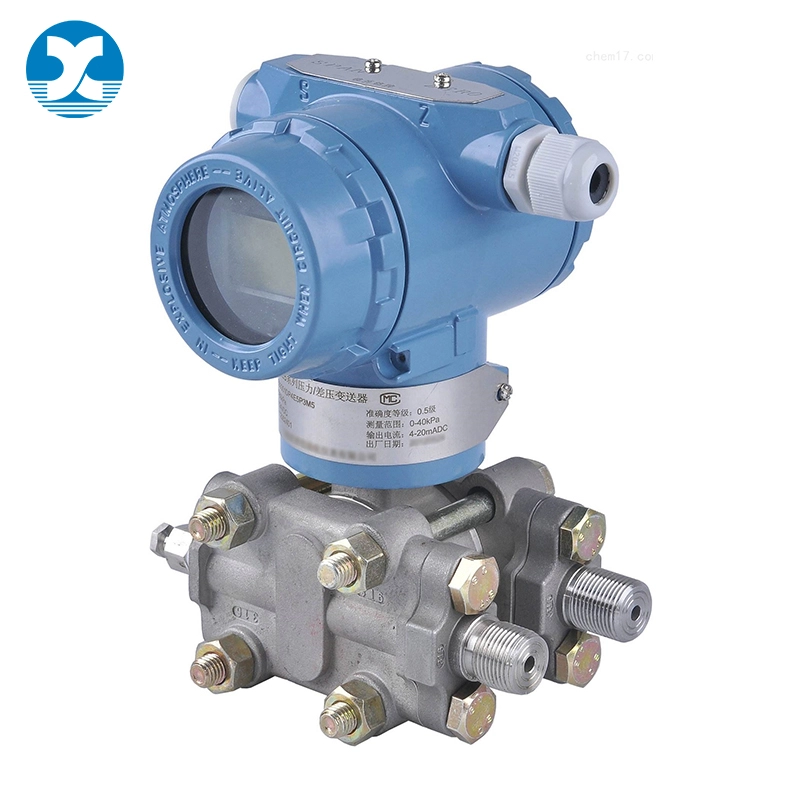
Differential pressure (DP) transmitters measure the difference in pressure between two separate input ports. They do not tell you the pressure at either point - only how much higher one side is than the other.
This is an extremely versatile measurement type. Differential pressure transmitters are used for:
- Flow measurement across orifice plates, Venturi tubes and flow nozzles
- Level measurement in pressurized tanks by comparing head pressure to gas blanket pressure
- Filter and strainer clog detection by measuring pressure drop
- Pump differential pressure monitoring
The sensor inside works the same basic way, but it is exposed to pressure on both sides of the sensing diaphragm instead of just one.
Standard Output Signals: 4–20mA vs. 1–5V
You will see two output standards used across nearly all industrial pressure transmitters. Each has its own best use case.
4–20 mA current loop (most common)
The 4–20 mA signal is the workhorse of industrial process control. 4 mA corresponds to 0% of the pressure range, and 20 mA corresponds to 100%.
The biggest advantage of a current signal is that it does not degrade over long wire runs, and it is highly resistant to electrical noise from motors, VFDs and other plant equipment. It also supports two-wire operation, where the same pair of wires supplies both power to the transmitter and carries the measurement signal.
The 4 mA "live zero" is intentional: if the signal drops to 0 mA, the control system immediately recognizes it as a broken wire or failed transmitter, not as a zero pressure reading. This is a critical safety and diagnostic feature.
1–5 V voltage output
Voltage outputs are less common in field installations but widely used in control cabinets, test benches and shorter distance applications. 1 V = 0% range, 5 V = 100% range.
Voltage signals are simpler and cheaper for short runs, but they lose accuracy over long distances due to wire resistance, and they pick up electrical interference much more easily. They also require separate power wiring. For anything outside of a controlled cabinet environment, 4–20 mA is almost always the better choice.
Quick Selection Tips & Common Misconceptions
After working with these instruments across process plants, there are a few mistakes I see repeated more than others.
1.Don't buy absolute pressure by accident. If you order an absolute transmitter for a standard gauge pressure application, all your readings will be off by roughly 14.7 psi. Always double-check the reference type before placing an order.
2.4–20 mA is not obsolete. Even with all the digital fieldbus protocols available today, plain 4–20 mA is still the most universally supported, easiest to troubleshoot and most reliable signal standard for basic pressure measurement.
3.Accuracy depends on more than the sensor. A high-precision transducer will still give bad readings if it's installed wrong, exposed to temperature extremes outside its rating, or matched to the wrong diaphragm material for the process medium.
If you're sizing pressure transmitters for your process and aren't sure which pressure type, output signal or diaphragm material fits your application, it's always worth confirming with an instrument specialist first. Getting the specification right on the front end avoids weeks of lead time delays and returns later.
Frequently Asked Questions
Is a pressure transducer the same as a transmitter?
Not exactly. A transducer converts pressure into a raw electrical signal. A transmitter takes that raw signal and turns it into a standardized, long-range output. Most field pressure transmitters sold today include both parts in one housing, so the terms are often used interchangeably.
Why is 4–20mA used instead of 0–20mA?
The 4 mA live zero serves two purposes: it powers the transmitter on a two-wire loop, and it lets the control system tell the difference between a true zero pressure reading and a broken wire or failed transmitter. If the signal drops to 0 mA, it is immediately recognized as a fault.
What are the three types of pressure measurement?
The three primary types are gauge pressure (referenced to atmosphere), absolute pressure (referenced to vacuum) and differential pressure (measuring the difference between two points).
Can a transducer work without a transmitter?
A raw transducer will produce an electrical signal, but it will be very weak, non-standard and unsuitable for long distance transmission. For general process control use, a transmitter is required to condition and standardize the signal.
Final Thoughts
Pressure transmitters are one of the most common instruments in any process plant, but it's easy to treat them like a black box. Understanding the difference between a transducer and a transmitter, how the sensing element works, and what the different pressure and signal types mean will help you specify them correctly, troubleshoot them faster, and avoid the most common sizing mistakes.
At the end of the day, the best pressure transmitter is not the one with the fanciest specs - it's the one correctly matched to your process medium, pressure range, temperature and installation environment.
If you need help selecting the right pressure transmitter for your application, or you have questions about output signals, diaphragm materials or pressure types, our technical team can review your process parameters and recommend a properly sized configuration.
References
- International Society of Automation (ISA). (2022). Pressure Measurement: Principles, Installation and Calibration. Research Triangle Park, NC: ISA.
- Rosemount Inc. (2024). Pressure Transmitter Fundamentals: Technology and Application Guide. Emerson Automation Solutions.
- WIKA Alexander Wiegand SE & Co. KG. (2023). Pressure Transducers vs. Transmitters: Technical Explanation. WIKA Industrial Instrumentation.
- National Institute of Standards and Technology (NIST). (2021). Calibration of Pressure Measuring Instruments. NIST Handbook 150.
- ABB Measurement & Analytics. (2024). Industrial Pressure Transmitters: Technology Selection Guide.