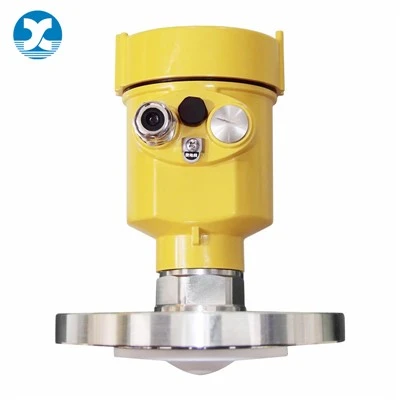
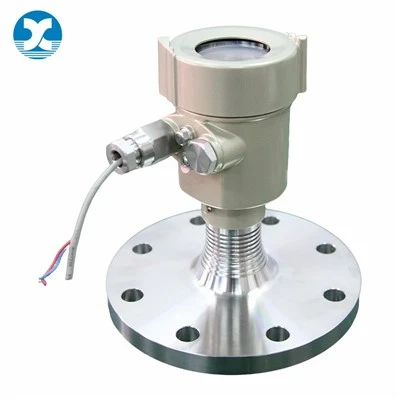
Both radar level gauges and ultrasonic level gauges are non-contact level measurement instruments, widely used in petroleum, chemical, pharmaceutical, environmental protection, and water treatment industries. While their functions are similar, they differ significantly in several aspects.
Measurement Principle
Radar Level Gauge: Based on the time-of-flight principle, it emits extremely short microwave pulses (electromagnetic waves) with very low energy, transmitted and received through an antenna system. Radar waves travel at the speed of light, and their travel time can be converted into a level signal by electronic components. The probe emits high-frequency pulses that propagate through space at the speed of light. When the pulse encounters the material surface, it is reflected back and received by the receiver inside the instrument, converting the distance signal into a level signal.
Ultrasonic Level Gauge: A digital level instrument controlled by a microprocessor. In measurement, ultrasonic pulses are emitted by a sensor (transducer). The sound waves are reflected by the liquid surface and received by the same sensor. This is converted into an electrical signal by a piezoelectric crystal, and the distance from the sensor to the measured liquid surface is calculated from the time between the emission and reception of the sound wave.
Temperature and Pressure of Measuring Medium
Radar Level Gauge: Utilizing electromagnetic waves, it is unaffected by vacuum and has a wide applicable range for medium temperature and pressure, from -200℃ to 800℃ (some models can reach 1200℃) or even higher.
Ultrasonic Level Gauge: Can only be used in atmospheric pressure containers; the temperature at the probe cannot exceed 80℃. The speed of sound is greatly affected by temperature and pressure.
Usage Environment
Radar Level Gauge: Available in various styles, such as horn, teardrop, rod, and cable types, it can be applied to different measurement conditions. Radar level gauges are unaffected by vacuum and can be used in complex conditions such as those with steam, foam, and inert gases.
Ultrasonic Level Gauge: Cannot be used in vacuum, high steam content, or conditions with foam on the liquid surface.
Accuracy and Measuring Range
Radar Level Gauge: Higher accuracy than ultrasonic level gauges, typically reaching millimeter level. It has a larger measuring range, generally 0-100m (some models may vary).
Ultrasonic level gauges: Relatively low accuracy, with a typical measuring range of 0-60m (some models may reach 0-30m).
Installation and Maintenance
Radar level gauges: Various installation methods are available, such as top mounting, side mounting, bypass pipe mounting, and waveguide mounting. Debugging is convenient and quick, using programming modules, SOFT software, or HART handheld programmers.
Ultrasonic level gauges: The blind zone must be considered during installation, ensuring the probe is a certain distance above the highest liquid level. Mechanical installation should be perpendicular to the surface of the test object. Avoid using them to measure foamy substances, and avoid installing them at a distance from the surface of the object being measured that is less than the blind zone distance.
In summary, radar level gauges and ultrasonic level gauges differ significantly in measurement principles, measured medium temperature and pressure, operating conditions, accuracy and range, price, and installation and maintenance. When choosing between them, factors such as the characteristics of the measured medium, measurement requirements, and budget should be considered comprehensively.