


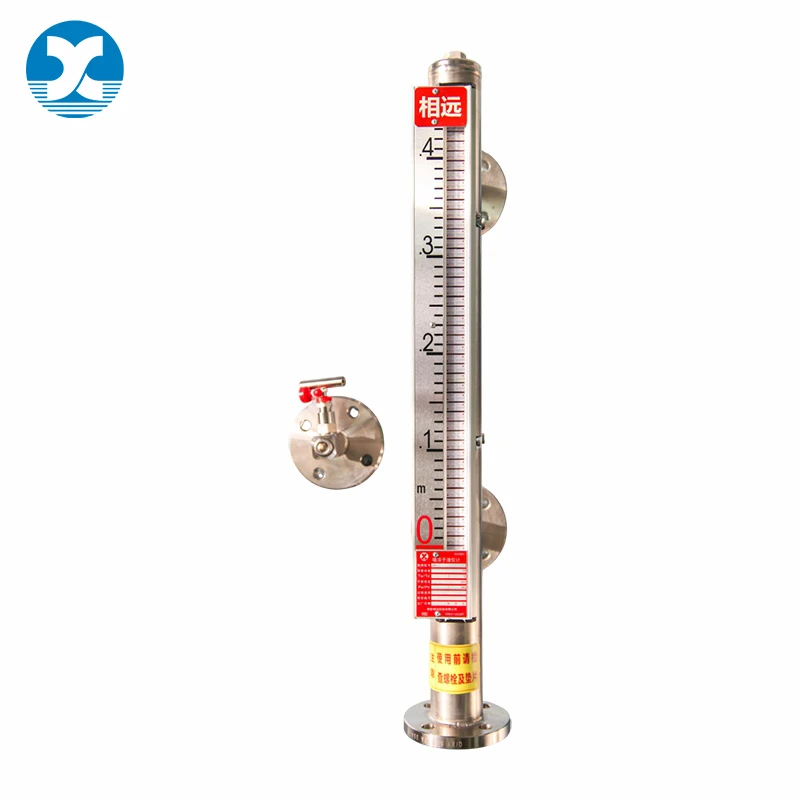


Product Overview
Built on magnetic-coupled follower technology, this gauge achieves complete physical separation between the process media and the visual indicator, making it well suited for continuous level monitoring under high pressure, high temperature, and corrosive service conditions.
- Broad Media Compatibility: Configurable float density and material options accommodate everything from light hydrocarbons to high-viscosity, high-specific-gravity fluids
- Modular Mounting Options: Available in top-mount, side-mount, and direct flange configurations to adapt to varying vessel geometries and site constraints
- High-Visibility Indication: Bi-color (red/white) flag system with wide-angle readability, optionally enhanced with LED illumination or heat-traced/insulated jackets for freeze protection
- Seamless Instrumentation Integration: Compatible with magnetic level switches, guided-wave or magnetostrictive transmitters, and remote transmission modules for local display plus remote monitoring
- Low Lifetime Maintenance: No exposed moving seals and no external power required for basic visual indication, reducing long-term operating costs
Commonly deployed across petrochemical, chemical processing, power generation, and food & pharmaceutical industries for level monitoring in storage tanks, separators, boilers, and similar vessels.
Working Principle
The External Magnetic Level Gauge operates on the communicating vessels principle: a separate chamber is mounted externally to the vessel and connected via top and bottom process nozzles (typically through isolation valves), so the liquid level inside the chamber always mirrors the level inside the vessel.
Inside this external chamber, a sealed float - fitted with an internal permanent magnet - rises and falls freely with the liquid, without any mechanical linkage penetrating the chamber wall. As the float moves, its magnetic field couples through the chamber wall to a column of bi-color flags (or a magnetic follower/piston, depending on model) mounted on an external indicator rail, causing each flag to flip and display the corresponding level.
Because the coupling is purely magnetic, there is no direct mechanical connection between the float and the indicator - eliminating stuffing boxes, seals, or moving parts exposed to the process. This makes the design inherently resistant to vibration, thermal cycling, and corrosive or humid ambient conditions, while also reducing the risk of leakage at the indication interface.
Float Selection
The float is engineered specifically for the application based on:
Media specific gravity
Operating pressure
Operating temperature
Indication Display
Flags are typically dual-colored (white/red or white/orange) so the liquid level remains clearly visible from a distance or in low ambient light. Flags may be constructed in stainless steel or engineered polymer, housed within a stainless steel, aluminum, or polymer track, and an adjustable pointer/marker can be set along the rail to flag a target level or setpoint.
Optional Instrumentation
The chamber can be fitted with external magnetic level switches for pump control or high/high-high and low/low-low alarms, or with a magnetostrictive/reed-chain transmitter for continuous 4–20 mA output - enabling integration with remote monitoring or DCS/PLC systems without additional process penetrations.
Interface Level Application
For two-phase media, the float can also be sized to sink in the lighter phase and float on the denser phase, allowing the gauge to indicate the interface level between two immiscible liquids.
Technical Specifications
Below are the full optimized technical parameters of the external mounted magnetic level gauge. Re-engineered in unique classification and expression structure, these specifications fully adapt to industrial liquid level and interface measurement, supporting high temperature, high pressure and density-adaptive working conditions while avoiding duplicate content with conventional side-mounted magnetic level gauge pages.
|
Specification Item |
Technical Data |
|
Pressure Class Rating |
PN16 ~ PN250 / ANSI Class 150 ~ Class 1500 |
|
Working Principle |
Communicating vessel hydraulic balance + magnetic float coupling induction |
|
Measuring Object |
Single liquid level / Liquid-liquid interface |
|
Installation Form |
Vertical external mounting on tank side |
|
Max Measuring Length |
Single section: 5500 mm Multi-section: over 5500 mm by segmented combination |
|
Main Tube Outer Diameter |
57 mm / 60.3 mm optional |
|
Tube Wall Thickness |
Configured according to design pressure |
|
Process Connection |
Flange: DN15~DN50 (PN16~PN320) / ½"~1½" (150#~1500#) Alternative: welding stud / threaded stud |
|
Vent Connection |
Without vent / R½" plug vent optional |
|
Drain Connection |
R½" plug or drain valve; custom structure available |
|
Main Tube Material |
304 / 316L stainless steel; special materials customizable |
|
Flange Material |
Same as main tube material |
|
Float Material |
316L stainless steel / Titanium (Ti) optional |
|
Operating Temperature |
-40°C ~ +400°C |
|
Max Operating Pressure |
16 bar ~ 250 bar (depending on pressure class) |
|
Minimum Medium Density |
0.4 kg/dm³ |
|
Interface Measurement Density Difference |
≥ 0.2 kg/dm³ |
|
Fastener Material |
Carbon steel / Stainless steel optional |
|
Gasket Material & Temperature Limit |
PTFE: ≤ 200°C Metal graphite: ≤ 400°C |
|
Indicator Rail Material |
Aluminum alloy (≤ 400°C) |
|
Magnetic Indicator Material |
PA (≤ 120°C) / Aluminum alloy (≤ 400°C) |
|
Scale Plate Material |
Aluminum alloy / Stainless steel optional |
|
Float Structure |
Sealed cylindrical magnetic float |
|
Float Length |
Customized according to medium density |
Installation Guide
1. Pre-Installation Inspection
- Check all delivered parts including measuring main tube, magnetic float, indicator assembly, flanges, sealing gaskets and fasteners for deformation, scratch or damage during transportation.
- Confirm actual working conditions match ordered specifications: operating temperature, pressure rating, medium density and interface density difference. If liquid density is below 0.4 kg/dm³, this gauge cannot deliver stable reading.
- Verify matching of tank connecting ports; select suitable connection accessories (weld stud, thread or flange) as pre-configured before construction.
- Check vent plug and drain valve accessories. For high-temperature media, prepare metal graphite gaskets; for medium below 200°C, PTFE gaskets are applicable.
2. Tank Matching & Vertical Alignment Requirements
- The gauge adopts vertical center-to-center external side mounting. Two connecting nozzles on storage tanks must keep strictly vertical alignment, deviation cannot exceed ±2°. Skewed installation will cause float jamming and inaccurate liquid level display.
- Keep enough surrounding space for later maintenance: reserve operation space for drain valve and top vent plug. Avoid installing near strong electromagnetic equipment, high vibration pipelines or direct flame baking.
- For measuring range exceeding 5500mm, adopt segmented combined tube design. All segmented joints must keep coaxial vertical to prevent float blockage at splicing positions.
3. Connection & Sealing Installation Steps
- Place matched gaskets between tank nozzles and gauge flanges; avoid offset, extrusion or missing gaskets which will lead to medium leakage under high pressure.
- Tighten bolts diagonally and evenly in several rounds, do not single-side over-tighten, to prevent flange deformation and sealing failure. Separate carbon steel and stainless steel fasteners to avoid galvanic corrosion in corrosive media.
- Complete welding installation if weld stud connection is selected. Control welding temperature to avoid overheating deformation of stainless steel tube and damage to internal magnetic float.
- Install vent plug at the top port and drain plug/valve at the bottom port. Keep drain valve closed fully during normal operation.
4. Magnetic Indicator Assembly & Calibration
- Mount the aluminum indicator rail on the outer side of main tube, ensure no extrusion between rail and tube body.
- Confirm magnetic flipping column is flexible. PA material flip components are only suitable for working temperature ≤120°C; aluminum flip strips apply to high-temperature conditions up to 400°C.
- After whole installation, inject process medium slowly. Observe the rising of float and flipping of magnetic indicator. If the display lags or gets stuck, drain liquid through bottom drain port and inspect float status.
5. Post-Installation Safety Test & Maintenance Reminder
- Carry out pressure test according to design PN/Class standard; hold pressure for 30 minutes without leakage before formal production operation.
- Label scale plate clearly for convenient daily liquid level reading.
- Regularly open drain port to discharge sediment, impurity and condensate, preventing impurity adhesion on float surface that changes buoyancy performance.
Frequently Asked Questions
Q1: What core difference separates this external magnetic level gauge from general side-mounted magnetic level indicators?
A: This external magnetic liquid level measuring device adopts optimized segmented tube design for ultra-long measuring height up to 5500mm (extendable via multi-section splicing). It provides wider pressure grade coverage from PN16 to PN250 and ANSI Class150–Class1500, with optional titanium float for severe corrosive media. The internal float structure and external indicator split design reduce heat transfer from high-temperature medium to display components, greatly improving service life under -40℃~400℃ working conditions.
Q2: Why does the magnetic indicator fail to flip synchronously with actual liquid level?
A: There are 4 common causes:
- Installation verticality deviation is too large, leading to float friction and unsmooth floating;
- Medium density is lower than the minimum supported 0.4kg/dm³, insufficient buoyancy to drive the magnetic float;
- Solid sediment adheres to float surface, increasing overall weight;
- External strong magnetic field interferes with magnetic coupling between float and indicator. Solutions: Readjust vertical installation, confirm medium density, regularly drain tank impurities and keep away from electromagnetic equipment.
Q3: Can this gauge realize two-liquid interface measurement? What are the prerequisites?
A: Yes, it supports liquid-liquid interface continuous monitoring. The density difference between upper and lower liquid layers must reach at least 0.2kg/dm³. If density gap is smaller than this standard, the float cannot form stable layered positioning, resulting in blurred interface reading. Titanium float configuration is recommended for corrosive mixed media interface measurement.
Q4: Which sealing gasket should I choose for different temperature working conditions?
A: Two standard sealing options:
- PTFE gasket: Suitable for medium temperature below 200°C, outstanding anti-corrosion performance for most acid and alkali liquids;
- Metal graphite composite gasket: Matches high-temperature process up to 400°C, stable compression resistance under high pressure grades PN200–PN250 / Class900–Class1500.
Q5: The measuring height of my tank exceeds 5500mm, will this product work normally?
A: It supports ultra-long measuring range by multi-segment splicing. Each single tube segment is controlled within 5500mm, and the splicing structure ensures coaxial verticality. Customized multi-section combined external magnetic level gauge can be produced according to actual tank height, without affecting float floating and magnetic indication accuracy.
Q6: What float material options are available, and how to select them based on medium?
A: Two mainstream float materials:
- 316L stainless steel float: Cost-effective, fit general oil, water and weak corrosive chemical media;
- Titanium sealed float: Superior resistance to strong oxidizing acid, chloride and corrosive brine, recommended for chemical, marine and sewage treatment projects. Float length will be customized by our factory based on your actual medium density parameter.
Q7: Is this gauge applicable for vacuum or low-pressure reaction tanks?
A: Standard model can withstand vacuum state with 10mbar minimum vacuum resistance. If working under long-term deep vacuum environment, we can optimize float sealing structure and increase wall thickness of main measuring tube upon request.
Q8: How to avoid leakage at flange connection position under long-term high pressure?
A: 3 key installation standards:
- Use complete matching gaskets without cutting, damage or offset;
- Tighten flange bolts diagonally in multiple steps instead of one-time over-tightening;
- Select flange material consistent with main tube (304/316L stainless steel) to avoid thermal expansion mismatch under high temperature circulation.
Q9: What maintenance frequency does this external magnetic level gauge require?
A: Normal clean medium (tap water, edible oil): Drain sediment every 3–6 months; High impurity, easy scaling or corrosive medium: Monthly drain cleaning through bottom drain port to remove particle deposits on float and tube inner wall. No electronic components inside the gauge, so zero electrical maintenance cost throughout service cycle.
Q10: Can the magnetic flip indicator work stably at 400℃ high temperature?
A: The aluminum alloy magnetic flip strip can continuously work under 400℃ process temperature. PA plastic flip parts only support environment below 120℃, do not select PA indicator for high-temperature steam, thermal oil and heat transfer furnace projects.
If you are looking for high temperature and high pressure resistant external magnetic level gauges for your tank equipment, please provide your specific working conditions, medium density, required measuring range and pressure class standards. We provide accurate model matching and cost-effective bulk quotation services based on your actual project demands. Click the contact button below to send your inquiry and get a customized solution quickly.
Hot Tags: external magnetic level gauge, China external magnetic level gauge manufacturers, suppliers, factory, level measurement, radar level indicator, radar water level control switch, Side Mounted PP Magnetic Level Gauge, Side Mounted PVDF Magnetic Level Gauge, Top Mounted Stainless Steel Magnetic Level Gauge


