High-viscosity liquid level measurement remains one of the most persistent operational challenges in industrial process control. Thick fluids such as heavy crude oil, coal tar, molten resin, high-grade syrup, industrial grease, and sludge do not flow like conventional water-based media. Their high flow resistance, strong surface adhesion, and slow movement routinely clog, coat, and lock up standard level instruments. The end result is fluctuating level readings, frequent mechanical faults, and unplanned maintenance downtime that disrupts entire production cycles.
Most plant operators and procurement teams encounter the same recurring issue day-to-day. Float gauges, tuning fork switches, and standard submersible transmitters work flawlessly for clean, low-viscosity fluids. Yet these same devices degrade rapidly within weeks when deployed for thick, sticky process media. Viscous residue builds up on probe surfaces, immobilizes mechanical components, and distorts sensor signals. Inaccurate level data directly compromises batch dosing, tank storage monitoring, and automated process stability.
No single level measurement technology suits all fluid types. Choosing an incompatible instrument leads to unnecessary replacement costs, unplanned operational downtime, and inconsistent product quality. This field-focused guide breaks down the most practical, field-proven level instruments for high-viscosity liquids. It compares real-world pros and cons, defines clear application boundaries, and summarizes actionable selection rules to help engineering and procurement teams make stable, cost-effective deployment decisions.
Unique Measurement Challenges of High Viscosity Liquids
To select the optimal level measurement solution, it is critical to understand exactly how high-viscosity media impairs standard instrumentation. Thick fluids introduce three distinct field challenges that directly undermine instrument accuracy and service lifespan.
Severe Surface Adhesion and Fouling
High-viscosity fluids adhere aggressively to probes, floating bodies, and vibrating sensing components. Over time, layered residue forms a solid coating on instrument surfaces. For contact and vibration-based devices, this buildup adds excess load and mechanical damping. The outcome is gradual signal deviation, slow response latency, or complete failure to trigger level alarms.
Poor Fluid Mobility and Residue Blockage
Thick liquids drain sluggishly and frequently settle inside gauge chambers, bypass tubes, and pipeline junctions. Traditional float-based magnetic level gauges suffer from dead zone blockage in these conditions. Tank liquid levels may fluctuate normally, but trapped residue prevents float movement, leaving static, inaccurate readings that fail to reflect real-time process conditions.
Unstable Dielectric and Turbulent Surface
Many viscous process fluids - including polymer solutions and industrial slurries - feature unstable dielectric properties and uneven liquid surfaces. Surface foam, suspended solids, and slow flow fluctuations interfere heavily with acoustic and low-frequency electromagnetic sensing. Standard sensors produce erratic, jumping data and cannot maintain stable measurement output.
Top 4 Reliable Level Instruments for High Viscosity Liquids
Decades of field deployment and industry standard validation confirm four instrument types deliver consistent performance in high-viscosity environments. Each option occupies a unique cost and application niche, fully covering low, medium, and extreme high-viscosity industrial measurement requirements.
1. 80GHz High-Frequency Radar Level Transmitters (Best Overall Solution)
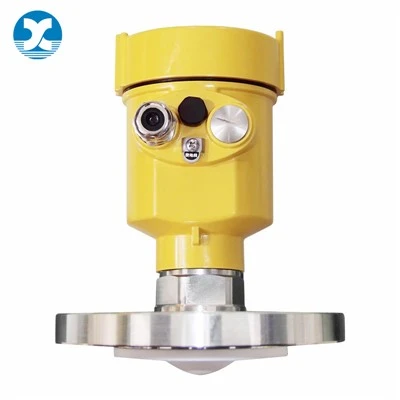
80GHz FMCW high-frequency radar transmitters represent the most reliable, versatile solution for high-viscosity liquid measurement in modern process industries. As a fully non-contact technology, the radar antenna never contacts process media, eliminating adhesion buildup, clogging, and mechanical jamming entirely.
Compared to conventional low-frequency radar, 80GHz units feature shorter wavelengths, superior signal penetration, and higher measurement resolution. Their narrow beam angle effectively avoids interference from tank wall residue, surface foam, and suspended particulate matter. Even for extreme media like coal tar and heavy grease exceeding 5000 mPa·s in viscosity, these radars capture stable, repeatable level signals through thick surface fouling layers.
PTFE and ceramic antenna upgrades further boost anti-fouling and corrosion resistance. These transmitters are widely specified for heavy oil storage tanks, resin reactors, high-viscosity syrup processing vessels, and slurry storage systems. With negligible routine maintenance requirements, they stand as the ideal long-term solution for harsh viscous process environments.
2. Guided Wave Radar (GWR) Level Meters
Guided wave radar (GWR) uses a rigid rod or cable probe to guide microwave signals for precise level detection. While classified as a contact device, it contains no moving mechanical parts, so it avoids the jamming issues common to float-based instruments.
GWR delivers stable, accurate readings for medium-viscosity fluids with minor surface adhesion. It outperforms ultrasonic sensors in environments with steam, surface foam, and pressure fluctuations. That said, thick curing residues on ultra-high-viscosity media can attenuate probe signals. For this reason, guided wave radar is best suited for medium-viscosity applications, not extreme heavy-fluid conditions.

3. Ultrasonic Level Sensors (Cost-Effective for Low-to-Medium Viscosity)
Ultrasonic level sensors offer an affordable, non-contact measurement option for low-to-medium viscosity fluid monitoring. Operating via acoustic echo detection, they have no wearable or moving components, which rules out mechanical failure caused by viscous adhesion and residue buildup.
Ultrasonic technology has clear operational limits. Thick surface foam, dense vapor, and heavy viscous surface layers severely attenuate acoustic echoes, causing weak, incomplete, or missing level signals. This makes ultrasonic sensors reliable for light viscous media such as lubricating oil and food-grade syrup, but unsuitable for heavy tar, high-density slurry, and easily cured resin fluids.

4. RF Admittance Level Transmitters
RF admittance level transmitters improve upon traditional capacitance sensing, with firmware and hardware optimized for sticky, viscous, and crystallization-prone process media. Built-in intelligent signal compensation actively offsets measurement errors triggered by wall fouling and residual surface coverage.
Without vibrating forks or floating assemblies, RF admittance devices avoid the sticking and false-alarm issues that plague standard level switches. They excel at continuous level monitoring and high/low level alarm interlock for viscous storage tanks. The primary limitation is contact-based sensing; regular visual inspections are required for heavily curing media to sustain long-term accuracy.
Instruments to Avoid for High Viscosity Liquids
Most level measurement failures in high-viscosity environments stem from poor instrument selection, not manufacturing defects. Three common instrument types are fundamentally incompatible with thick fluid conditions and should be excluded during engineering design specification.
Float-type magnetic gauges and float switches rely on free buoyancy movement, which viscous resistance and residue buildup completely immobilizes, resulting in locked, static readings. Tuning fork switches suffer damped vibration from surface fouling, triggering persistent false alarms. Standard submersible transmitters accumulate residue on sensing diaphragms, causing gradual signal drift and total sensing failure. All three devices are only rated for clean, low-viscosity process water and light fluids.
Field Application Case
A mid-scale petrochemical facility struggled with unstable level monitoring across its heavy crude and intermediate tar tank farm. The on-site media featured ultra-high viscosity and rapid surface curing. The original setup deployed conventional float gauges and standard ultrasonic sensors for tank level control.
Float jamming and heavy surface residue created constant reading inaccuracies. Ultrasonic sensors failed to penetrate the thick oil surface layer, producing unstable data that disrupted automated tank feeding and unloading sequences. The maintenance team was forced to perform full cleaning and recalibration on a weekly basis, draining significant labor resources and limiting throughput efficiency.
After a full process and instrument audit, the engineering team upgraded all critical measurement points to 80GHz high-frequency radar transmitters. The non-contact design eliminated adhesion and blockage-related issues entirely. Post-installation parameter tuning delivered consistent, reliable long-term measurement stability. Weekly maintenance routines were eliminated, and real-time accurate level data optimized tank farm material scheduling, delivering measurable improvements in overall operational efficiency.
Practical Selection Guidelines by Viscosity Range
To streamline on-site specification and eliminate trial-and-error selection, we compiled field-verified guidelines matched to standard viscosity grading:
- Low viscosity (≤500 mPa·s): Ultrasonic sensors or RF admittance transmitters, balancing cost and stability
- Medium viscosity (500–3000 mPa·s): Guided wave radar or high-frequency ultrasonic sensors
- High viscosity (≥3000 mPa·s): 80GHz high-frequency non-contact radar (most recommended)
- Curing-prone and sticky media: Prioritize fully non-contact radar solutions, avoid all mechanical contact instruments
Common Field Selection Mistakes
The most prevalent specification error is applying general-purpose instrument experience to specialized viscous media. Engineers and buyers often select standard sensors based on clean water performance, ignoring the unique damping, adhesion, and curing properties of thick fluids. Underestimating medium curing tendencies leads to progressive residue buildup and premature instrument failure over time.
Process temperature is another commonly overlooked variable. Elevated operating temperatures increase fluid viscosity and accelerate surface curing speed. For combined high-temperature and high-viscosity working conditions, only anti-fouling high-frequency radar instruments deliver sustained long-term operational stability.
Conclusion
At its core, high-viscosity level measurement is a problem of avoiding fouling, blockage, and signal attenuation. Mechanically actuated contact instruments are inherently unsuitable for thick, sticky, curing-prone media. In modern industrial settings, 80GHz high-frequency non-contact radar provides the most robust, low-maintenance turnkey solution for high-viscosity applications. Guided wave radar, ultrasonic sensors, and RF admittance transmitters serve as cost-effective alternatives for lower viscosity tiers.
Strategic instrument selection aligned with fluid viscosity, curing behavior, and process temperature resolves chronic measurement instability, cuts routine maintenance frequency, and supports stable, fully automated production line operation.
If you need tailored level instrument configuration for your high-viscosity process, share your exact media type, viscosity rating, operating temperature, and tank structure details. Our technical team can deliver optimized, budget-friendly measurement solutions matched to your site's specific working conditions.
References
1. IEC 61518:2024, Industrial Process Measurement and Control – General Selection Guidelines for Liquid Level Instruments
2. ISA-TR77.00.01:2023, Technical Report on Level Measurement for Viscous and Slurry Process Media
3. NACE SP0198:2025, Field Deployment Standards for Process Instruments in High-Fouling Industrial Environments
4. International Society of Automation. (2025). Best Practices for Level Sensing in High-Viscosity Fluid Applications
5. Process Industry Instrumentation Association. (2026). Technology Comparison of Viscous Media Level Measurement