


What Is a Radar Level Gauge and How Does It Work?
If you work in industrial manufacturing, chemical processing, or bulk material storage, you must have encountered radar level gauges. These compact devices are commonly mounted on top of storage tanks and silos. For years, Most industrial users recognize it as a trustworthy level measuring device, yet only a handful truly understand its internal working mechanism.
In this article, I will break down what a radar level gauge is and explain its working principle in simple, non-technical language. This guide is suitable for plant operators, procurement staff, and beginner engineers.

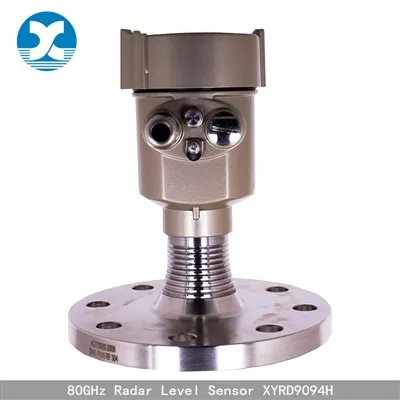

What Is a Radar Level Gauge?
A radar level gauge is an industrial measuring instrument that uses microwave signals to detect the material level inside sealed tanks or vessels. Unlike traditional mechanical sensors such as float gauges, most radar transmitters complete measurement without touching liquids, powders or slurries.
This non-contact feature makes it stand out in harsh working conditions. It performs well for corrosive chemicals, high-temperature oil liquids, and dusty bulk solids. Simply put, it is one of the most cost-effective level measurement solutions for modern industrial production.
How Does a Radar Level Gauge Work?
Most buyers only care about the measuring accuracy and stability. But knowing its working mechanism helps you pick a suitable model. Industrial radar level gauges mainly adopt two working principles: Time-of-Flight and FMCW.
1. Time-of-Flight (ToF) Radar
ToF radar is widely used in entry-level and medium-cost measuring equipment. Its working logic is straightforward.
First, the antenna emits low-energy microwave pulses downward. Once the pulses hit the surface of raw materials, they reflect back to the sensor. The gauge records the round-trip time of the microwave. Combined with the fixed speed of light, it calculates the distance between the antenna and the material surface.
Finally, the system subtracts the empty tank height to get the real-time material level. Although the principle is simple, it meets the measurement needs of most conventional industrial scenarios.
2. FMCW Radar
Frequency-Modulated Continuous Wave radar is an upgraded version. Instead of intermittent pulses, it sends out continuous microwave signals with changing frequencies.
The gauge compares the frequency difference between transmitted and reflected signals to judge the distance. This method brings higher measuring accuracy, usually up to ±1mm. FMCW radar is ideal for precision manufacturing and high-pressure sealed tanks.
Two Main Types of Radar Level Gauges
In actual procurement, customers often confuse non-contact radar and guided wave radar. Here is an easy-to-understand distinction for your reference.
Non-Contact Radar Level Gauge
The antenna is installed at the tank top without any contact with internal materials. Microwaves travel through air space to complete detection. It fits large storage tanks, high-temperature chemical liquids, and hygienic production lines such as food and beverage.
Guided Wave Radar (GWR)
GWR is equipped with a probe extending into the tank. Microwaves transmit along the probe. It is more suitable for materials with low dielectric constant, such as special hydrocarbons. It also works stably in tanks with foam and vapor interference.
Why Choose Radar Level Gauges Over Other Sensors?
Many customers used to choose ultrasonic or pressure sensors to cut costs. However, after long-term use, most of them switch to radar gauges. The core advantages are obvious.
Strong environmental adaptability: Not affected by temperature, pressure, dust and vapor.
Low maintenance cost: No moving parts, effectively reducing later replacement and maintenance expenses.
Wide compatibility: Available for liquids, solids, slurries and oil-water interface measurement.
Admittedly, radar level gauges have higher upfront costs than ordinary sensors. But considering service life and stability, it is still the most cost-effective long-term choice.
Common Industrial Applications
At present, radar level measuring technology has covered almost all heavy industries. Oil and gas factories use it for crude oil tank monitoring; chemical plants rely on it to measure corrosive solvents. Besides, it is also widely applied in water treatment, mining, food processing and power generation industries.
Simple Tips for Selecting Radar Level Gauges
Several key selection points are summarized for your reference.
Confirm the tank temperature and pressure first. For low-dielectric materials, choose guided wave radar. If you need food-grade hygiene standards, pick PTFE antenna materials. For large silos with dust, high-frequency non-contact radar is the best option.
Final Words
Radar level gauges are not complicated high-tech equipment. Its stable performance makes it an indispensable part of industrial automation measurement. Having a clear grasp of its working principles and product characteristics can help users pick the most suitable device to match their industrial tank measurement scenarios.
We hope this straightforward guide has cleared up your confusion about radar level gauges. With diverse models and stable performance, these measuring devices remain a reliable long-term solution for industrial level monitoring.


