Product Overview
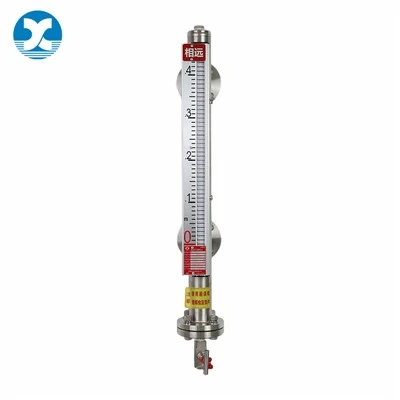
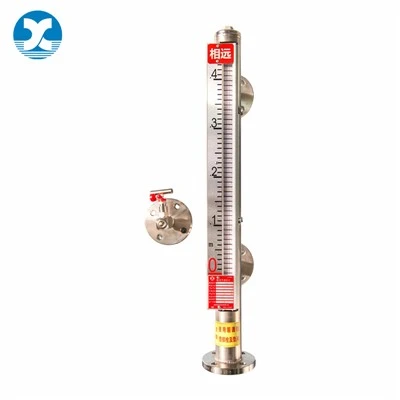
The Titanium Magnetic Level Gauge uses commercially pure titanium (Grade 2, with Grade 7 available for crevice-prone geometries) for the chamber pipe, flanges, and float. It's a side-mounted, communicating-tube design - the same basic mechanics as our stainless steel, Hastelloy, and Monel gauges - but titanium behaves differently from all three in one specific way that matters a lot for certain plants: it forms a tenacious oxide film that actually gets more stable, not less, in oxidizing chloride media like seawater and hypochlorite solutions.
That's the reason this product exists as its own line rather than just being "an upgrade option" on the stainless steel gauge. Stainless steel pits in chlorides because the passive film breaks down locally. Titanium's oxide film does the opposite in most of that same chemistry - it stays intact. So if your corrosion problem is specifically chloride pitting in an oxidizing environment (seawater, bleach, chlorine dioxide, hypochlorite), titanium is often the more targeted fix than jumping straight to Hastelloy.
Why Choose Titanium Magnetic Level Gauge
- It's the right answer for seawater and marine service, specifically
Titanium has been the go-to material in seawater-handling equipment for decades - desalination plants, offshore platforms, marine cooling systems. It doesn't pit in seawater the way 316L does, and it doesn't need the higher alloy content (and higher cost) of Hastelloy to get there.
- Strong in oxidizing chlorides - the opposite corner from Monel
This is worth being clear about because customers sometimes lump all "exotic alloy" gauges together. Monel earns its keep in reducing acids like HF. Titanium earns its keep in oxidizing chloride environments - chlorine dioxide bleaching, sodium hypochlorite, seawater, brine. Put titanium in a strongly reducing acid without oxidizer present and it can actually underperform stainless steel, because it needs that oxidizing condition to maintain its protective film. So the selection really is about which corner of the corrosion map your process sits in.
- Excellent strength-to-weight ratio
Titanium is roughly 45% lighter than stainless steel at comparable strength. On long gauges - multi-section units running past 5500mm - that weight saving actually matters for support bracket loading and installation handling.
- No magnetic interference with the float coupling
Titanium is non-magnetic, so unlike some ferritic stainless grades there's zero risk of the chamber wall itself interfering with the float-to-indicator magnetic coupling. Not usually a problem with 316L either, but it's one less variable to think about.
- Long service life offsets the material premium
Titanium costs more than stainless steel and can run close to or above Hastelloy pricing depending on the market. In seawater and marine chloride service specifically, though, plants replacing pitted 316L gauges every couple of years often find the titanium unit pays for itself within a few replacement cycles it doesn't need.
Technical Specifications
Below are complete technical specifications of our titanium Grade 2 bypass magnetic level gauge, engineered for strong corrosive media such as seawater, chloride brine, nitric acid and oxidizing chemical solutions. All titanium alloy configurations, pressure ratings and temperature limits are listed for your precise model matching.
|
Parameter |
Specification |
|
Pressure / Temperature Class |
PN16 – PN250, CLASS150 – CLASS1500 |
|
Operating Principle |
Communicating tubes with magnetic float coupling induction |
|
Measurement Type |
Single liquid level / Liquid-liquid interface |
|
Mounting |
Vertical, center-to-center (C-C) |
|
Measuring Range |
Up to 5500 mm in one sectionMulti-section spliced assembly for longer ranges |
|
Pipe Size |
14 × 14 / 57 mm, or 14 × 14 / 60.3 mm |
|
Pipe Connection |
Welding stud or necked welding |
|
Pipe Wall Thickness |
Per pressure rating requirement |
|
Process Connections |
Flange: DN15–DN50, PN16–PN320 (½"–1½", 150#–1500#)Alternative: welded or threaded stud |
|
Vent |
None, or R½" threaded plug vent |
|
Drain |
R½" plug drain, or drain valve available on request |
|
Pipe Material |
Titanium Grade 2 |
|
Flange Material |
Titanium Grade 2 (matched to pipe material) |
|
Float Material |
Titanium Grade 2(Grade 7 available for weld-sensitive or crevice-critical applications) |
|
Operating Temperature |
-40°C to +400°C |
|
Operating Pressure |
Up to 250 bar (depending on flange class) |
|
Minimum Media Density |
0.4 kg/dm³Interface measurement: density difference ≥ 0.2 kg/dm³ |
|
Bolts / Nuts |
Carbon steel, stainless steelTitanium fasteners available on request for fully alloy-matched systems |
|
Gaskets |
PTFE (up to 200°C) / Metal graphite (up to 400°C) |
|
Indicator Rail |
Aluminium alloy, service temperature up to 400°C |
|
Flap / Column Material |
PA plastic (up to 120°C) / Aluminium alloy (up to 400°C) |
|
Scale |
Aluminium alloy or stainless steel |
|
Float Type |
Cylindrical, fully sealed, titanium construction |
|
Float Length |
Sized and customized to actual process medium density |
How to Select the Right Model
- Is your process chemistry oxidizing or reducing?
This is the single biggest factor. If your medium is seawater, brine, hypochlorite, chlorine dioxide, or generally chloride-rich with an oxidizer present, titanium is a strong fit. If it's a reducing acid - HF, sulfuric acid at lower concentrations without oxidizer, or similar - titanium can actually corrode faster than expected, and Monel or Hastelloy is usually the better call. Send us your medium composition and we'll flag it if titanium isn't the right direction.
- Do you have crevice geometry in the installation?
Titanium Grade 2 is excellent in open exposure but can be more susceptible to crevice corrosion than Hastelloy in tight gasket/flange crevices under certain hot chloride conditions. If your service runs hot (above roughly 80°C) with tight crevices at gasket faces, Grade 7 (palladium-stabilized) is worth the upgrade - it's specifically more resistant in that scenario.
- What's your actual operating temperature ceiling?
Titanium's chloride resistance advantage is strongest at moderate temperatures. At the upper end of our 400°C range, material selection gets more nuanced and we'd want to review your specific duty cycle rather than default to a standard grade.
- Is this a retrofit on an existing chloride-pitted stainless gauge?
If you're replacing a 316L gauge that's failed from chloride pitting and the process hasn't changed, that's usually a clean signal titanium (or possibly Hastelloy, depending on whether oxidizers are present) is the right upgrade path - not a case where you need to re-engineer the whole measuring range or mounting.
- Interface or straight level measurement?
Same rule as the rest of our range: interface work needs at least 0.2 kg/dm³ density difference between the two media. Titanium doesn't change that requirement - the float sizing logic is identical, just the wetted material differs.
Frequently Asked Questions
Q1: Is titanium always the better choice over Hastelloy for corrosive service?
No, and this trips people up. Titanium is excellent in oxidizing chloride environments like seawater and hypochlorite. Hastelloy covers a broader spectrum, including a lot of mixed oxidizing/reducing acid conditions titanium doesn't handle as well. If you're not sure which corner your process falls into, tell us the medium and concentration and we'll point you the right direction rather than defaulting to whichever is more expensive.
Q2: Can titanium be used in reducing acids like hydrochloric or sulfuric acid?
Generally not recommended without an oxidizer present. Titanium relies on an oxide film that needs oxidizing conditions to stay stable - in a purely reducing acid environment it can corrode faster than stainless steel in some cases. Monel or Hastelloy is usually the safer pick for that chemistry.
Q3: Why would I pick titanium over 316L stainless steel if my medium is just seawater, not an exotic chemical?
Because "just seawater" is actually one of the more aggressive services for 316L specifically - chloride pitting and crevice corrosion in seawater is a well-documented failure mode for standard stainless. Titanium was essentially developed for exactly this kind of service and doesn't have that failure pattern.
Q4: Does the titanium float change how the gauge responds or how accurate it is?
No - same pressureless float, same magnetic coupling mechanics as our other material options. Titanium changes what the wetted parts can survive chemically; it doesn't change the measuring principle or response behavior.
Q5: What's the difference between Grade 2 and Grade 7 titanium, and do I need Grade 7?
Grade 2 is standard commercially pure titanium and covers the large majority of chloride/seawater applications. Grade 7 has a small palladium addition that improves crevice corrosion resistance in hot, acidic, or tight-crevice conditions. Unless your service runs hot with tight gasket crevices, Grade 2 is typically sufficient and more economical.
Q6: Can this gauge be used for interface measurement between two liquids?
Yes, under the same condition as our other gauges - the density difference between the two media needs to be at least 0.2 kg/dm³ for stable interface positioning.
Q7: Is titanium construction compatible with switches or a 4-20mA transmitter?
Yes. Adjustable magnetic switches and reed transmitters mount externally and work the same way regardless of chamber material, including on titanium units.
Q8: How does titanium compare on lead time and cost versus stainless steel or Hastelloy?
Titanium typically runs a longer lead time and higher cost than 316L stainless, and pricing versus Hastelloy varies with the metals market - sometimes comparable, sometimes higher depending on grade and current alloy surcharges. We'll give you a firm number against your actual spec rather than a rule of thumb, since it moves with material pricing.
Related Products
Not sure titanium is the right fit for your process? Here's how it compares against the rest of our magnetic level gauge range:
- Stainless Steel Magnetic Level Gauge - general-purpose corrosion resistance for standard chemical, water, and hydrocarbon service
- Hastelloy Magnetic Level Gauge - broad-spectrum resistance for mixed oxidizing/reducing acids and heavy chloride combinations
- Monel Magnetic Level Gauge - best fit for hydrofluoric acid, caustic, and other reducing-condition media
- Bypass Chamber Magnetic Level Gauge - isolation-valved chamber design for maintenance without vessel shutdown, available across all material options above
Still not sure which material fits your process? Send us your medium, concentration, operating temperature, and pressure, and we'll confirm the right alloy before you commit to an order - happy to flag it if titanium isn't actually the best fit for what you're running.
Hot Tags: titanium magnetic level gauge, China titanium magnetic level gauge manufacturers, suppliers, factory, digital level box, Hot water jacketed Magnetic level gauge, mechanical float level indicator, radar level indicator, Top Mounted Magnetic Level Gauge, Top Mounted PVDF Magnetic Level Gauge